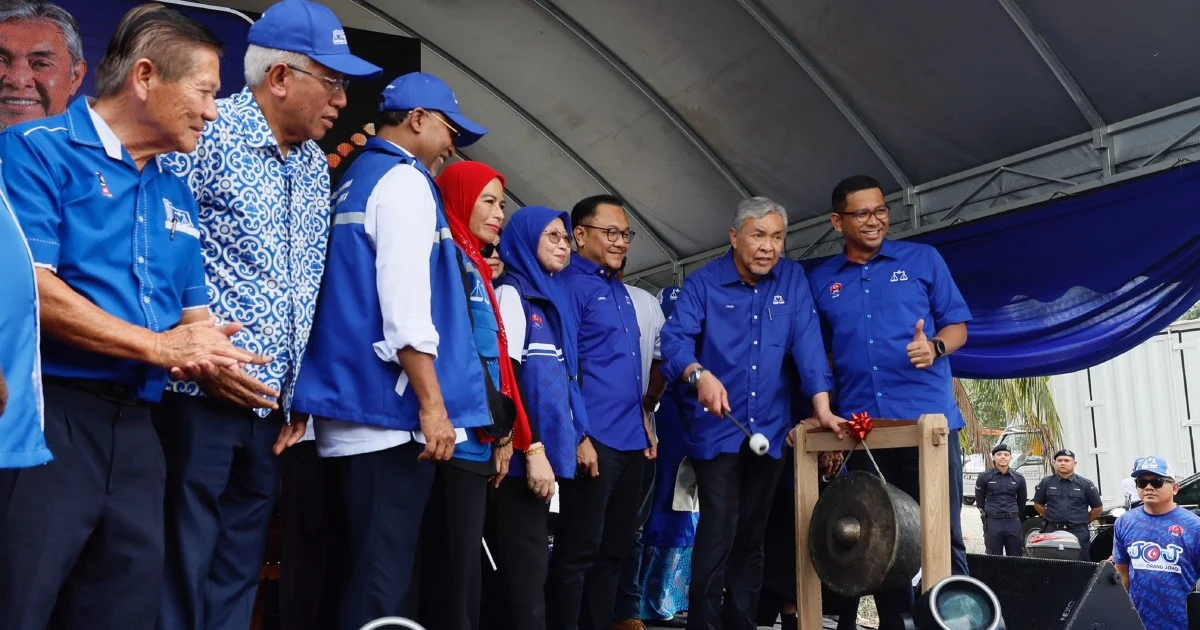
Deputy Prime Minister Datuk Seri Dr Ahmad Zahid Hamidi has issued a pointed challenge to Pas, asking the Islamist party to demonstrate its commitment to Barisan Nasional through concrete electoral support rather than mere rhetoric during the forthcoming Johor election. Speaking in Batu Pahat, Zahid made clear that pledges of cooperation must be substantiated at the ballot box if the coalition partnership is to be meaningful.
The remark reflects underlying tensions within the broader political coalition that has governed Malaysia. While Pas formally supports Barisan Nasional at the federal level through the Unity Government arrangement, coordination at state and constituency level remains inconsistent. Zahid's public call suggests frustration with gaps between Pas's public declarations of unity and its actual ground mobilisation efforts. Such friction between coalition partners is not uncommon as elections approach, with each party seeking to maximise its own representation whilst maintaining the broader political alliance.
Zahid's intervention carries particular weight given his position as Deputy Prime Minister and his role within the United Malays National Organisation (UMNO), the dominant component of Barisan Nasional. His comments signal that senior Barisan leadership expects tangible reciprocal support from Pas, not merely symbolic gestures. In electoral mathematics, the difference between lukewarm endorsement and active campaigning can determine outcomes in closely contested seats, particularly in a state like Johor where multiple power bases compete.
The Johor election represents a significant test for the Unity Government arrangement that has shaped Malaysian politics since late 2022. Barisan Nasional has traditionally dominated Johor's electoral landscape, and the state remains strategically important for UMNO's political standing. Any erosion of support in this stronghold would signal broader weakness within the federal coalition. Pas's performance in mobilising its own supporters and sympathisers therefore carries disproportionate significance for how the overall Unity Government framework functions at state level.
Pas faces a delicate balancing act in Johor. The party commands support among certain voting constituencies and maintains organisational networks across the state. However, Pas must calculate whether deploying those resources fully for Barisan candidates advances its own institutional interests or dilutes its independence. This calculation becomes particularly acute given Pas's parallel efforts to strengthen its own party brand and representation. The tension between being a reliable coalition partner and pursuing autonomous political growth remains unresolved.
Historically, Johor has been contested territory between rival coalitions, though Barisan's grip has been considerably more secure than in other Malaysian states. The emergence of meaningful political competition in Johor, if Pas fails to deliver expected support, could reshape state politics more substantially than recent federal-level changes. Zahid's public pressure on Pas should be read as an attempt to prevent precisely such an outcome by establishing explicit expectations before the campaign intensifies.
The broader context involves questions about how Malaysia's new political equilibrium will function in practice. The Unity Government was constructed to address federal-level instability, but translating such arrangements into effective state-level operations remains challenging. Johor's election therefore becomes a barometer for whether the coalition model can produce coherent strategy or whether individual parties will prioritise narrow self-interest over collective performance. Zahid's remarks suggest that Barisan leadership recognises this potential weakness and is attempting to establish clarity beforehand.
For Malaysian voters, this dynamic illustrates how formal coalition arrangements frequently mask deeper strategic divergences. Pas and Barisan Nasional inhabit different ideological spaces and appeal to overlapping but distinct constituencies. When these parties campaign together, the question of which party voters should support becomes complicated. Zahid's insistence on concrete action from Pas attempts to overcome this ambiguity by making explicit that Barisan expects Pas to direct its supporters toward Barisan candidates rather than positioning itself as an independent alternative.
The Johor election will reveal whether such pressure produces results. If Pas mobilises effectively for Barisan, the unity arrangement gains credibility. If Pas merely tolerates Barisan's presence without active support, questions about the coalition's durability will intensify. For regional observers, how Malaysia's largest Muslim-majority party chooses to engage with this moment will carry implications for broader Southeast Asian politics, where questions of Islamist integration into mainstream political coalitions remain contested and evolving.

