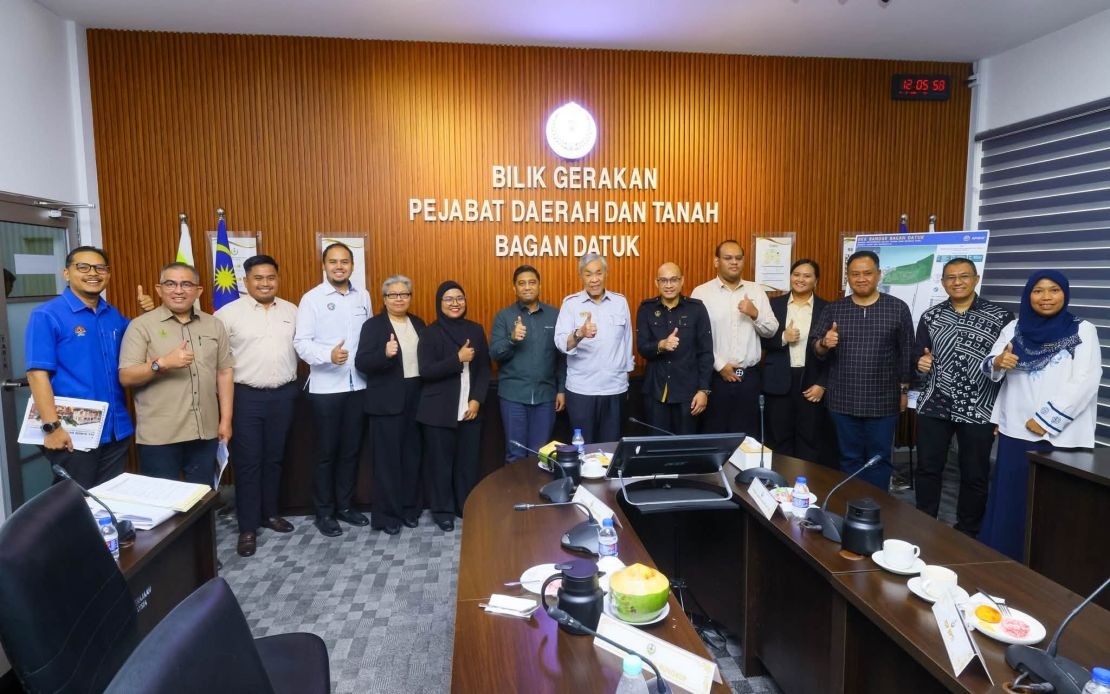
Deputy Prime Minister Datuk Seri Dr Ahmad Zahid Hamidi has articulated a comprehensive vision for transforming Bagan Datuk into a modern administrative town, leveraging what he describes as the parliamentary constituency's substantial untapped potential. Speaking in Ipoh on August 14, Zahid, who represents Bagan Datuk in Parliament, emphasised that the district could evolve into a distinctive, competitive hub characterised by quality infrastructure, expanded economic opportunities, and enhanced quality of life for its residents.
The initiative centres on a special area plan, known locally as the Rancangan Khas Kawasan (RKK), which Zahid reviewed during a working session with the Teluk Intan Municipal Council, Bagan Datuk District administration, the Land Office, and consulting firms. This coordinated approach reflects a multi-agency framework designed to align planning efforts across local government, land administration, and private sector expertise. The emergence of such comprehensive planning mechanisms signals growing attention to strategic regional development beyond Kuala Lumpur's conventional development corridors.
For Malaysian policymakers and investors, the Bagan Datuk initiative underscores a broader regional strategy to decentralise economic activity and administrative functions away from overstretched metropolitan centres. Perak, like several Malaysian states, has historically laboured under infrastructure deficits and limited institutional capacity compared to western seaboard counterparts. Bagan Datuk's positioning as a potential administrative and commercial node could help rebalance growth patterns within the state and contribute to more distributed economic development across the peninsula.
Zahid's emphasis on community consultation and needs-based planning reflects contemporary governance expectations, particularly among younger, urbanised populations seeking transparency in development decisions. By framing the initiative around listening sessions and comprehensive surveys, the Deputy Prime Minister signals receptiveness to resident input, a contrast to top-down approaches that historically dominated Malaysian development discourse. This consultative framing, whether executed comprehensively or performatively, indicates shifting political communication norms in Malaysia's federal system.
The concept of an "administrative town in a park" invokes international best practices in urban design, drawing inspiration from planned cities like Putrajaya. Such aspirations, when realised effectively, can enhance liveability metrics including green space accessibility, walkability, and environmental quality. For property investors and businesses, the Bagan Datuk plan potentially signals land appreciation opportunities and commercial anchoring around civic infrastructure, though realisation timelines remain unclear.
Economically, expanding Bagan Datuk's competitive positioning requires deliberate sectoral development beyond administrative functions. The district's proximity to Teluk Intan and broader Perak networks suggests potential synergies with manufacturing, agro-processing, logistics, and digital services sectors. Without targeted economic clustering and workforce development initiatives, however, administrative infrastructure alone may prove insufficient to generate sustainable employment and retain talent.
Zahid's personal connection to Bagan Datuk—he identifies as a native of the district—adds a political dimension to the development agenda. Such locally-rooted advocacy can accelerate bureaucratic responsiveness and secure budgetary commitments, though it simultaneously raises questions about resource allocation prioritisation across competing constituencies. In Malaysian federal politics, where Deputy Prime Ministers wield significant portfolio influence, Bagan Datuk's elevated visibility may translate into tangible infrastructure investment.
The integration of land office coordination within the planning framework suggests attention to tenure clarity and property rights, fundamental prerequisites for investor confidence. Streamlined land administration, if achieved, could reduce transaction costs and accelerate commercial development cycles. However, Perak's history of complex land claims and competing traditional authority interests necessitates careful navigation of customary rights alongside modernisation objectives.
Sustainability considerations remain partially implicit in Zahid's articulation. A genuinely livable administrative town must address waste management, water supply reliability, renewable energy integration, and public transport connectivity—infrastructure domains where many Malaysian secondary cities experience chronic underinvestment. The plan's environmental credentials will ultimately determine whether Bagan Datuk can attract knowledge-intensive sectors and retain educated residents rather than functioning primarily as a government employment centre.
The timing of the initiative reflects broader federal government repositioning following recent elections and cabinet reshuffles. Emphasising decentralised development and provincial investment can bolster coalition cohesion by demonstrating tangible commitment to non-metropolitan constituencies. For Perak voters and business communities, the Bagan Datuk announcement represents an opportunity to articulate concrete expectations regarding timelines, funding allocations, and accountability mechanisms.
International precedents for administrative relocation and regional city development offer instructive lessons. Indonesia's Nusantara project and South Korea's Sejong City demonstrate both the transformative potential and formidable challenges of planned urban development at scale. Success typically requires sustained political commitment transcending electoral cycles, adequate capital mobilisation, and genuine institutional decentralisation rather than merely relocating office functions.
For Southeast Asian observers, Malaysia's continued experimentation with strategic regional development provides comparative data on federal systems' capacity to balance metropolitan concentration with provincial growth. Bagan Datuk's trajectory will illuminate whether Malaysian governance can effectively coordinate multi-level institutions around long-term development objectives, a capability increasingly recognised as essential for regional competitiveness.

