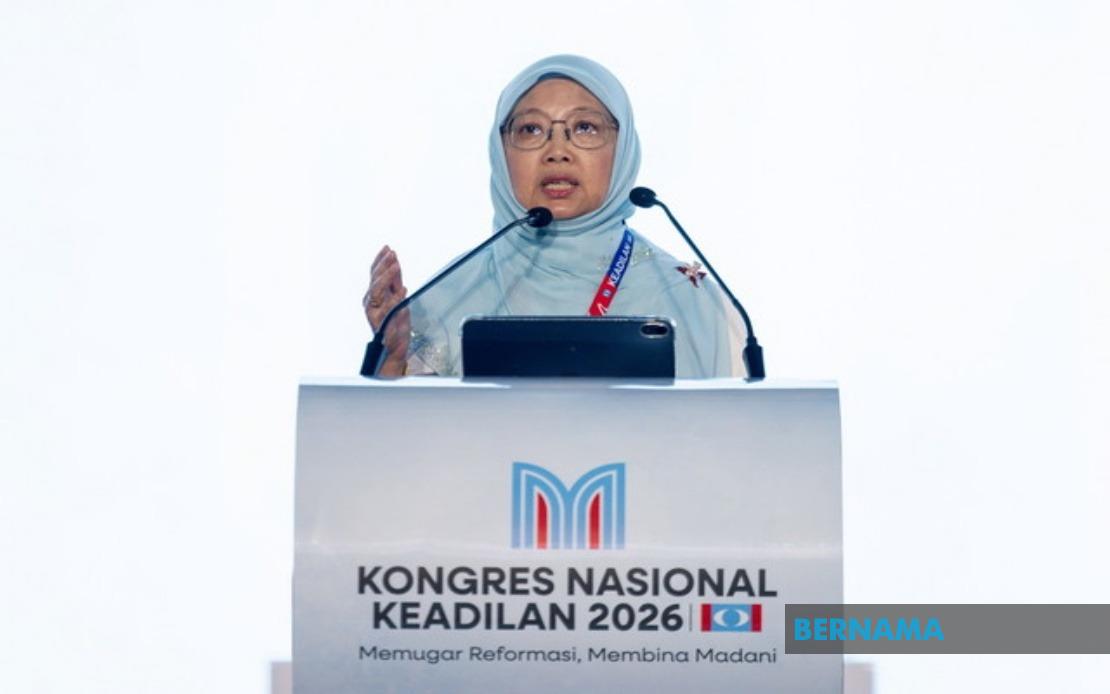
The true measure of Parti Keadilan Rakyat's quarter-century push for reform will not be tallied in votes won or seats captured, but rather in how effectively the party translates its agenda into tangible institutional change now that it holds government office. This was the central message delivered by PKR vice president Datuk Seri Dr Zaliha Mustafa at the party's 2026 National Congress in Melaka, where she reframed the narrative surrounding the party's ascent to power as merely the opening chapter in a far longer story of governance transformation.
Zaliha's remarks at the Melaka International Trade Centre deliberately stripped away any triumphalism that might accompany political victory, instead positioning the party's involvement in government as a critical juncture where theory meets practice. She articulated a distinction that often gets lost in Malaysian political discourse: the difference between capturing power and wielding it purposefully. A movement calling for change that merely swaps out one set of faces for another risks becoming little more than an exercise in political musical chairs, she argued. The PKR's ambition, by contrast, centres on reconstructing the foundations and operating principles of governance itself—a vastly more complicated and consequential undertaking.
Central to this reconceptualisation is the notion that reformasi must translate into concrete institutional reforms. Zaliha outlined several pillars that the party must now deliver upon: fortifying democratic institutions to ensure they function with genuine independence, launching a sustained assault on endemic corruption that has corroded public trust, preventing the abuse of executive power through stronger checks and balances, and crucially, ensuring that ordinary citizens at all socioeconomic levels experience justice as a tangible reality rather than an aspiration. These are not marketing slogans but foundational shifts that require sustained political will and administrative competence.
The PKR vice president's invocation of the historical example of Khalifah Umar Abdul Aziz—referenced by party president Datuk Seri Anwar Ibrahim during the congress opening—demonstrates the party's attempt to ground its reform project in a philosophical framework that privileges measured, strategic change over hasty revolutionary upheaval. Zaliha recognised that implementing reforms requires both courage and wisdom, and that these virtues are not always naturally aligned. It would be easier, she implied, to simply bulldoze through existing structures and declare victory, but sustainable transformation demands a different calculus. Reforms must be sequenced thoughtfully, with some changes made immediately where circumstances permit, while others require extended periods of negotiation, preparation, and careful institutional redesign.
This calibrated approach is particularly relevant for Malaysian readers observing a government still in its comparative infancy, navigating pressures to deliver visible wins while managing competing factions and entrenched bureaucratic interests. Zaliha's framing acknowledges the reality that radical speed often breeds instability, yet she was equally emphatic that gradualism must never become an excuse for procrastination. The party must maintain unwavering clarity about its reform direction and targets, constantly moving incrementally but relentlessly toward those objectives. This distinction between purposeful patience and dilatory excuse-making may prove to be one of the defining tests of PKR's time in government.
Beyond structural reforms, Zaliha identified a critical weakness that threatens to undermine even well-executed policy initiatives: the party's capacity to communicate its achievements effectively to the broader electorate. She noted an uncomfortable truth that resonates across Southeast Asian democracies: winning on paper does not automatically translate into public acceptance or understanding. A government can implement sound policies that improve lives, yet fail entirely if citizens remain unaware of these improvements or attribute them to other sources. This communications deficit, she warned, represents a significant vulnerability that opposition forces will exploit.
The PKR vice president called for a systematic overhaul of the party's communications infrastructure, demanding that messaging become more structured, more rapid in deployment, and above all more genuinely rooted in the language and concerns of ordinary Malaysians. This reflects a broader challenge facing the current government coalition: the sophistication of modern political opposition, particularly in leveraging social media spaces where narratives form faster than traditional media can counter them. Zaliha's concern was not merely that PKR must explain itself, but that it must master the terrain of digital communication or risk ceding narrative control to better-organised opposition voices.
Critically, Zaliha emphasised that numerical victory—whether in the form of legislative majorities or successful policy passage—creates a false sense of security if the party fails to capture what she termed the "feelings" of the electorate. This concept points to something deeper than rational policy assessment: the emotional resonance and intuitive trust that citizens place in their government. Malaysian voters, across the diverse landscape of the nation's multiethnic and multifaith constituencies, make political judgments that blend policy preferences with cultural values, historical grievances, and present-day anxieties. A government that wins on policy grounds but loses on emotional grounds faces mounting legitimacy challenges that cannot be resolved through better administration alone.
For Malaysia and the Southeast Asian region more broadly, Zaliha's intervention carries implications that extend beyond PKR internal deliberations. The region's democracies face persistent questions about whether reform movements can govern effectively once they capture power, or whether the logic of revolutionary opposition proves incompatible with the pragmatic necessities of statecraft. Thailand's repeated cycles of reform-driven upheaval followed by authoritarian consolidation, Myanmar's military reversions to power, and Indonesia's ongoing struggles to entrench democratic norms all suggest that this transition from opposition movement to governing party is far from automatic or assured. Zaliha's speech implicitly acknowledges these regional cautionary tales by insisting that PKR must prove itself worthy of the trust placed in it—and that such proof demands nothing less than comprehensive institutional transformation.
The speech ultimately frames Malaysia's current political moment as a genuine inflection point rather than a mere change of administration. If the PKR can deliver on the harder work of actually reforming governance institutions, combating corruption with consistency, and ensuring that reforms improve the lived experience of citizens across all strata, then the 27-year struggle takes on historical significance. If, conversely, the party retreats into comfortable governance of the existing system while claiming victory, then reformasi becomes what critics have sometimes charged: a movement distinguished more by the sincerity of its rhetoric than the depth of its structural impact.

