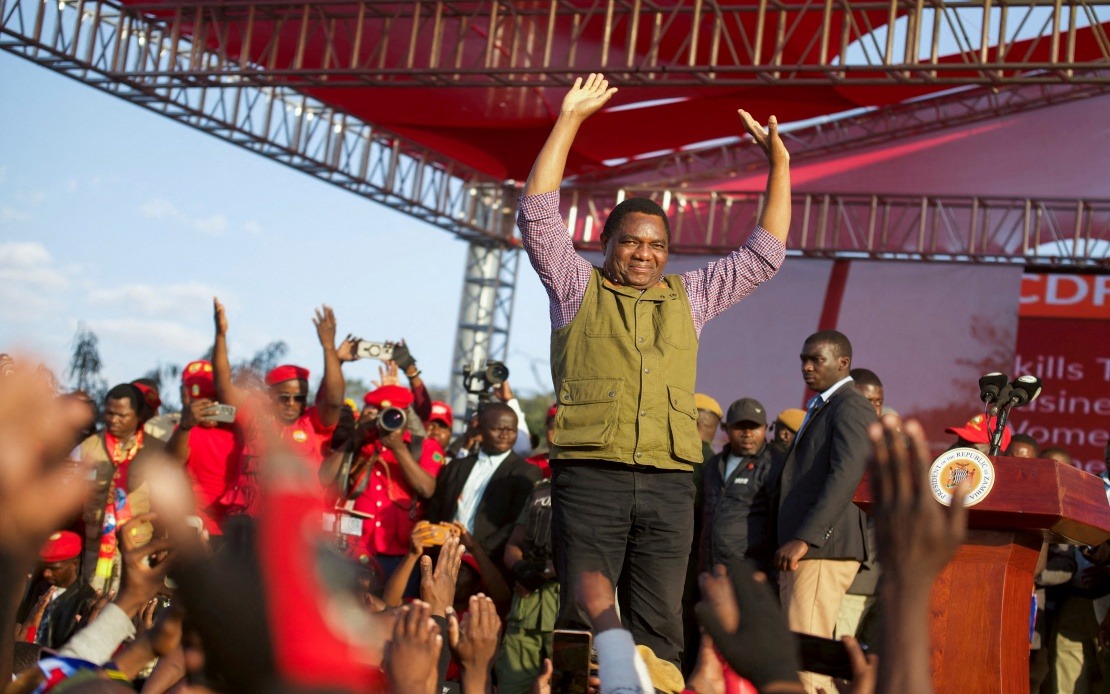
Zambian President Hakainde Hichilema has secured a second term in office following last Thursday's presidential election, with the Electoral Commission of Zambia confirming his victory early Tuesday morning. The 64-year-old incumbent garnered more than 2.9 million votes, substantially exceeding the constitutional requirement of 50 per cent plus one vote necessary to claim outright victory without a runoff.
Hichilema's commanding performance at the polls represents a significant endorsement of his administration's policies and direction. His nearest challenger, Brian Mundubile of the National Restoration Party for Unity and Progress, finished a distant second with 1.8 million votes, indicating a substantial margin of victory. Electoral Commission chairperson Mwanagala Zaloumis declared Hichilema president-elect at the national election centre in Lusaka, noting that his lead was so substantial that remaining results from selected polling stations across five of Zambia's 226 constituencies would not materially alter the outcome.
The magnitude of Hichilema's victory was evident in the jubilant scenes that unfolded across Lusaka even before official results were announced. Despite early morning temperatures, citizens from diverse backgrounds gathered in the streets to celebrate, with celebrations continuing throughout the day and into the evening. This widespread public expression of support suggests that Hichilema's first term resonated with a broad cross-section of Zambian society.
In his immediate response to the electoral victory, Hichilema expressed gratitude to the Zambian electorate through a Facebook post, acknowledging the significant responsibility they had entrusted to him. He emphasised his commitment to serving the nation and the people who had placed their faith in his leadership once again. Such rhetoric, following decisive electoral mandates, typically sets the tone for the incoming administration's priorities and messaging.
The ruling United Party for National Development saw its candidate's decisive victory as vindication of its governance record. Collins Maoma, the party's national chairperson, used the occasion to call upon Hichilema to maintain the standards of leadership the electorate had apparently recognised. Maoma's public statement underscored the party's interpretation of the results as reflecting strong public confidence in Hichilema's administration and its direction for the country.
For the Malaysian and wider Southeast Asian audience, Zambia's electoral outcome carries several implications. The election demonstrates the importance of transparent and credible electoral processes in securing legitimacy for governing mandates, even amid competitive multi-party contests. Zambia's approach to announcing results with appropriate acknowledgment of outstanding tallies yet confidence in the overall outcome reflects institutional maturity in electoral management.
Hichilema's re-election also reflects broader patterns in African political leadership, where incumbents with perceived economic management credentials can secure substantial public support. The contrast between Hichilema's 2.9 million votes and Mundubile's 1.8 million represents a significant victory margin that gives the incoming administration considerable political capital to pursue its agenda during its second term.
The turnout and engagement evident in Lusaka's streets suggest that Zambian voters viewed this election as consequential and worthy of their participation. For a nation navigating economic challenges and competing political visions, this level of civic engagement is noteworthy. It indicates that despite inevitable frustrations with incumbent performance, Zambians remain invested in democratic participation and electoral competition.
Looking forward, Hichilema's second term will face the typical pressures facing any re-elected African leader: managing economic performance, addressing service delivery expectations, and navigating intra-party dynamics. The substantial margin of victory provides political room to implement significant policy initiatives, though expectations generated during electoral campaigns must be translated into tangible results to maintain public confidence.
The electoral commission's handling of the announcement process, with clear communication about outstanding results whilst confidently declaring an outcome, reflects professional electoral administration. This approach balances transparency with decisiveness, ensuring that democratic processes maintain both credibility and efficiency.
For Southeast Asian observers, the Zambian election reinforces that African democracies continue evolving institutional mechanisms for managing electoral competitions. The peaceful transfer of victory announcements, public celebration without reported violence, and the apparent acceptance of results across major political contestants demonstrate functional democratic norms.
Hichilema's second-term mandate extends until the next scheduled election cycle, during which the UPND will seek to consolidate its hold on power while opposition parties, including Mundubile's NRPUP, will regroup and strategise for future contests. The electoral landscape will likely remain competitive, as demonstrated by the scale of Mundubile's vote share, though Hichilema's current dominance is undeniable.
As Zambia moves into this new electoral phase, the international community, including regional partners, will observe how effectively Hichilema translates his electoral mandate into improved governance outcomes and economic performance. His second administration's success will significantly influence perceptions of UPND governance and shape the trajectory of Zambian politics through the remainder of this decade.

