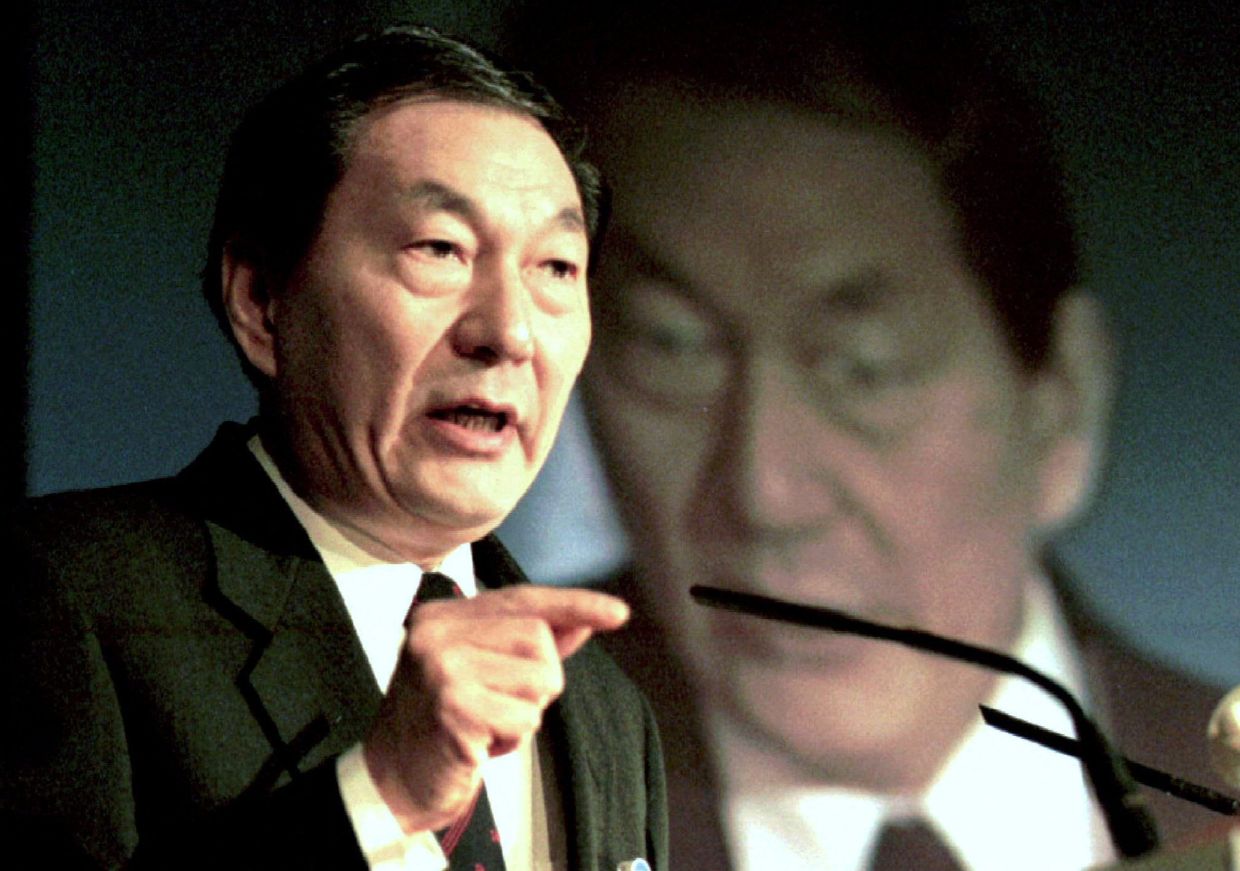
Zhu Rongji, the former Chinese premier whose bold economic restructuring programmes transformed state enterprises and positioned China for integration into global trade structures, has died in Beijing at the age of 98. The senior leader, who served as premier from 1998 to 2003, passed away on Wednesday (Aug 12) following medical treatment for an unspecified ailment, according to the official Xinhua News Agency. His death marks the end of an era for a figure whose tenure coincided with some of the most consequential economic shifts in modern Chinese history.
During his leadership, Zhu orchestrated one of the most extensive overhauls of China's state-owned enterprise sector, a restructuring programme that involved closing tens of thousands of underperforming firms across telecommunications, banking, petroleum, and other strategic industries. The consolidation drive was aimed at tackling mounting debt levels and spurring economic dynamism through private sector expansion. This aggressive approach entailed significant social dislocation, with tens of millions of workers shedding their positions at state enterprises. Yet Zhu remained convinced that such painful adjustment was necessary to establish a more efficient, market-responsive economy capable of sustaining long-term growth.
Prior to his elevation to the premiership, Zhu had already earned recognition for his economic acumen during his stewardship of the People's Bank of China between 1993 and 1995. In that capacity, he substantially liberalised the financial sector by introducing experimental schemes for foreign financial institutions and conducting China's inaugural global bond issuance. These measures reflected his conviction that international capital flows and external expertise could accelerate China's institutional modernisation. His tenure at the central bank underscored a pragmatic philosophy: economic strength derived from openness and institutional credibility rather than isolation and state micromanagement.
One of Zhu's most consequential legacies was his pivotal role in securing China's admission to the World Trade Organization, a geopolitical and economic achievement that he helped negotiate following discussions with European Union Trade Commissioner Pascal Lamy in Beijing in 2000. China's formal WTO accession in 2001 fundamentally altered the trajectory of the global economy. In the two decades since then, China's gross domestic product has expanded more than elevenfold, positioning the nation as the world's second-largest economy. However, this integration into multilateral trade rules has proven contentious; numerous trading partners have levelled accusations that Beijing employs subsidies for domestic producers, erects informal import barriers, and permits intellectual property infringement—grievances that remain unresolved in contemporary trade disputes.
Zhu's tenure as the architect of China's financial sector restructuring proved indispensable to the stability and eventual globalisation of Chinese banking. In 1999, he oversaw the establishment of asset-management companies tasked with acquiring 1.4 trillion yuan (approximately US$220 billion) in non-performing loans from the nation's four largest banks. This intervention prevented a potential banking crisis and allowed these institutions to rehabilitate their balance sheets sufficiently to pursue public listings commencing in 2005. The recapitalisation and market orientation of Chinese banking became a foundation for the country's subsequent emergence as a major global financial centre, a transformation that would have been unthinkable without these foundational reforms.
Beyond economic restructuring, Zhu distinguished himself through vigorous anti-corruption initiatives and bureaucratic streamlining as premier. His aggressive efforts to eliminate redundant administrative procedures and reduce official sign-offs earned him the colloquial epithet "one-chop Zhu," a reference to the traditional official seals, or chops, that authorised government documents in China. This reputation for no-nonsense administration and relative administrative efficiency contrasted sharply with the bureaucratic sprawl that had accumulated through decades of incremental institutional layering. For foreign observers and investors, Zhu's emphasis on procedural clarity and reduced governmental interference signalled a shift towards more predictable, rules-based economic management.
Zhu's personal charisma and linguistic facility in English made him an exceptionally effective ambassador for Chinese economic interests to Western audiences. His fluency in English and evident comfort with international audiences allowed him to articulate China's economic rationale to sceptical foreign audiences. During a 1999 joint press conference with United States President Bill Clinton in Washington, Zhu fielded accusations that China had made illicit political contributions to the Democratic Party with characteristic wit. He noted that if campaign contributions were genuinely consequential, China possessed sufficient foreign-exchange reserves—then standing at US$146 billion—to deploy far more substantial sums than the alleged US$300,000. His rejoinder drew laughter and scattered applause, demonstrating his ability to deploy humour as a diplomatic tool while deflecting criticism.
Zhu's early career trajectory reflected both the ideological turbulence and subsequent pragmatic reorientation of the Chinese Communist Party. Born in October 1928 in Hunan province in southern China, he attended Tsinghua University from 1947 to 1951, where he studied electrical engineering and joined the Communist Party in 1949, the same month that Chairman Mao Zedong proclaimed the founding of the People's Republic. During the Hundred Flowers Campaign in the 1950s, when the party briefly encouraged critical discourse, Zhu articulated reservations about Mao's economic policies, arguing they generated irrational and unsustainable growth trajectories. This candour resulted in his classification as a "rightist," leading to demotion and subsequent assignment to rural agricultural labour for five years during the Cultural Revolution, where he laboured on farms raising pigs and cultivating rice.
Following his rehabilitation in 1978, as the party shifted decisively toward market-oriented reforms under Deng Xiaoping's leadership, Zhu ascended through successive governmental positions with remarkable rapidity. He assumed the position of Shanghai's mayor in 1987 and was elevated to vice premier in 1991, subsequently gaining membership in the Politburo's elite Standing Committee in 1992. Deng Xiaoping himself praised Zhu as a "rare talent" possessing both profound economic understanding and the fortitude to confront formidable challenges. This endorsement from China's paramount leader catalysed Zhu's subsequent elevation to the premiership and invested his reform agenda with considerable institutional authority.
The contrast between Zhu's reform-oriented approach and the subsequent direction of Chinese economic policy under President Xi Jinping merits consideration for regional observers. Whereas Zhu championed the rationalisation and privatisation of state enterprises and greater reliance on market mechanisms, Xi Jinping has advocated for a "stronger, better, and bigger" state-controlled economy designed to advance what Beijing characterises as strategic national interests. This ideological divergence reflects differing assessments of the relationship between state ownership, economic efficiency, and national security—a tension that remains unresolved within Chinese policymaking circles and that carries implications for how China manages its regional economic relationships and engagement with Southeast Asian partners.
After ceding the premiership to Wen Jiabao in 2003, Zhu channelled his energies toward augmenting the international prestige of his alma mater, Tsinghua University, and directed book royalties toward supporting rural educational institutions. His philanthropic activities reflected a conviction that educational advancement constituted a pathway toward sustained economic development and social mobility. During a 2000 address to the national legislature, Zhu articulated his aspiration with characteristic modesty: "I only hope that after I leave office, the Chinese people will say that he was a clean official, not a corrupt one. I would be very satisfied. If they are more generous and say that Zhu Rongji got some real things done, then I'd thank heaven and Earth." Zhu maintained a marriage to Lao An and fathered two children; his son, Levin Zhu, headed China International Capital Corp, a Beijing-based investment bank, while his daughter, Zhu Yanlai, occupied senior management positions at Bank of China (Hong Kong).

