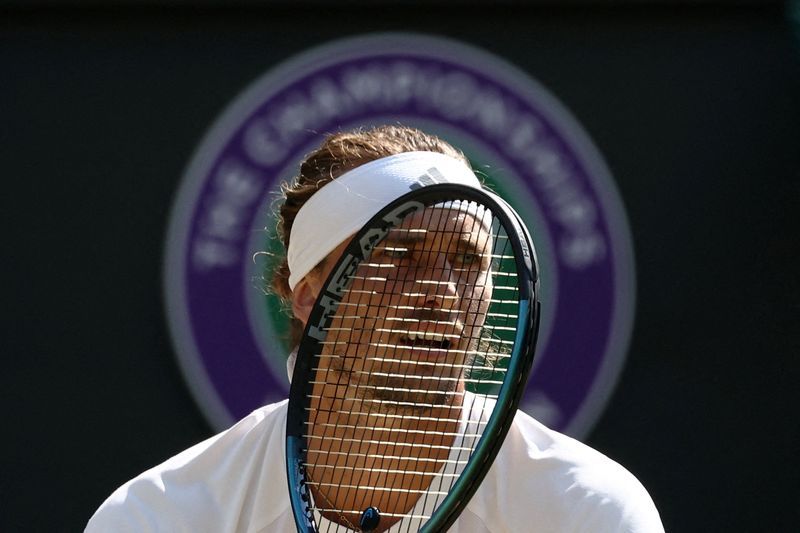
Alexander Zverev has finally broken through a troubling barrier in his pursuit of Wimbledon glory, dispatching American Taylor Fritz with a commanding 6-4 6-4 6-2 performance on Court One to secure a place in the tournament's semi-finals. The German second seed's breakthrough comes as significant relief after seven consecutive defeats to Fritz, including a painful loss at the All England Club just twelve months earlier, making this straight-sets victory far more than a routine quarter-final win.
Zverev's advancement to the last four maintains his momentum toward consecutive Grand Slam triumphs, having claimed the French Open title earlier in the season. The 29-year-old's pathway through southwest London has been methodical and increasingly assured, and with his emotional breakthrough against Fritz now secured, he enters the semi-final stage with considerable confidence. His opponent will be Britain's Arthur Fery, who eliminated Italy's Flavio Cobolli in his quarter-final clash, setting up a tantalising domestic showdown that carries enormous significance for both players and the home crowd.
Zverev's ascent to the Wimbledon semi-finals marks a historic moment for German tennis in the professional era. By reaching this stage for the first time in his career at the All England Club, he joins an elite group of four previous German men who achieved the feat since 1968: Boris Becker, Michael Stich, Rainer Schuettler, and Tommy Haas. This milestone underscores both his individual achievement and the continued relevance of German excellence in men's tennis, a legacy built on technical precision and mental fortitude that Zverev demonstrated abundantly during his quarter-final performance.
The match unfolded with Zverev establishing early dominance under intense conditions on Court One. He secured an early service break to build a commanding 5-4 lead in the opening set, then showed considerable nerve by fending off a late fightback from Fritz in the tenth game to clinch the set under the blazing sun. The psychological weight of his two-year losing streak appeared to dissipate as soon as he sealed that first set, with Zverev visibly relaxing into his game and allowing his superior court positioning and consistency to take control.
Fritz's physical challenges compounded his tactical difficulties as the match progressed. The American required a medical timeout for a persistent right knee issue after just three games of the second set, an intervention that proved crucial in determining the match's trajectory. With his opponent compromised physically, Zverev capitalised ruthlessly, seizing a crucial break to leave Fritz on the metaphorical ropes. The momentum shifted decisively when news of Fery's two-set advantage against Cobolli on Centre Court filtered through the crowd, energising both the spectators and Zverev himself, who promptly held serve with assurance to move further clear as Fritz's hopes deteriorated.
Zverev's execution in the third set reached near-flawless levels, particularly highlighted by a scintillating backhand winner that sealed a double break at 4-1. He closed out the set with minimum fuss to claim his 12th major semi-final appearance overall, continuing to forge new territory in this year's tournament. The German's ability to maintain intensity and precision even after establishing complete control demonstrated the maturity that separates genuine Grand Slam contenders from occasional bright performers. His statistical dominance was reflected not merely in the scoreline but in the quality of tennis, with serves landing cleanly, returns proving increasingly difficult for Fritz, and baseline exchanges consistently resolved in Zverev's favour.
Post-match, Zverev addressed the psychological magnitude of finally vanquishing his long-standing nemesis. He candidly acknowledged that Fritz had dominated their head-to-head record for over two years, a reality that inevitably weighs on a competitor's mind regardless of surface or tournament context. The mental barrier created by such losing streaks can become self-perpetuating, with doubts accumulating through each successive defeat. Zverev's breakthrough therefore carries significance beyond pure ranking points and tournament progression, representing validation of his belief that technical excellence and mental resilience could overcome the narrative his recent record against Fritz had created.
Zverev emphasised that no match at the highest level ever becomes truly comfortable, even against opponents appearing comprehensively outplayed. He reflected that facing Fritz, despite the overwhelming deficit in their head-to-head record entering this encounter, required unwavering focus from the opening serve. Facing three break points in his opening service game, Zverev recognised immediately that complacency would prove fatal. This awareness drove him to deliver what he himself characterised as near-perfect tennis throughout the match, maintaining intensity across all three sets while avoiding the mental lapses that historically have plagued his major tournament performances.
Zverev's humorous exchanges with the Centre Court crowd, joking about audience support naturally gravitating toward home favourite Fery and demonstrating his characteristic wit through wordplay about his opponent's surname, revealed a relaxed demeanor that contrasted sharply with the tension evident during his quarter-final clash. This looseness suggested genuine confidence rather than mere bravado, a psychological state he will carry into his semi-final meeting with Fery. The German recognised that squaring off against a British player on British soil presents obvious challenges given crowd dynamics, yet he expressed determination to trust his technical abilities and competitive instincts when facing the home favourite.
Zverev's semi-final assignment against Fery carries broader significance for Southeast Asian tennis followers invested in the sport's European narrative. Both players represent the new generation pushing forward the legacy of major champions, with Zverev's previous accomplishments and Fery's emerging Wimbledon breakthrough creating a generational clash. For Malaysian readers following international tennis, this semi-final encapsulates the contemporary professional game's intensity, where even beating a familiar opponent after a two-year drought requires the sort of comprehensive excellence Zverev delivered. His pathway to the final now depends on reproducing this performance against an opponent buoyed by achieving his own breakthrough in this historic tournament.
The implications of Zverev's advancement extend beyond Wimbledon itself, signalling that his French Open triumph was no aberration but evidence of genuinely heightened form and mental strength. Should he continue this trajectory through the semi-finals and potentially to the championship, it would represent his first Grand Slam title on grass—a surface where he has never previously reached such heights. This progression would establish him definitively among tennis's elite echelon, cementing his position as a major threat in future Grand Slam events and reshaping expectations around his career trajectory during what should represent his prime competitive years.
As Zverev prepares to face Fery in the semi-finals, the German carries momentum derived not merely from defeating Fritz but from exorcising a psychological demon that had haunted his recent record. The manner of his victory—dominant, relatively comfortable despite the psychological weight involved, and executed with tactical intelligence—suggests he has elevated his game to the level required to challenge for major titles. Whether this form extends to defeating Fery and ultimately claiming Wimbledon's crown remains uncertain, but Zverev has decisively answered the central question confronting him entering the quarter-finals: whether he possessed the mental and technical resources to overcome his persistent struggles against Fritz. He answered emphatically in the affirmative.

