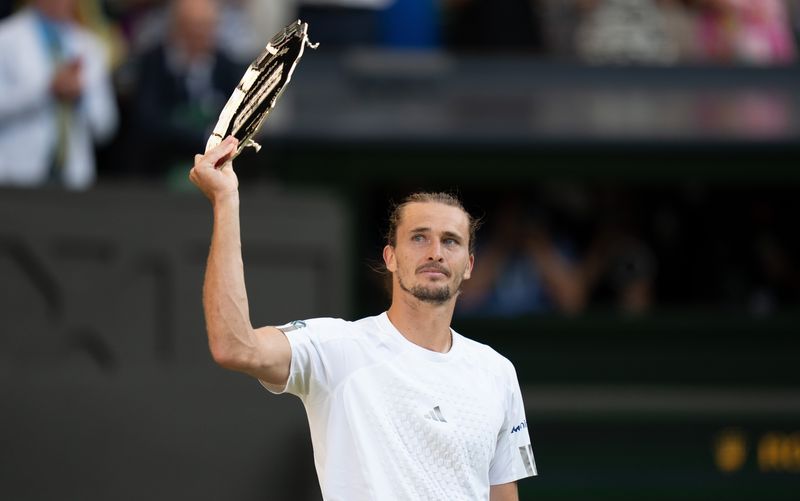
Alexander Zverev is poised to ascend to the number two ranking in men's professional tennis following his performance at Wimbledon, where he reached the championship final before succumbing to world number one Jannik Sinner. The 29-year-old German believes that despite the 6-7(7), 7-6(2), 6-3, 6-4 loss on Centre Court, his evolving tactical approach offers a viable pathway to compete with the sport's reigning elite. Sinner and Carlos Alcaraz have established themselves as the clear standard-bearers of men's tennis, yet Zverev contends that his willingness to embrace a more aggressive posture, particularly with his forehand, can narrow the considerable gap that has traditionally separated him from these titans of the sport.
The final against Sinner represented far more than a conventional defeat in Zverev's recent history. Prior to Sunday, the German had experienced a troubling stretch of 14 consecutive sets lost to the Italian, a statistical reality that underscored the psychological and tactical disadvantage he faced. This latest encounter, however, told a different story. Zverev pushed Sinner to the brink in a match that featured genuine competitiveness and momentum swings, suggesting that his methodical shift toward a more offensive blueprint may yield tangible dividends. Had a fall at 3-3 in the third set, which occurred at his only genuine break point opportunity throughout the contest, not disrupted his rhythm, Zverev could potentially have claimed the All England Club's singles crown and become the first German male champion since Michael Stich achieved that feat in 1991.
Zverev's recent Grand Slam breakthrough at Roland Garros, where he claimed his maiden major title at his 41st attempt, marked a watershed moment in his career trajectory. The psychological lift from that Paris triumph proved instrumental in shaping his Wimbledon campaign, as he visibly carried greater conviction and purpose throughout his grasscourt performances. Critics have noted, with some justification, that his Roland Garros victory arrived under somewhat fortuitous circumstances—Sinner was eliminated in the second round whilst Alcaraz, a seven-time major champion, remained sidelined with a persistent wrist injury. Nevertheless, the significance of breaking through at tennis's highest level fundamentally altered Zverev's self-perception and competitive framework entering the English summer.
The strategic transformation underpinning Zverev's recent success centres on a pronounced stylistic evolution. Rather than defaulting to his historically more conservative baseline patterns, Zverev has deliberately constructed a game architecture emphasizing offensive initiation. His forehand, long regarded as a vulnerability due to an overly cautious application, has been reengineered as an aggressive weapon capable of dictating rallies and dismantling opponents' constructions. During the Wimbledon final, his first serve percentage remained robust at approximately eighty percent, providing him with the platform to execute his forehand with maximum conviction. This synthesis of serving reliability and forehand assertiveness created genuine problems for Sinner, pushing the world number one to the margins of his own comfort zone.
Zverev articulated this philosophical reorientation with considerable clarity in his post-final reflections, emphasizing that this attacking methodology represents not merely a temporary tactical adjustment but rather a fundamental reimagining of his long-term competitive identity. He explained that whilst certain early-season matches saw him struggling with the implementation of this more aggressive approach, his persistent commitment to the blueprint gradually yielded improved execution and elevated performance levels. The correlation between his willingness to take risks, particularly with his forehand, and his improved trajectory through major tournaments suggests a causal relationship between stylistic boldness and enhanced results. Zverev recognizes that this transformation demands continued refinement, yet he expresses genuine conviction that the trajectory will continue ascending as his comfort with this attacking framework deepens.
The statistical reality of the contemporary men's tennis landscape reveals a stark concentration of Grand Slam titles among an elite pair. Sinner and Alcaraz collectively possess twelve major championships, a dominance that appeared almost insurmountable from Zverev's perspective merely months ago. However, Zverev's recent performances have materially altered the competitive calculus. He has begun to push both players toward their absolute limits in critical matches, even when outcomes have eluded him. His performance against Alcaraz at the Australian Open showcased genuine competitive intensity, whilst his Wimbledon showing against Sinner demonstrated that the Italian's supremacy, though undeniable, no longer represents an unbridgeable chasm.
The narrative surrounding a potential third force in men's tennis has persisted for several seasons, with Zverev frequently cast in that role. Yet he candidly acknowledges that his previous positioning as the peripheral third participant masked a substantial distance separating him from Sinner and Alcaraz. The distinction between merely occupying that third position and genuinely competing at their tier proved substantial. Should Zverev successfully translate his improved tactical execution into sustained tournament performance, he would transition from occupant of an abstract third position to legitimate competitor capable of contending for and winning the sport's marquee events. This distinction carries profound implications for men's tennis, potentially disrupting what otherwise threatens to become an uncompetitive duopoly.
The physical toll of elite tennis competition emerged as a complicating factor during the Wimbledon final. Zverev's fall during the third set, occurring at a critical juncture when he possessed a break point, resulted in an apparent knee hyperextension reminiscent of a more serious injury he sustained two years prior. This incident demonstrably impacted his serving mechanics, as he acknowledged, with his first serve velocity subsequently diminishing. The third set witnessed a perceptible decline in his overall performance level, though he managed to recover during the fourth set, maintaining respectable tennis despite the physical compromise. For a player operating at Zverev's current level, such injuries, even when not catastrophic, can represent the difference between victory and defeat in matches of such magnitude and intensity.
Zverev's assessment of the final emphasized the match's elevated standard throughout, suggesting that despite the outcome, the quality of tennis produced by both combatants reflected their elevated competitive standing. He particularly highlighted how his attacking approach, when executed cleanly, created genuine problems for Sinner. The German's willingness to take risks with his forehand, refusing to retreat into defensive patterns, fundamentally altered the match's character compared to previous encounters. Rather than adopting a passive role, Zverev dictated numerous exchanges and forced Sinner into uncomfortable positions, validating his thesis that aggressive tennis represents his optimal pathway forward.
Looking toward his broader competitive future, Zverev maintains that consistent execution of his attacking blueprint offers genuine promise. He remains committed to this stylistic approach despite occasional inconsistency in implementation, recognizing that mastery of this methodology demands sustained practice and refinement. His argument that major tournament success follows naturally from the application of this philosophy rests on reasonable logic—his French Open triumph and Wimbledon final appearance both emerged directly from his execution of this attacking template. Were he to achieve similar consistency in applying this approach across all major tournaments, the statistical probability of capturing additional Grand Slam titles increases substantially.
The implications of Zverev's potential elevation to genuine major contender status extend beyond his individual career trajectory. Should he establish himself as a legitimate third force competing at Sinner and Alcaraz's level, men's tennis would benefit from renewed competitive dynamism and unpredictability at sport's highest echelon. The prospect of three competitors rather than two possessing realistic aspirations for major titles would generate compelling narrative tension and tournament drama. Malaysian and Southeast Asian tennis enthusiasts should monitor Zverev's continued development, particularly his application of this attacking philosophy in future major championships. His trajectory offers a compelling reminder that strategic reinvention, combined with demonstrated major tournament success, can fundamentally alter competitive hierarchies even when facing seemingly entrenched opponents.

