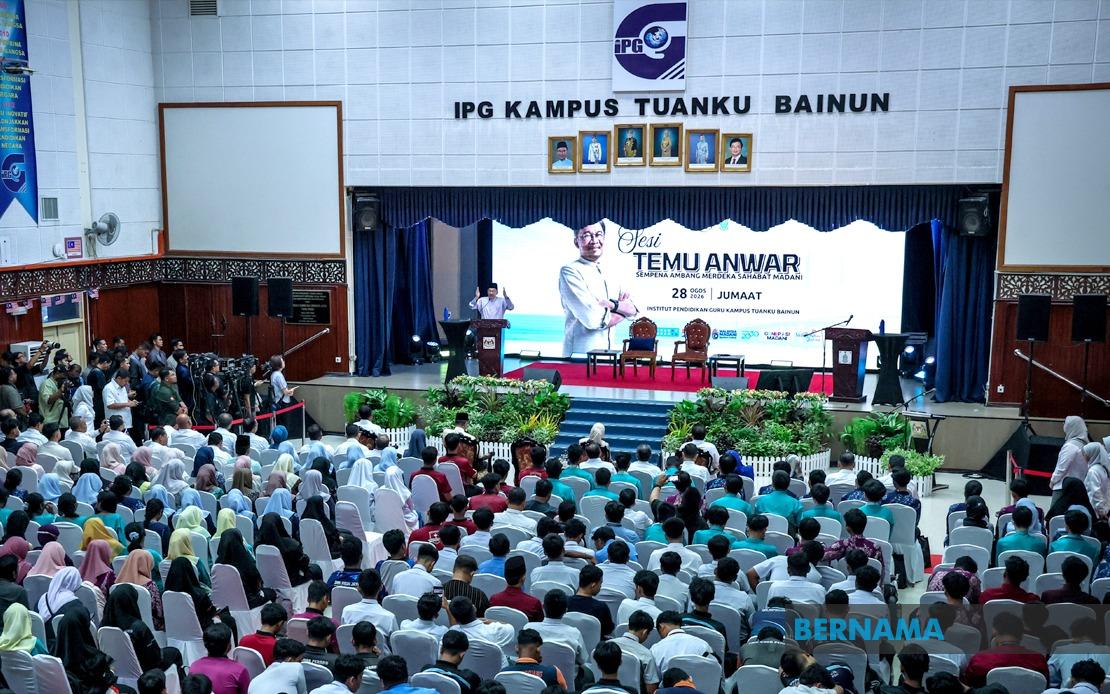
Prime Minister Datuk Seri Anwar Ibrahim has announced that the repeal of the Universities and University Colleges Act 1971 (AUKU) represents a deliberate policy shift aimed at granting Malaysian university students considerably greater latitude in expressing their viewpoints. Speaking at a Temu Anwar session in Bukit Mertajam attended by Education Minister Datuk Seri Fadhlina Sidek, the Prime Minister emphasised that removing these longstanding restrictions will create conditions for young people to cultivate creativity, independent judgment, and the capacity for rigorous analytical thinking.
The 1971 Act has long constrained student activism and political engagement on Malaysian campuses, representing a regulatory framework imposed during a different political era. Anwar's rationale for dismantling these controls centres on a fundamental demographic and civic argument: young Malaysians who reach the age of 18 possess the constitutional right to vote in elections and thereby participate in democratic processes, yet have simultaneously been denied the ability to freely articulate their political perspectives and engage in campus-based discourse without legal jeopardy.
This philosophical position reflects Anwar's broader conception of how universities should function within a democratic society. Rather than viewing student activism as inherently destabilising, he characterises open debate and divergent opinions as essential mechanisms through which intellectual development occurs. The Prime Minister acknowledged that students' expressed views will not invariably prove accurate or wise, but contended that the process of articulating, defending, and being challenged on those ideas constitutes a crucial educational experience that cannot be replicated in classroom settings alone.
The AUKU repeal carries significant implications for Malaysia's higher education sector and broader intellectual climate. For decades, the legislation has created a chilling effect on campus political organising, with students facing potential disciplinary action or legal consequences for participating in demonstrations, organising political discussion groups, or publicly advocating policy positions. By removing this legal framework, the government has essentially signalled that campuses should operate more as genuine marketplaces of ideas rather than controlled environments where only officially-sanctioned discourse occurs.
For Malaysian universities competing in global rankings and attempting to attract international academic talent and student populations, this policy shift addresses long-standing criticisms from international educational organisations concerning restrictions on academic freedom. Many established universities worldwide have demonstrated that fostering environments where students engage critically with contested issues—whether political, social, or economic—produces graduates with stronger analytical capabilities and greater capacity for independent reasoning.
The ramifications extend beyond the immediate university setting. Students who develop habits of careful argumentation, who learn to construct evidence-based cases for their positions, and who experience respectful intellectual disagreement with peers and faculty members, typically carry these habits into their professional and civic lives. This educational approach potentially strengthens Malaysia's capacity for evidence-based policymaking and informed public deliberation across all sectors of society.
However, the transition from a restrictive to permissive regulatory environment requires careful institutional management. Universities will need to establish clear guidelines distinguishing between protected forms of expression and conduct that genuinely threatens institutional functioning or individual safety. The challenge lies in creating frameworks that maximise opportunities for intellectual freedom while maintaining order and ensuring that campuses remain inclusive spaces where all students feel secure engaging with challenging ideas.
The policy also reflects recognition of generational shifts in political attitudes and educational philosophy. Younger Malaysians have grown up with unprecedented access to diverse information sources and global perspectives through digital platforms. Maintaining regulatory restrictions designed for a pre-internet era has become increasingly difficult to justify or enforce. Aligning official university policy with the information environment in which students actually operate represents a pragmatic acknowledgment of changing social conditions.
Education Ministry involvement in this transition suggests that the government is moving toward a coordinated approach rather than simply removing restrictions and hoping institutions adapt independently. Minister Fadhlina's presence at the Bukit Mertajam session indicates that the education portfolio is actively engaged in supporting this regulatory reform and presumably in developing implementation guidance for universities.
For regional observers, Malaysia's AUKU repeal represents a notable policy development within Southeast Asia's higher education landscape. The region encompasses countries with varying approaches to student activism and campus speech, from highly restrictive regimes to more permissive models. Malaysia's movement toward greater freedom may influence discussions elsewhere in the region regarding how universities can balance institutional stability with intellectual vitality.
The practical effectiveness of this reform will ultimately depend on how individual universities translate the legal repeal into institutional culture. Universities will need to encourage faculty members to engage thoughtfully with student perspectives, provide platforms for structured debate on controversial topics, and foster norms where disagreement is treated as intellectually productive rather than socially threatening. Without accompanying institutional changes, legal reform alone may prove insufficient to achieve the outcomes the Prime Minister envisions.
For students contemplating political engagement or considering whether to pursue further education in Malaysia, the AUKU repeal signals that campus participation in political discourse no longer carries automatic legal risk. This may prove particularly significant in encouraging students from disadvantaged backgrounds who might previously have avoided university politics from fear of jeopardising their future employment prospects. Broadening participation in campus intellectual and political life has potential to strengthen democratic culture and ensure that student movements represent more diverse segments of the population.
Looking forward, the success of this policy will be measured not merely by the absence of student arrests or disciplinary expulsions, but by whether Malaysian universities genuinely become spaces where intellectual challenge flourishes and where graduates emerge equipped with the critical thinking capacities that contemporary societies increasingly demand across professions and sectors.

