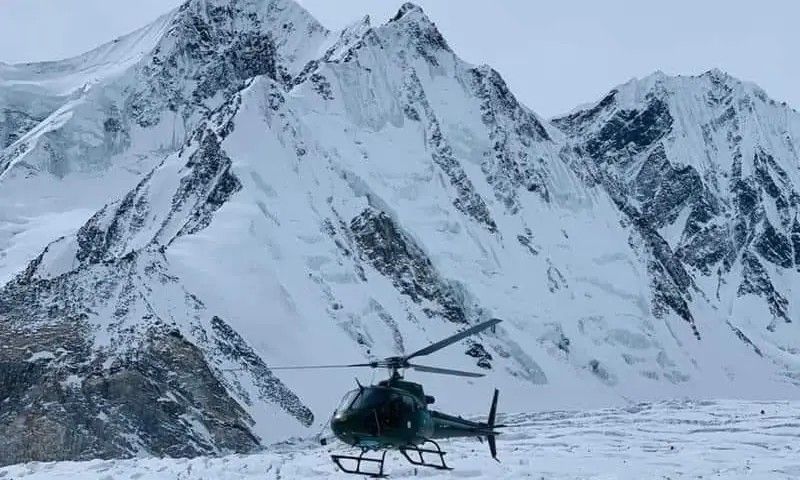
An avalanche on Broad Peak in Pakistan's Karakoram range has triggered an urgent search and rescue operation for ten mountaineers, among them Nirmal Purja, one of the world's most accomplished high-altitude climbers. The incident occurred on Thursday around midday when multiple expedition teams conducting a joint summit push were struck by the avalanche, which swept the climbers roughly a kilometre down the mountainside. Rescue efforts began immediately, with Pakistan Army Aviation deploying two helicopters equipped with specialised equipment and personnel to support ground operations coordinated from Gilgit.
The missing climbers represent a diverse international expedition. Six are from Nepal, including Purja alongside Pur Bahadur Gurung, Kili Pemba Sherpa, Nima Sherpa, Nawang Thindu Sherpa and Gyalu Sherpa. The remaining four hail from Pakistan, Oman, the United States and China—specifically Sohail Sakhi, Nadhira Ahmed Abdullah Al Harthy, Mallory Geis and Wang Zhong respectively. According to the Alpine Club of Pakistan, GPS signals from some of the missing mountaineers indicated they had been carried downslope and remain trapped, though their exact condition remains unclear pending helicopter access.
Nirmal Purja's disappearance has sent shockwaves through the global mountaineering community. The 43-year-old Nepali climber is renowned for extraordinary feats that have redefined what is considered possible at extreme altitude. Between April and October 2019, he summited all 14 of the world's "eight-thousanders"—peaks exceeding 8,000 metres—in just six months and six days, then a world record that demonstrated both exceptional physical capability and meticulous logistical planning. His achievement compressed what had previously taken others years into an unprecedented timeframe, making him a figure of genuine admiration among mountaineers globally.
Purja's mountaineering credentials extend beyond record-breaking timelines. A former member of Britain's Brigade of Gurkhas and the Special Boat Service of the Royal Marines, he brought military discipline and training to commercial high-altitude expeditions. In 2021, he led a team of ten Nepalese climbers to achieve the first winter ascent of K2, the world's second-highest mountain and widely considered the most technically difficult. These accomplishments have made him a mentor figure and ambassador for Nepali mountaineering on the international stage.
Sohail Sakhi, the Pakistani climber among the missing, represents the calibre of local talent on high-altitude mountains. Hailing from Hunza, a region historically renowned for producing exceptional mountaineers, Sakhi had recently summited Kanchenjunga in Nepal in May, the world's third-highest peak at 8,586 metres. What distinguishes his record is his specialisation in climbing without supplemental oxygen, a practice that significantly increases risk and requires exceptional physiological adaptation. He had previously ascended K2, Nanga Parbat, Gasherbrum I and Gasherbrum II without bottled oxygen, establishing himself among Pakistan's elite high-altitude mountaineers and demonstrating that technical capability on these mountains is not limited to foreign expeditions.
The Alpine Club of Pakistan's Senior Vice President Karrar Haidri stated that all available resources were being mobilised for the rescue operation, though weather conditions and operational constraints were complicating efforts. Helicopter-assisted rescue operations were expected to commence once visibility and wind conditions permitted safe flight at altitude. The statement emphasised constant coordination between the club's leadership, Pakistan Army Aviation, government authorities and relevant agencies, reflecting the complexity of high-altitude rescue in one of the world's most remote mountain ranges.
Gilgit-Baltistan Chief Minister Amjad Hussain Advocate directed all relevant departments to maintain high alert status and utilise every available resource to assist the mountaineers. He instructed district administration to keep aerial and ground rescue teams on standby despite adverse weather, ensuring immediate response should conditions improve. His directives underscore the political gravity of the incident and the determination of regional authorities to support rescue efforts, though the inherent dangers of high-altitude operations mean that successful outcomes remain uncertain regardless of resources deployed.
Alpine Club of Pakistan General Secretary Ayaz Shigri acknowledged that several local high-altitude porters may have also been caught in the avalanche, potentially expanding the number of people at risk. The involvement of support staff is typical on commercial expeditions but often receives less international attention than the climbers themselves. Rescue operations must account for all individuals on the mountain, complicating an already dangerous endeavour. Shigri's assessment that GPS data indicated climbers had been swept significant distances downhill suggested the avalanche possessed considerable force, raising concerns about injuries and survival prospects.
Broad Peak, standing at 8,051 metres, ranks as the world's twelfth-highest mountain and sits in the Karakoram range along the Pakistan-China border. While technically less demanding than K2 or Kangchenjunga, Broad Peak remains a serious alpine challenge where avalanches, falls and altitude-related illness claim lives regularly. The peak attracts experienced mountaineers and commercial expeditions, but hazards remain extreme. This incident serves as a sobering reminder that even climbers with remarkable track records and experienced teams remain vulnerable to the mountains' unforgiving nature.
The timing of the incident—occurring during what appears to be the climbing season—reflects the compressed windows when weather at extreme altitude permits safe summit attempts. Multiple teams conducting joint pushes suggests coordinated commercial expeditions seeking to maximise efficiency and share logistics costs. Such cooperation among operators is common but requires careful communication and planning to prevent overcrowding and maintain safety protocols. The avalanche's occurrence during these coordinated efforts raises questions about whether conditions or procedures contributed to the incident, though premature conclusions would be inappropriate given incomplete information.
For Malaysian and Southeast Asian readers, this incident underscores the risks inherent in high-altitude mountaineering and the international nature of modern climbing expeditions. The presence of mountaineers from Nepal, Pakistan, Oman, China and the United States demonstrates how these peaks attract talent globally. The disappearance of someone of Purja's calibre demonstrates that achievement and experience offer no guaranteed protection against mountain hazards. The ongoing rescue operation represents a test of international cooperation and Pakistan's capacity to coordinate complex emergency responses in remote terrain, with implications for how such crises are managed across Asia's mountain regions.

