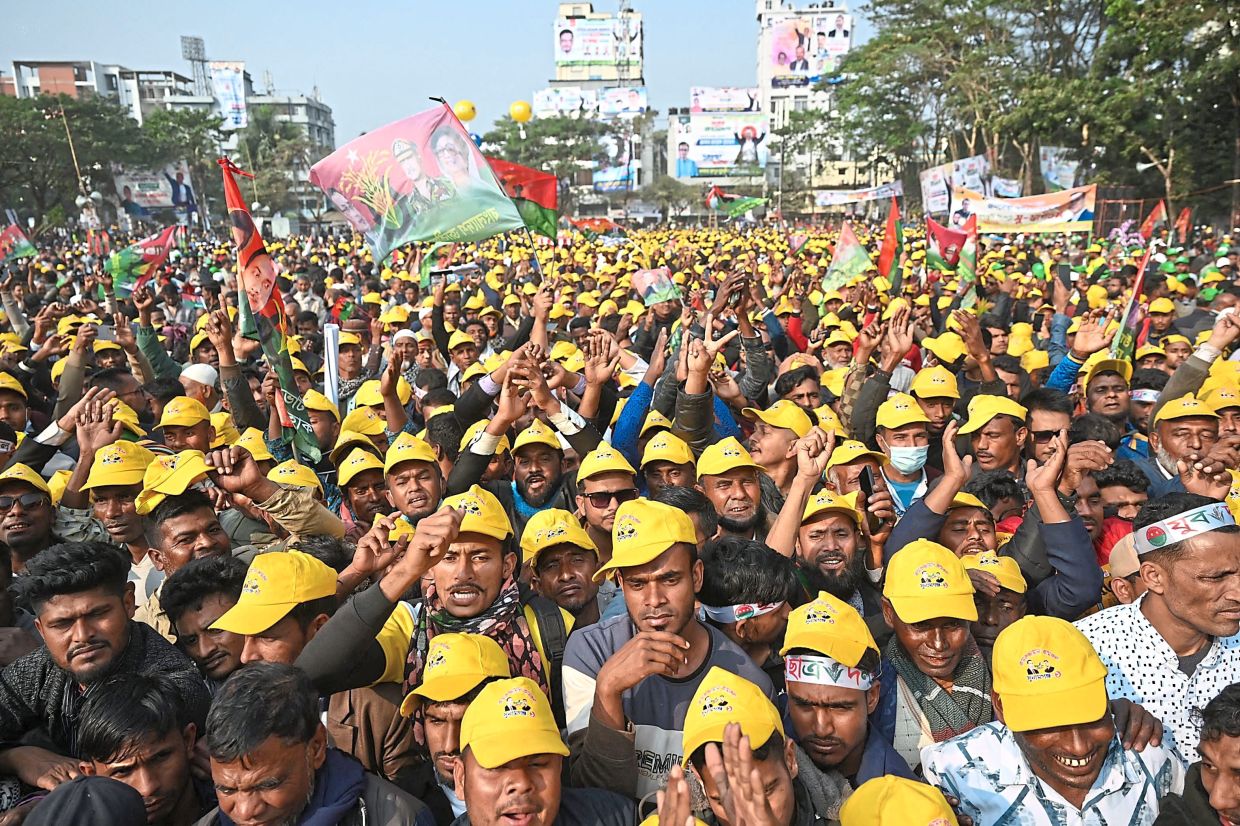
Bangladesh's parliament will elect a new president on Thursday, with Mirza Fakhrul Islam Alamgir, the 78-year-old secretary general of the ruling Bangladesh Nationalist Party, widely expected to secure the position unopposed in practical terms. The vote represents another step in the consolidation of power by Prime Minister Tarique Rahman's party since its commanding February election victory, which took place in the aftermath of a 2024 popular uprising that removed Sheikh Hasina from office.
Alamgir's expected ascendancy to the largely ceremonial five-year role comes at a pivotal moment for Bangladesh, a nation of 170 million people navigating the political aftermath of significant upheaval. Reflecting on the prospect of becoming the country's 23rd president, Alamgir told reporters on Tuesday that the development was unexpected, attributing it to his party's confidence and faith. He expressed a commitment to remaining engaged with ordinary citizens despite assuming the presidency, signalling continuity with the BNP's political messaging during its recent campaign period.
The presidential election itself will feature minimal competition. While the opposition 11-party alliance, led by the Jamaat-e-Islami group, has nominated Oli Ahmed as a challenger, the arithmetic heavily favours Alamgir's triumph. Voting is scheduled to commence at approximately 2pm local time, with the parliamentary proceedings likely concluded by evening. The formality of the vote underscores the BNP's current dominance within the legislature following its February landslide, which delivered the party an overwhelming mandate after years of political turbulence.
Alamgir's political credentials span decades of activism and public service. Born on 26 January 1948, he emerged as a significant student leader during the 1969 uprising that challenged Pakistan's military occupation, a movement that catalysed Bangladesh's independence struggle two years later. After completing university studies in economics at Dhaka University, where he had already become politically active, Alamgir pursued an academic career before transitioning into government service and electoral politics.
His ministerial portfolio expanded across multiple sectors throughout his career, encompassing agriculture, aviation, and tourism portfolios. However, his political prominence and popular recognition grew substantially during the Hasina era, when he served as a leading opposition figure. This period proved particularly consequential for Alamgir's political standing, as he maintained organisational control of the BNP during years when the party faced severe persecution. While BNP chairwoman Khaleda Zia was imprisoned and her son Rahman lived in foreign exile, Alamgir became instrumental in preserving party structures and sustaining political presence against government suppression.
Hasina's administration subjected Alamgir to repeated arrests and prosecutorial action, with charges that he consistently characterised as politically motivated harassment. The accumulation of dozens of cases against him reflected the broader pattern of authoritarian governance that eventually precipitated the 2024 uprising. Rights organisations had documented extensive abuses under Hasina, including extrajudicial killings, systematic suppression of opposition activities, institutional capture of the judiciary, and electoral manipulation. These documented violations contributed to the groundswell of public anger that ultimately forced Hasina from power.
The departure of Hasina, who now resides in India while avoiding domestic trial proceedings, represents a dramatic reversal of her previous political dominance. In November, a Bangladesh court convicted Hasina of crimes against humanity and imposed a death sentence, though her absence from the country prevents the sentence's enforcement. Her flight to India and refusal to participate in judicial proceedings underscore the totality of her political collapse and the BNP's contrasting electoral triumph.
Mohammed Shahabuddin, Alamgir's predecessor, vacated the presidency in July after serving since 2023. Shahabuddin, a 76-year-old who had been closely associated with Hasina's political interests, cited health reasons for stepping down, declining to complete the five-year term that would have extended until 2028. His departure cleared the path for the BNP-aligned candidate to assume the position, further consolidating the party's institutional control following electoral victory.
Alamgir's personal background reflects the trajectory of an earnest political operator who navigated Bangladesh's complex twentieth and twenty-first century history. He is married to Rahat Ara Begum, a retired financial sector official, and the couple has two daughters. His economic training and long involvement in policymaking positions distinguish him from purely ideological political operators, suggesting a technocratic dimension to his leadership approach alongside political commitment.
The presidential election carries significance for Malaysia and other Southeast Asian observers interested in understanding democratic transitions and institutional dynamics in the region. Bangladesh's experience demonstrates both the fragility of democratic institutions when concentrated executive power permits abuse, and the potential for electoral processes to reset political direction when public pressure becomes overwhelming. The BNP's consolidation of power following its electoral mandate raises questions about how the party will govern during its tenure, particularly concerning minority protections, press freedom, and judicial independence—matters of regional concern given Bangladesh's strategic importance and demographics.
Alamgir's assumption of the presidency, while largely ceremonial, will nonetheless symbolise the completion of Bangladesh's institutional transition from Hasina's ousted government to the BNP administration. His election will proceed with parliamentary approval, and he will assume office during a period of significant social and economic challenges facing the nation. How the BNP-led government navigates these pressures, and whether it can avoid repeating patterns of democratic backsliding that characterised Hasina's tenure, will substantially influence Bangladesh's political trajectory and regional stability across the coming years.

