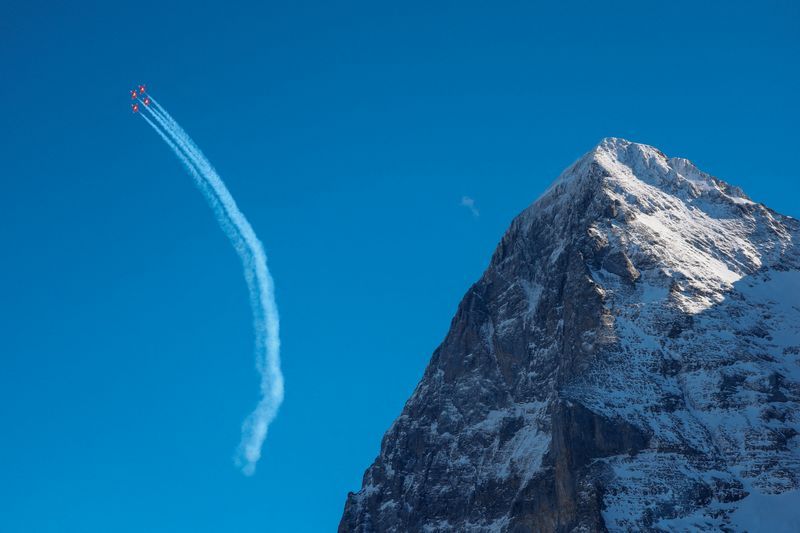
Fay Manners, a 39-year-old British alpinist, has etched her name into mountaineering history this summer by accomplishing what no British woman has done before: opening an entirely new climbing route on the formidable Eiger North Face in the Swiss Alps. Working alongside her Swiss partner Roger Schaeli over a gruelling 13 days, Manners established the "Solar Eclipse" route, a challenging 900-metre, 33-pitch ascent that demands to be noticed not merely as a feat of physical endurance but as a significant symbolic breakthrough in a sport long dominated by male climbers.
The Eiger North Face commands respect and fear in equal measure among mountaineers worldwide. Stretching 1,800 metres of near-vertical rock and ice, the wall is notoriously exposed to unpredictable Alpine weather and the constant threat of rockfall and avalanches. Its dark reputation was forged over decades of fatal attempts before a German-Austrian expedition finally succeeded in reaching the summit in 1938, an achievement that remains one of climbing's most celebrated milestones. Today, it remains one of Earth's most challenging and dangerous mountain walls, drawing climbers seeking to test themselves against nature's most unforgiving terrain.
Manners first experienced the Eiger four years ago when she climbed the well-established Heckmair Route, one of the mountain's classic lines. That expedition stirred something within her, prompting intensive research into the wall's geological features, weather patterns, and untouched sections. Rather than settling into the comfortable rhythm of repeating known climbs, she became consumed by the prospect of charting her own path through previously unclimbed rock. This ambition would eventually drive her return to the mountain with a singular purpose: not to follow in others' footsteps, but to forge something entirely new.
The distinction between repeating an established route and opening one cannot be overstated. When climbers tackle a known path, they carry the collective knowledge of those who came before: detailed guidebook descriptions, documented difficulty ratings, understood hazard locations, and proven protection placements. Opening a new route eliminates all such certainties. Manners confronted an expedition where success remained genuinely uncertain, where each pitch presented unknowns about difficulty, where decisions about safety anchors required judgment untested by previous ascents, and where the route itself might ultimately prove impossible to complete. This uncertainty demands not only superior technical skill but also psychological resilience and innovative problem-solving abilities that surpass what repetition demands.
Beyond the physical accomplishment, Manners recognises that her achievement carries profound significance for mountaineering culture. When aspiring climbers consult route guidebooks, they encounter a historical record in which virtually every route-opener is male. This cumulative absence of female names sends a powerful—though often unspoken—message about who "really" establishes routes in elite mountaineering, subtly reinforcing assumptions about women's place in the sport. Manners articulates this concern with clarity: having women actively engaged in the creative, pioneering work of route-opening is not merely about representation on a ledger; it fundamentally alters the narrative that future generations of female climbers inherit about what they can achieve.
Women have participated in Eiger climbing since at least 1964, when Japanese-American climber Daisy Voog became the first woman to successfully ascend the North Face—an accomplishment particularly notable given that her applications to join mountaineering clubs devoted to extreme climbing had been rejected solely on account of her gender. Five years later, Japanese mountaineer Michiko Imai stood as the sole woman among six team members establishing the "Japanese Summer Direttissima" route. Yet these accomplishments, while groundbreaking, represented women primarily as climbers within male-led expeditions rather than as autonomous pioneers defining new possibilities on the mountain.
Manners reflects on how subtle gendered assumptions become internalised throughout childhood and adolescence, shaping what people come to believe possible for themselves. Small moments—a parent carrying more weight because their daughter supposedly cannot bear as much, comments about capability gaps, unseen pressures to accommodate perceived limitations—accumulate into unconscious self-doubt. These barely perceptible social cues construct invisible boundaries that many women never think to question, simply accepting restrictions as natural law rather than recognising them as culturally constructed assumptions. Breaking through such internalised barriers requires not just individual boldness but also visibility of role models who have escaped their confines.
Manners' own journey to professional climbing illuminates how these assumptions operate across generations. Growing up in England surrounded by sport, she harboured genuine aspirations toward athletic careers. Yet those around her—parents, teachers, mentors—consistently steered her away from such dreams, arguing that women simply could not generate sufficient income or secure meaningful opportunities in sports. Accepting this guidance, she pursued data science and secured employment as a consultant, establishing conventional career stability. Even after relocating to Chamonix, France, while maintaining her data work, Manners continued compartmentalising climbing as a passion rather than a profession.
A critical turning point arrived when outdoor brand The North Face approached her about becoming a sponsored athlete. Initially, the arrangement permitted her to maintain both her consulting work and climbing activities in balance. Yet within approximately one year, she recognised that genuine professional opportunity in mountaineering was genuinely available, and she departed from her data career entirely to pursue climbing full-time. Remarkably, she emphasises that she only recognised such possibilities were attainable at the precise moment they were actively unfolding. Even as opportunity presented itself, her mind had been so thoroughly conditioned by the assumption that women could not sustain sports careers that she struggled to internalise her own changing reality.
Looking toward the future, Manners expresses intention to return to the Solar Eclipse route and witnesses its legacy unfold through other women's achievements. For her, success will ultimately be measured not by the route's difficulty rating in guidebooks but by observing all-female teams of climbers tackling the route, repeating what she and Schaeli established, and continuing the momentum toward gender parity in mountaineering's pioneering work. This aspiration points toward a climbing culture where women's presence among route-openers normalises female participation in the sport's most creative and challenging dimensions, gradually reconstructing the narratives that upcoming generations of climbers inherit about their own possibilities.

