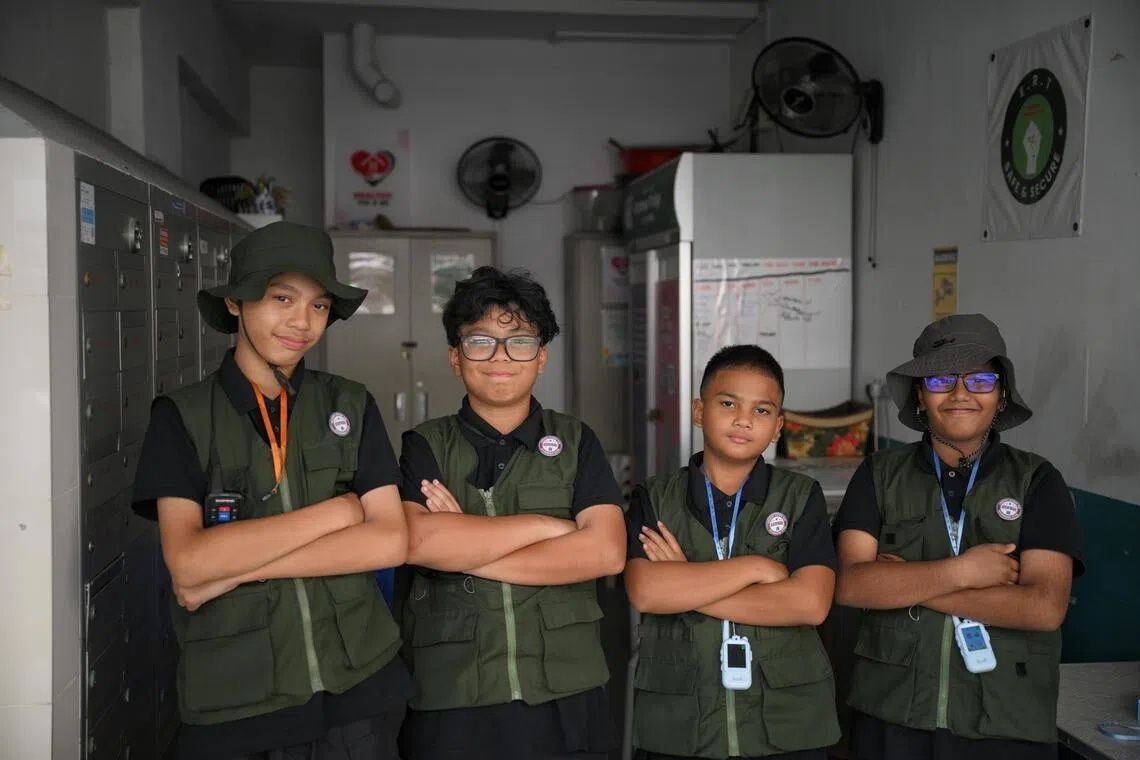
When 12-year-old Rafieq Sahin Rafizal noticed residents repeatedly depleting a community fridge stocked with free milk and drinks for disadvantaged children in the Lengkok Bahru neighbourhood, he was moved to take action. Rather than simply standing guard over the fridge—his initial instinct—his mother Marlina Yased encouraged a broader response. That decision spawned the Emergency Response Team LB, an unlikely but effective civilian patrol comprising four primary school students aged 11 to 14, now recognised as one of Singapore's most compelling grassroots community initiatives.
The patrol emerged from a genuine neighbourhood need. Lengkok Bahru, a residential estate in the western part of Singapore, faced recurring problems typical of dense public housing: illegal dumping of bulky items, vandalism, and fire hazards from improperly charged personal mobility devices in common areas. Rather than relying solely on official channels, Marlina proposed that her son and his friends document and report these issues systematically. The children, clad in matching vests bearing their names and team insignia, now venture out daily in pairs to cover up to six blocks of their estate after school, armed with mobile phones and walkie-talkies to maintain contact with Marlina and fellow volunteer Fahmidah Farihullah, a 21-year-old mentor who helps coordinate their activities.
Since launching their patrols in August 2025, the four youngsters have evolved beyond their initial mandate. They have assisted an elderly resident with mobility problems transport groceries home, intervened to resolve disputes between neighbourhood children, and reported maintenance issues that might otherwise have gone unnoticed. The work demands genuine commitment: patrol days are scheduled for one hour after school, replacing leisure time that most children their age would prioritise. Yet for Rafieq, Aaron Sarandev (11), Al-Mirza Danish (12), and Didie Andiqa Muhaimin (14), all students at Gan Eng Seng Primary School, the sacrifice has proven worthwhile in tangible and unexpected ways.
The patrol's most sobering discovery occurred earlier in 2026, when they detected an unusual odour emanating from a residential unit. Following protocol, they alerted Marlina, who informed estate maintenance staff while other residents simultaneously contacted police. The subsequent investigation revealed the decomposed remains of an elderly man who had likely passed away some time earlier. This incident underscores how neighbourhood vigilance by engaged residents—even young ones—can serve a genuine protective function in communities, particularly for isolated elderly persons who may lack regular contact with family or social services.
The origin of the patrol team reflects the broader community initiative that Marlina established in 2023. Concerned about food insecurity among lower-income families in her block, she launched a community fridge at the void deck of her two-room rental flat at Block 59 Lengkok Bahru. While the primary fridge is secured, a second unlocked unit contains milk and beverages available to neighbourhood children before school each morning. When she observed portions being consumed by adults rather than reserved exclusively for children, Marlina recognised an opportunity to redirect her son's impulse to guard the fridge into something more constructive: community service that would benefit all residents while teaching the boys valuable life lessons about civic responsibility.
Rafieq's choice of name for the unit—inspired by Singapore's Emergency Response Team, the police unit that handles high-risk incidents—reveals his aspirations and the seriousness with which he approaches the role. "We can play any time," the Primary 6 student explained, articulating a maturity unusual for his age. "But we want to spend one hour of our time every day to serve our community." His dedication resonates particularly when contrasted with societal concerns about youth engagement and screen time. Rather than seeking entertainment through passive consumption, these four have found meaning in active community participation.
Not all residents initially embraced the initiative. Scepticism about children conducting patrols is understandable; some questioned whether young teenagers possessed the judgment necessary for such responsibilities. However, community sentiment has shifted noticeably. Nasha Asrin, a 27-year-old mother of five living in Lengkok Bahru, expressed relief at witnessing the boys channelling their energy into neighbourhood improvement rather than idle loitering. The patrol has effectively transformed how some residents perceive youth involvement in their community, shifting the narrative from potential social problems to tangible civic contribution.
The personal growth experienced by patrol members extends beyond their official responsibilities. Aaron credits daily patrols with teaching him responsibility and perseverance, noting that he continues walking the neighbourhood even on days when motivation flags. Marlina has observed notable changes in several of the boys, with feedback from their mothers indicating improved school attendance and enhanced concentration during lessons. Such ancillary benefits—strengthened work ethic, improved academic engagement, and enhanced self-discipline—suggest that structured community service provides developmental benefits comparable to formal youth programmes.
The patrol has not remained static since its inception. Originally comprising seven members, the team now consists of four core volunteers, a natural consolidation that perhaps reflects the genuine demands of sustained commitment. The remaining members have demonstrated longevity precisely because they understand the work's purpose. Didie joined because he "had nothing to do" and welcomed meaningful engagement; his continued participation suggests that purposeful activity resonates with young people regardless of initial motivation.
Rafieq's observation that community service can coexist with childhood pleasures captures an important message for Malaysian readers observing Singapore's approach to youth civic engagement. The patrol members are not sacrificing their entire adolescence; they maintain normal friendships, complete homework, and enjoy recreational activities. Instead, they have simply allocated one hour daily to something beyond themselves. For a generation often characterised as self-absorbed or disconnected, their commitment offers a powerful counternarrative.
The invitation to participate in Singapore's National Day Parade represents the culmination of their efforts and public recognition of their contribution. Scheduled for August, the NDP performance will mark their first appearance in the annual celebration, which honours Singaporeans who strengthen their nation. Their inclusion in the parade segment celebrating community heroes underscores official acknowledgment that neighbourhood improvement need not depend on formal governance structures alone—engaged residents, even school-aged children, possess agency to enhance their environment.
For Southeast Asian communities grappling with similar challenges of public housing maintenance, community cohesion, and youth engagement, the Lengkok Bahru model offers instructive lessons. The patrol succeeds because it addresses genuine neighbourhood problems, involves young people meaningfully rather than tokenistically, maintains proper adult supervision and guidance, and operates within a framework of mutual responsibility between residents and youth. As Malaysian housing estates face comparable issues around common areas and community safety, the story of four primary school boys demonstrating that positive change emerges through committed, organised civic participation carries relevance extending well beyond Singapore's borders.

