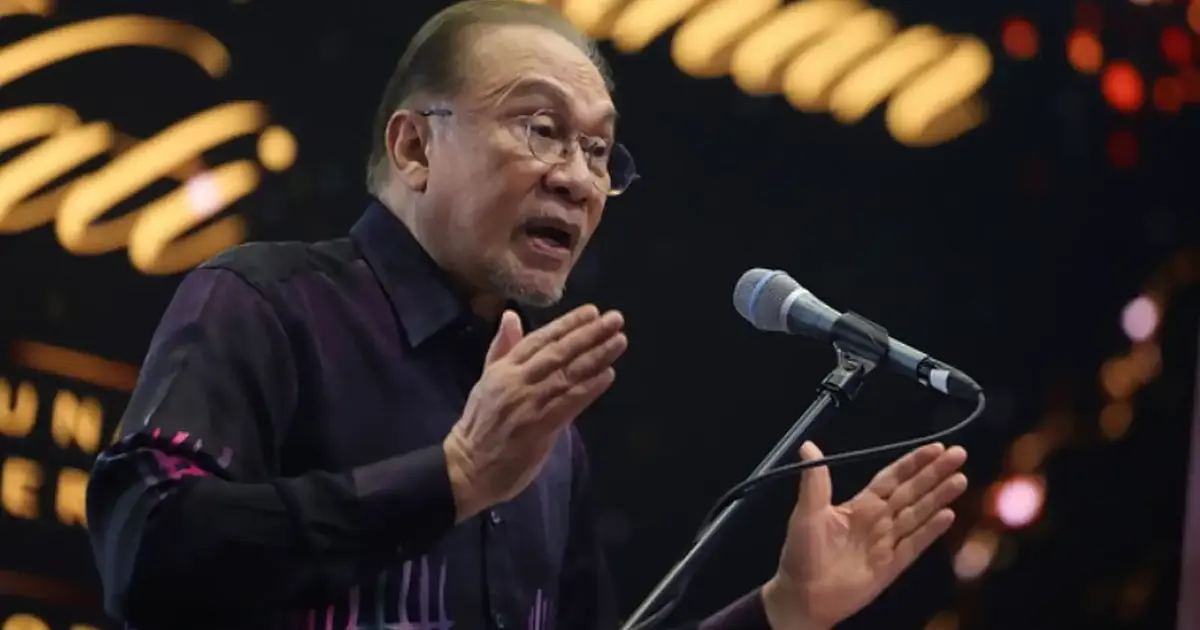
Prime Minister Anwar Ibrahim has made a direct appeal to Malaysians to transcend divisive messaging promoted by specific political figures, positioning the nation's multicultural fabric as a fundamental asset rather than a vulnerability. In his statement, Anwar emphasised that Malaysia's ability to sustain harmony across its diverse ethnic communities stands as one of its defining characteristics and competitive advantages on the global stage.
The intervention signals growing concerns within the federal government about the tenor of political discourse, particularly regarding ethnic and religious sensitivities that have historically triggered tensions in Malaysian society. By calling out the peddling of hate, Anwar appears to be addressing a pattern of rhetoric that analysts have observed gaining traction among certain opposition and fringe political actors in recent months, rhetoric that typically exploits communal anxieties for electoral advantage.
Malaysia's constitutional framework and historical social contract were explicitly designed to accommodate the country's three major ethnic communities—Malay-Muslims, Chinese, and Indians—alongside numerous indigenous groups and other minorities. This pluralistic arrangement has endured, despite periodic strains, for over seven decades since independence. Yet maintaining this balance requires constant reinforcement from political leaders, particularly when populist forces attempt to weaponise identity concerns for short-term political gain.
Anwar's emphasis on diversity as strength carries particular resonance given Malaysia's economic interdependencies across communities. Chinese-dominated businesses in commerce and trade, Indian representation in the professions and civil service, and Malay-Muslim dominance in administration and security sectors create a complex ecosystem where undermining community relations has immediate economic consequences. The Prime Minister's framing thus addresses both moral and pragmatic dimensions of national cohesion.
The timing of this statement reflects broader regional patterns in Southeast Asia, where authoritarian populism has sometimes weaponised ethnic and religious identity to consolidate power. Indonesia, Thailand, and the Philippines have all experienced cycles of communal tension exacerbated by political entrepreneurs. Malaysia, having navigated such episodes with relative success historically, faces renewed vigilance as global polarisation trends intersect with local vulnerabilities.
Anwar's government has sought to position itself as defender of constitutional secularism and institutional pluralism, distinguishing itself from predecessors perceived as tolerating or even encouraging communal polarisation. This stance carries risks, as it potentially alienates Malay-Muslim constituencies who may perceive their interests as subordinated. Yet the Prime Minister appears willing to stake political capital on the argument that inclusive governance ultimately serves majority interests better than zero-sum ethnic competition.
The phenomenon of hate peddling through digital channels has complicated the traditional mechanisms through which Malaysian society managed ethnic relations. Social media algorithms amplify divisive content, reaching younger voters with less lived experience of intercommunal violence or earlier cycles of tension resolution. Political leaders must therefore articulate counterspeech more actively than previous generations required. Anwar's statement represents this necessary adaptation to contemporary communication ecology.
For investors and trading partners evaluating Malaysia's stability, such affirmations carry weight. Foreign direct investment decisions frequently factor social stability into risk assessments. When senior political leadership explicitly rejects divisive rhetoric, it sends reassuring signals to markets concerned about potential instability. Conversely, normalisation of hate speech would signal weakening institutional capacity to manage conflict, potentially driving capital flows toward jurisdictions perceived as more stable.
The challenge ahead for Anwar's administration involves translating rhetorical commitment to pluralism into concrete policy outcomes that demonstrably benefit all communities. Affirmative rhetoric without corresponding resource allocation, institutional reform, or tangible improvements in equity across ethnic lines risks appearing hollow, potentially creating space for rival politicians to exploit perceptions of unfairness. This dynamic has historically underpinned cycles of ethnic tension in Malaysia.
Opposition responses to Anwar's statement will likely reveal whether there exists any political consensus on the value of harmony, or whether certain actors remain committed to exploiting communal divisions. The absence of unified rejection of hate rhetoric from major opposition voices would suggest a more fragmented political landscape where ethnic competition has become systemically embedded, complicating the Prime Minister's unifying project.
Regionally, Anwar's stance aligns Malaysia with moderate forces across Southeast Asia resisting the hardening of ethno-nationalist politics. Coordinated messaging emphasising pluralism and constitutional governance, particularly among ASEAN nations, could collectively strengthen resistance to communal polarisation. Yet such regional solidarity remains inchoate, leaving individual nations to manage pressures somewhat in isolation.
Ultimately, sustaining Malaysia's multiethnic society requires continuous reaffirmation from political leaders that diversity constitutes strength rather than threat. Anwar's intervention represents necessary but insufficient effort—the real test lies in whether voters consistently reject politicians who peddle division, and whether institutional frameworks prove robust enough to contain pressures from those seeking to exploit identity anxieties for political advancement.