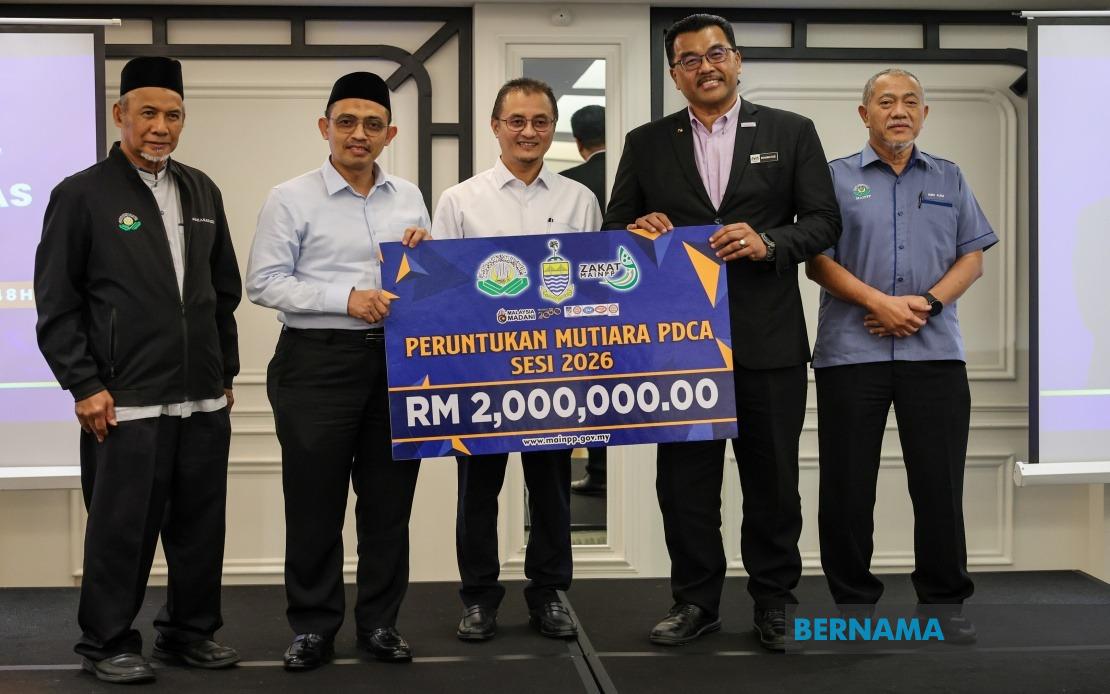
The Penang State Islamic Religious Council (MAINPP) is channelling RM2 million into its Mutiara Didik Cemerlang Akademik (MPDCA) Programme this year, extending educational support to 7,403 Bumiputera pupils and students across Penang. The initiative represents a sustained commitment to nurturing academic excellence among disadvantaged Bumiputera communities through targeted intervention and structured learning support.
Penang Deputy Chief Minister I Datuk Dr Mohamad Abdul Hamid, who announced the allocation at a coordinating teachers' briefing in Kepala Batas, emphasised that the funds would support a comprehensive range of educational interventions. These include organised tuition classes, systematically developed learning modules, academic seminars, and specialised workshops designed to equip students with effective examination techniques. The multipronged approach reflects recognition that academic improvement requires more than classroom instruction alone.
The MPDCA initiative has evolved substantially since its inception in 2006 as a collaborative enterprise involving multiple government agencies. Today it operates as a joint venture between MAINPP, the Penang State Education Department (JPNPP), the Penang Bumiputera Participation Coordination Division under the Prime Minister's Department Implementation Coordination Unit, and the Penang Regional Development Authority (PERDA). This institutional arrangement demonstrates the complexity of delivering targeted educational support across disparate school systems and administrative levels.
For the 2026 cycle, the programme mobilises 698 coordinating teachers deployed across 71 primary schools and 38 secondary schools, indicating substantial operational infrastructure. The scale of teacher involvement suggests that MPDCA functions as more than a supplementary tuition service; rather, it appears integrated into school-based support structures, with teachers assuming formal coordinating responsibilities within their institutions. This embeds the programme into existing pedagogical networks rather than treating it as an external intervention.
The curriculum focus demonstrates careful targeting of foundational competencies. For Year Six pupils preparing for primary assessment, the programme concentrates on four core subjects: Bahasa Melayu, English, Mathematics and Science. This reflects policy prioritisation of vernacular competency alongside critical STEM and English language capabilities. For students undertaking the Sijil Pelajaran Malaysia (SPM) examination, the programme expands to thirteen subjects, encompassing core academic disciplines alongside Arabic and curriculum subjects specific to government-aided religious schools, including Dini-Lughatul Arabiyyah Mu'asirah, Dini-As Syariah and Dini-Usuluddin.
Quantifiable evidence of MPDCA's effectiveness shapes continued institutional investment. Data compiled by JPNPP demonstrates that the programme has contributed meaningfully to improved academic performance and achievement trajectories among participating students since 2006. This longitudinal validation has enabled programme architects to justify successive annual allocations and expanded participation numbers, breaking the cycle where unproven initiatives struggle to secure ongoing funding.
The RM2 million MPDCA commitment exists within a broader ecosystem of MAINPP educational expenditure. The council has additionally allocated RM22.36 million for Higher Education Bursaries, RM6.3 million for the Permulaan IPT Scheme supporting initial polytechnic education, RM3 million for Early Schooling Aid, and RM3 million for School Uniform Aid during 2026. Aggregating these figures reveals total MAINPP educational spending exceeding RM36 million, positioning educational advancement as a central institutional priority. This comprehensive approach addresses educational barriers across the lifecycle, from early childhood through tertiary education.
Teacher testimonies provide granular insight into how the programme functions within school environments. Hartina Arjan, a Bahasa Melayu instructor at Sekolah Kebangsaan Permai Indah in Bukit Minyak, notes that MPDCA's systematically developed learning modules have enhanced student subject mastery whilst maintaining free accessibility across different academic ability levels. She emphasises that the programme's structured focus on foundational competencies in speaking, reading and writing creates stronger preparation for both classroom-based assessment and formal examinations.
Teacher perspectives reveal particular benefits for economically disadvantaged cohorts. Sadiah Roslan, teaching at Sekolah Rendah Islam Al-Masriyah Halimatun in Bukit Mertajam, observes that the programme has proven especially valuable for students from low-income families unable to afford commercial private tuition services. By providing structured academic support at no cost, MPDCA effectively removes financial barriers that would otherwise restrict educational opportunity to families with disposable income.
Pedagogical innovation within the programme has evolved to align with contemporary teaching approaches. Updated learning modules now incorporate interactive quiz-based activities designed to heighten student engagement and encourage classroom participation. This methodological adaptation acknowledges that passive receptive learning proves less effective than active, competitive learning formats, particularly for younger students. The deliberate integration of gamified elements demonstrates pedagogical sophistication beyond simple remedial tutoring.
For Malaysian policymakers and Southeast Asian education administrators, the MPDCA model presents valuable insights into sustaining targeted programmes that address equity gaps. Institutional stability—demonstrated through twenty years of continuous operation and progressive expansion—depends on establishing measurable impact metrics that justify persistent funding claims. The programme's longevity reflects both political commitment from state leadership and accumulated evidence of academic benefit.
As Malaysia grapples with persistent achievement disparities between different socioeconomic cohorts, initiatives like MPDCA demonstrate feasible policy responses at state level. The programme's integration within existing school structures, rather than operation as a disconnected external service, enhances sustainability and teacher buy-in. Regional governments throughout Southeast Asia facing similar equity challenges might examine how Penang's institutional architecture creates mutually reinforcing support systems spanning early childhood through higher education.

