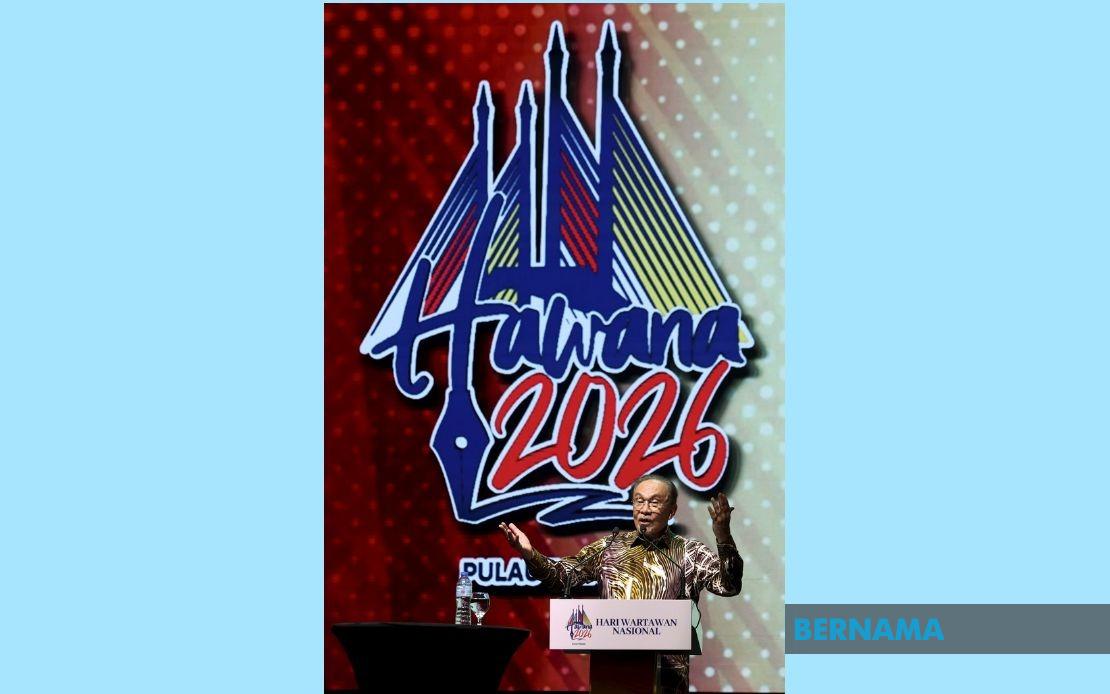
Prime Minister Datuk Seri Anwar Ibrahim has committed an additional RM1 million to the Tabung Kasih@HAWANA, a welfare assistance programme designed to support media practitioners across Malaysia. The announcement came during his address at the National Journalists' Day (HAWANA) 2026 main event held at PICCA Convention Centre@Butterworth Arena in Butterworth on June 20, where Anwar, who also holds the Finance Minister portfolio, underscored the government's deepening commitment to safeguarding the livelihoods of those working in the news industry.
The augmented funding represents a significant injection into a scheme that has already demonstrated measurable impact within Malaysia's media fraternity. Since the Tabung Kasih@HAWANA was established in 2023 to coincide with that year's HAWANA celebration, the programme has channelled assistance to 773 media practitioners nationwide, distributing RM2.26 million collectively. With the fresh allocation for 2026, the total available resources will reach RM3.26 million, substantially expanding the financial capacity of the fund to address pressing needs within the profession.
The welfare fund addresses multiple dimensions of hardship faced by journalists and media workers. Beyond emergency cash assistance, the scheme covers medical expenses for practitioners facing health crises, extends family welfare support during periods of economic distress, and provides other tailored forms of assistance determined on a case-by-case basis. This comprehensive architecture reflects official recognition that media professionals encounter vulnerabilities spanning employment disruptions, occupational hazards, and unforeseen personal circumstances that can precipitate financial emergencies.
The decision to boost funding coincides with broader strategic messaging about media's role in society. The HAWANA 2026 gathering, which drew more than 1,000 media practitioners from Malaysia and neighbouring countries including Timor-Leste, Cambodia, and Laos, operated under the thematic umbrella "Media Integrity Strengthens Credibility." This framing signals government perspective that a professionally secure and supported media workforce represents a stabilising force in democratic discourse and public information dissemination, particularly as regional countries navigate complex information environments and challenges to journalistic independence.
The event's attendance demonstrated high-level governmental prioritisation of media sector engagement. Alongside Prime Minister Anwar, the gathering included Penang Chief Minister Chow Kon Yeow and Communications Minister Datuk Fahmi Fadzil, signalling cross-level political investment in the occasion. Senior officials from the Communications Ministry, including secretary-general Datuk Abdul Halim Hamzah and deputy secretary-general Datuk Bahria Mohd Tamil (Strategic Communications and Creative Industry), further underscored institutional commitment to the media welfare agenda.
The programme's administration remains anchored within Malaysia's news establishment itself. Malaysian National News Agency Bernama, the state news organisation, provides institutional stewardship through its chairman Datuk Seri Wong Chun Wai and chief executive officer Datin Paduka Nur-ul Afida Kamaludin, who chairs the HAWANA 2026 Working Committee. This institutional positioning ensures that fund management reflects intimate understanding of practitioners' actual circumstances and professional culture, though it also raises questions about how independent oversight mechanisms function alongside Bernama's ownership by government interests.
For Malaysian journalists and media workers, the fund operates as a critical safety net within an industry facing substantial economic pressures. The traditional business models sustaining news organisations have undergone sustained erosion across Southeast Asia, driven by digital disruption, advertising migration to social platforms, and shifting consumption patterns. In this context, government-supported welfare mechanisms represent one policy response to professional vulnerability, though questions persist regarding whether supplementary income assistance adequately addresses underlying structural challenges confronting the media sector.
The regional dimension of HAWANA 2026 also merits attention. The gathering's attraction of significant delegations from Timor-Leste, Cambodia, and Laos suggests Malaysia positions itself as a convening centre for Southeast Asian media discourse and professional development. This positioning carries implications for regional media cooperation, professional standard-setting, and the exchange of practices among journalists operating under varied governmental relationships and press freedom environments across the region.
The RM1 million incremental allocation reflects incremental policy incrementalism rather than comprehensive restructuring of media support frameworks. While the fund addresses genuine practitioner needs, observers note that its scale remains modest relative to the broader challenges facing news organisations and journalism employment across Malaysia. The announcement thus functions simultaneously as substantive welfare intervention and symbolic gesture affirming governmental concern for a profession often characterised as watchdog of institutional accountability, creating complex dynamics as media practitioners navigate the tension between occupational independence and reliance on state-administered welfare provisions.
Looking forward, the sustainability and expansion trajectory of Tabung Kasih@HAWANA will merit monitoring. Whether future administrations sustain annual funding commitments, whether allocation levels adjust to reflect inflation and expanding needs, and whether complementary policies emerge to address structural media industry challenges remain open questions shaping the profession's medium-term viability and practitioners' economic security.
%22%2F%3E%3C%2Fpattern%3E%3C%2Fdefs%3E%3Crect%20width%3D%22100%25%22%20height%3D%22100%25%22%20fill%3D%22url(%23ph216jxg)%22%2F%3E%3Crect%20width%3D%22100%25%22%20height%3D%22100%25%22%20fill%3D%22url(%23ph216jxp)%22%2F%3E%3Ctext%20x%3D%2250%25%22%20y%3D%2250%25%22%20text-anchor%3D%22middle%22%20dominant-baseline%3D%22central%22%20fill%3D%22rgba(255%2C255%2C255%2C0.95)%22%20font-family%3D%22Georgia%2C%20'Times%20New%20Roman'%2C%20serif%22%20font-weight%3D%22700%22%20font-size%3D%22170%22%20letter-spacing%3D%22-0.02em%22%3EMalaysia%3C%2Ftext%3E%3C%2Fsvg%3E)
%22%2F%3E%3C%2Fpattern%3E%3C%2Fdefs%3E%3Crect%20width%3D%22100%25%22%20height%3D%22100%25%22%20fill%3D%22url(%23ph1jlcmg)%22%2F%3E%3Crect%20width%3D%22100%25%22%20height%3D%22100%25%22%20fill%3D%22url(%23ph1jlcmp)%22%2F%3E%3Ctext%20x%3D%2250%25%22%20y%3D%2250%25%22%20text-anchor%3D%22middle%22%20dominant-baseline%3D%22central%22%20fill%3D%22rgba(255%2C255%2C255%2C0.95)%22%20font-family%3D%22Georgia%2C%20'Times%20New%20Roman'%2C%20serif%22%20font-weight%3D%22700%22%20font-size%3D%22320%22%20letter-spacing%3D%22-0.02em%22%3ETV3%3C%2Ftext%3E%3C%2Fsvg%3E)