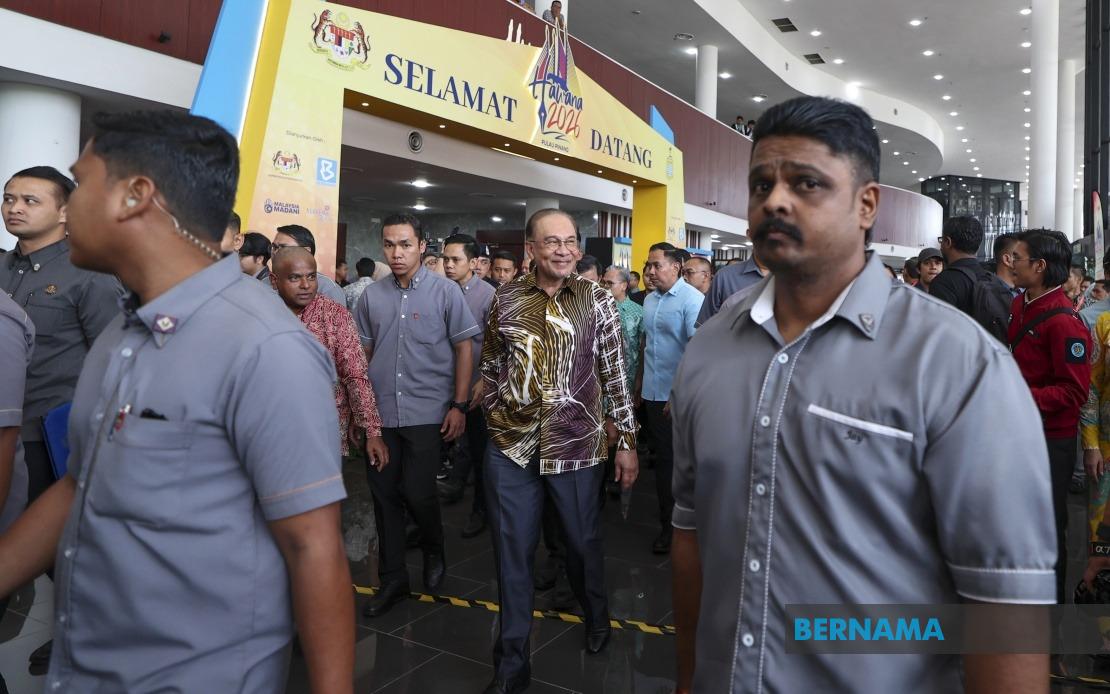
Prime Minister Datuk Seri Anwar Ibrahim arrived at the PICCA Convention Centre @ Butterworth Arena on Thursday afternoon to officiate the main celebration of the National Journalists' Day (HAWANA) 2026, marking a significant occasion for Malaysia's media fraternity and reinforcing the government's commitment to press freedom and journalistic excellence in the region.
Anwar, who arrived at 2.40 pm, was formally received by Penang Chief Minister Chow Kon Yeow, Communications Minister Datuk Fahmi Fadzil, and Communications Ministry secretary-general Datuk Abdul Halim Hamzah. The Prime Minister took time to tour exhibition booths and a dedicated HAWANA 2026 Photo Gallery positioned in the venue's entrance foyer, demonstrating his engagement with the thematic elements of the day-long gathering and his accessibility to participating journalists and media organisations.
The event drew an impressive delegation of ASEAN representatives, underscoring the regional significance of Malaysia's flagship media celebration. Timor-Leste sent Secretary of State for Social Communication Expedito Loro Dias Ximenes, while Cambodia's Ministry of Information was represented by Undersecretary of State Prak Thaveak Amida. Laos contributed Phuangpasert Keosouvanh, Permanent Secretary of the Cabinet Office within its Ministry of Technology and Communications. The presence of these high-ranking officials from neighbouring nations demonstrates the HAWANA forum's evolving role as a platform for fostering media cooperation and professional standards throughout Southeast Asia, particularly among developing democracies navigating complex information landscapes.
Notably, Timor-Leste's national news agency, Agencia Noticiosa de Timor-Leste (TATOLI), sent both its president Noemio Mateus Soares Falcao and deputy president Madalena DE JCP Carlos, signalling the importance placed on this bilateral media exchange. The gathering also attracted international observers and participants from Indonesia's Antara News Agency, the Vietnam News Agency (VNA), China's Xinhua News Agency, Indonesia's journalists association PWI, and the Malaysia-Indonesia journalists solidarity group ISWAMI, creating a diverse milieu of media professionals engaged in knowledge-sharing and professional development.
Organised jointly by the Communications Ministry and the Malaysian National News Agency (Bernama), the event convened approximately 1,000 media practitioners, positioning HAWANA 2026 as one of the region's largest professional gatherings of journalists and media leaders. This year's theme, 'Media Integrity Strengthens Credibility', reflects growing global concerns about information reliability and the erosion of public trust in news institutions—challenges that resonate acutely across Malaysia and Southeast Asia, where rapid digitalisation and the proliferation of social media have complicated the media landscape significantly.
During the ceremony, the Prime Minister was scheduled to present the prestigious HAWANA Award and Special HAWANA Award to individuals whose contributions to journalism have materially advanced the profession and enriched public discourse. These accolades represent the highest recognition bestowed by Malaysia's media community, honouring journalists and news professionals who have demonstrated exceptional integrity, courage in reporting, and commitment to factual accuracy under sometimes challenging circumstances. The presentation of these awards carries symbolic weight, affirming governmental support for independent journalism while publicly acknowledging the sacrifices and dedication of media professionals.
The Prime Minister also participated in distributing contributions from the Kasih@HAWANA Fund to veteran media professionals facing hardship or financial difficulty. This charitable component of the celebration underscores the mutual responsibility felt within Malaysia's media ecosystem to support colleagues throughout their careers and retirement years. Such initiatives, while modest in scale, strengthen professional solidarity and reinforce the notion that journalism is a collective endeavour with obligations to those who have contributed substantially to the field.
The HAWANA platform holds particular significance for Malaysia in the broader context of regional media development and democratic governance. As Southeast Asian nations grapple with disinformation, foreign interference in information spaces, and the commercialisation of news, forums like this provide essential opportunities for practitioners across borders to exchange best practices, discuss ethical standards, and collectively advocate for the professional independence necessary to maintain journalism's watchdog function. The gathering's international dimension signals that media integrity is not merely a national concern but a shared regional commitment.
Bernama, as the implementing agency and Malaysia's national news organisation, has positioned itself at the forefront of this advocacy, leveraging HAWANA as a vehicle to advance professional standards and celebrate journalistic achievement. The agency's leadership, including chairman Datuk Seri Wong Chun Wai, CEO Datin Paduka Nur-ul Afida Kamaludin, and editor-in-chief Arul Rajoo Durar Raj, played central roles in orchestrating the event and managing the HAWANA 2026 Working Committee's operations throughout the planning process.
For Malaysian readers and the broader Southeast Asian media community, HAWANA 2026 represents a reaffirmation of journalism's essential role in democratic societies and development initiatives. By bringing together practitioners from multiple nations and backgrounds, the celebration provides a counterweight to parochialism in media narratives and encourages regional perspectives on shared challenges. The thematic emphasis on integrity and credibility arrives at a crucial moment when public confidence in news institutions has declined measurably across many democracies, including Malaysia, making the collective recommitment to professional standards both timely and necessary.
The event's success in attracting high-level political participation and regional representation suggests that Southeast Asian governments increasingly recognise journalism's importance to stability and development. However, the gathering also implicitly raises questions about the operating environment for journalists across the region, the extent of editorial independence in practice, and whether official support for professional media ideals translates into substantive protections for investigative reporting and critical scrutiny of power. These tensions, while not explicitly addressed at ceremonial events, remain central to discussions within the broader HAWANA forum and its working committees.
%22%2F%3E%3C%2Fpattern%3E%3C%2Fdefs%3E%3Crect%20width%3D%22100%25%22%20height%3D%22100%25%22%20fill%3D%22url(%23ph216jxg)%22%2F%3E%3Crect%20width%3D%22100%25%22%20height%3D%22100%25%22%20fill%3D%22url(%23ph216jxp)%22%2F%3E%3Ctext%20x%3D%2250%25%22%20y%3D%2250%25%22%20text-anchor%3D%22middle%22%20dominant-baseline%3D%22central%22%20fill%3D%22rgba(255%2C255%2C255%2C0.95)%22%20font-family%3D%22Georgia%2C%20'Times%20New%20Roman'%2C%20serif%22%20font-weight%3D%22700%22%20font-size%3D%22170%22%20letter-spacing%3D%22-0.02em%22%3EMalaysia%3C%2Ftext%3E%3C%2Fsvg%3E)
%22%2F%3E%3C%2Fpattern%3E%3C%2Fdefs%3E%3Crect%20width%3D%22100%25%22%20height%3D%22100%25%22%20fill%3D%22url(%23ph1jlcmg)%22%2F%3E%3Crect%20width%3D%22100%25%22%20height%3D%22100%25%22%20fill%3D%22url(%23ph1jlcmp)%22%2F%3E%3Ctext%20x%3D%2250%25%22%20y%3D%2250%25%22%20text-anchor%3D%22middle%22%20dominant-baseline%3D%22central%22%20fill%3D%22rgba(255%2C255%2C255%2C0.95)%22%20font-family%3D%22Georgia%2C%20'Times%20New%20Roman'%2C%20serif%22%20font-weight%3D%22700%22%20font-size%3D%22320%22%20letter-spacing%3D%22-0.02em%22%3ETV3%3C%2Ftext%3E%3C%2Fsvg%3E)