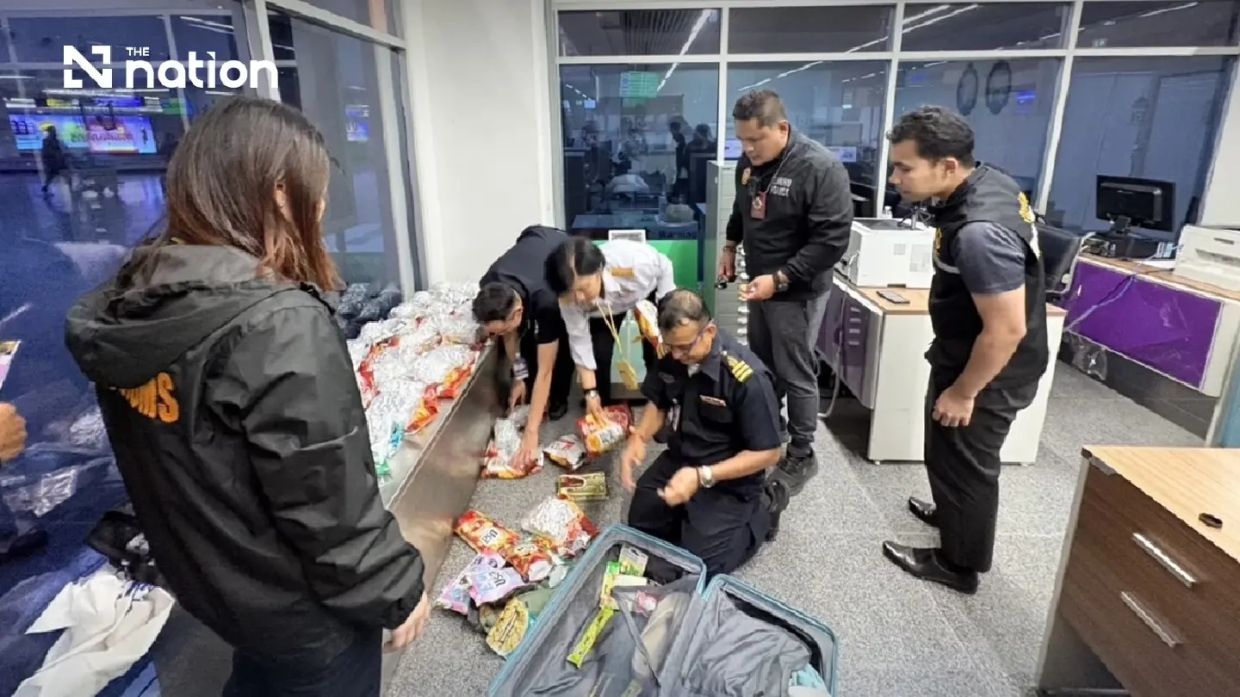
A 30-year-old Russian national has been taken into custody at Phuket International Airport following the discovery of substantial quantities of cannabis concealed in his luggage during a routine customs inspection on Wednesday. The arrest marks another significant drug trafficking case at one of Thailand's busiest international gateways, underscoring ongoing concerns about organised smuggling operations targeting Southeast Asian transit hubs.
The incident occurred inside the international departure terminal when customs officers led by chief Nucha Jeeradit intercepted two blue BP WORLD wheeled suitcases belonging to Sergei Chalabari. The suitcases, which together weighed eight kilogrammes, drew the attention of customs inspector Rawin Kanokakorn during the standard pre-departure screening process conducted at Mai Khao subdistrict in Thalang district.
A thorough examination of the luggage revealed the extent of the contraband operation. Officers discovered 35 vacuum-sealed packages containing cannabis flowers totalling 11.4 kilogrammes, alongside 12 additional packages of cannabis resin weighing 6.2 kilogrammes in aggregate. The methodical concealment across multiple packages suggests a degree of planning, though ultimately unsuccessful in evading detection. The discovery represents a substantial drug haul that could have reached international markets had the smuggling attempt succeeded.
Upon interrogation, Chalabari provided initial cooperation with authorities, acknowledging ownership of both the suitcases and the confiscated narcotics. This admission to investigators at Sakhu Police Station significantly simplified the evidentiary foundation for prosecution. He now faces charges related to attempting to export controlled substances without complying with customs procedures—a serious offence under Thai law carrying substantial penalties.
The apprehension reflects the effectiveness of Thailand's customs enforcement mechanisms at international airports, where trained personnel conduct systematic baggage screening. Phuket International Airport, serving millions of tourists and transit passengers annually, remains a critical checkpoint in Thailand's broader counter-narcotics strategy. The efficiency demonstrated by the inter-agency operation, coordinated between customs authorities and the Royal Thai Police, highlights institutional capacity to intercept major trafficking attempts.
From a regional perspective, such incidents illustrate the persistent vulnerability of Southeast Asian aviation infrastructure to organised drug trafficking networks. Russian and Eastern European nationals have featured prominently in several high-profile cannabis and synthetic drug cases across Thailand and the wider region in recent years, suggesting potential involvement of transnational criminal organisations. The sophistication of vacuum-sealed packaging and multi-package distribution indicates professional smuggling methodology rather than opportunistic trafficking.
Thailand's counter-narcotics framework has intensified scrutiny at airports and border crossings following government directives to combat drug trafficking. The seizure at Phuket exemplifies how intelligence-led approaches and technological capability in screening luggage continue to disrupt supply chains attempting to exploit Southeast Asia as a transit corridor. However, enforcement officers acknowledge that such seizures represent only a fraction of trafficking attempts, with detection rates varying significantly depending on timing, resources, and operational intelligence.
The legal proceedings that Chalabari now faces under Thai jurisdiction carry potentially severe consequences. Convicted offenders typically face imprisonment sentences ranging from five to fifteen years, depending on circumstances and aggravating factors. Rehabilitation programmes exist within Thai penal institutions, though foreign nationals often serve sentences before facing deportation upon release.
This case carries implications for travellers and tourism to Phuket, where the majority of passengers are tourists from Europe, Australia, and other international destinations. While individual arrests receive limited attention, the cumulative effect of enforcement activities at major tourism gateways contributes to perceptions of border security and rule of law. Authorities maintain that robust customs operations protect Thailand's tourism reputation whilst combating serious organised crime.
The investigation proceeds under supervision of Pol Col Salan Sankhisasanakun, superintendent at Sakhu Police Station, with oversight from deputy superintendent Pol Lt Col Rattanawut Nukaew. Customs officials Thanomjit Burirak and Charoenporn Jaengwansuk, representing the control and investigation divisions respectively, coordinated the technical aspects of detection and evidence handling. This multi-agency collaboration demonstrates institutional cooperation essential for combating sophisticated smuggling operations.

