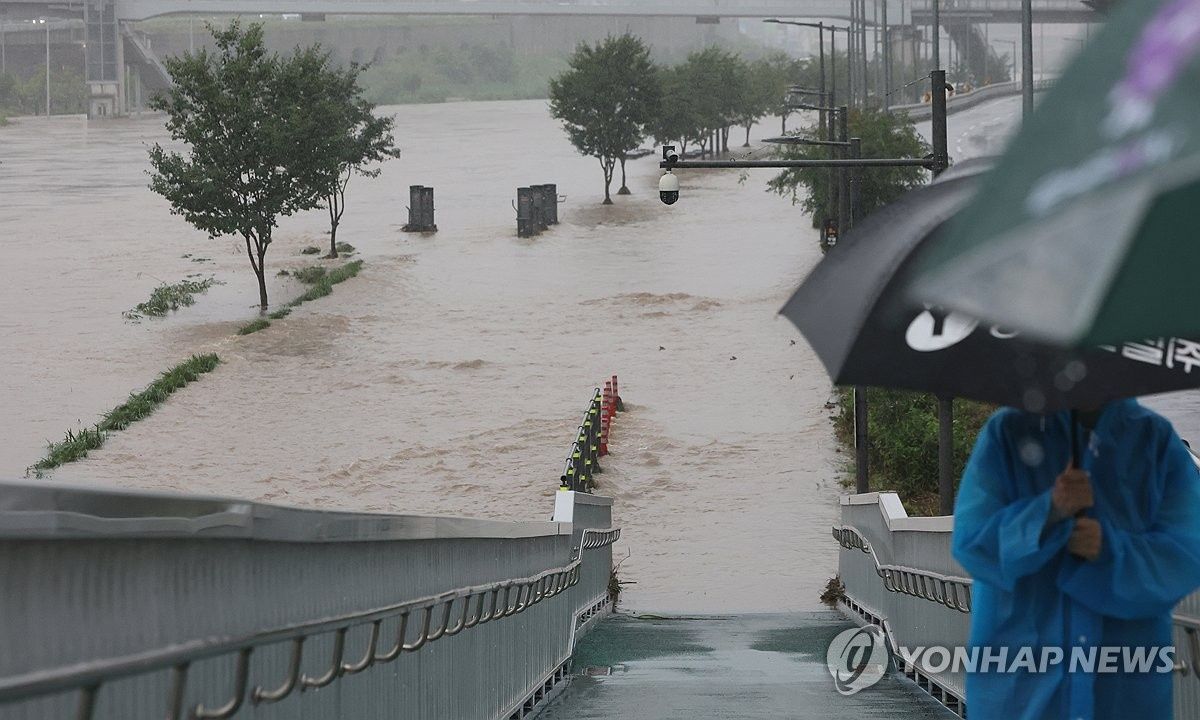
South Korea's capital region and surrounding provinces faced a deluge of rainfall overnight that triggered widespread flooding, infrastructure disruptions, and property damage affecting hundreds of households, authorities reported Saturday. The Central Disaster and Safety Countermeasure Headquarters documented approximately 540 cases of property damage across the Seoul metropolitan area and Gangwon Province, with emergency responders managing the fallout from one of the season's most severe weather events. The downpour, which persisted from midnight through the morning hours, unleashed nearly 200 millimetres of rain across vulnerable regions, overwhelming drainage systems and forcing authorities to implement extensive precautionary measures.
Rainfall measurements reveal the intensity of the meteorological event across multiple jurisdictions. The municipality of Paju recorded 192.5 millimetres, while Dongducheon received 189.5 millimetres during the eight-hour deluge. Other affected areas included Pocheon with 179 millimetres, Gimpo with 166.5 millimetres, and Cheorwon in Gangwon with 159.5 millimetres. These figures underscore how the weather system concentrated its most severe impacts across the greater Seoul region and into the mountainous east, areas that frequently experience seasonal precipitation challenges. The rapid accumulation of water in such a compressed timeframe overwhelmed local infrastructure that, despite modern drainage improvements, struggles during extreme weather events.
Property damage and infrastructure disruption represented the primary consequences of the overnight rainfall. Officials received 148 reports involving flooded residences and inundated roadways, while an additional 392 incidents involved fallen trees and scattered debris blocking thoroughfares and utility infrastructure. The combination of residential flooding and environmental debris created compounding challenges for municipal services attempting to restore normalcy. Road closures cascaded across the metropolitan area as public works teams assessed damage and cleared obstacles, while utility companies worked to address power disruptions caused by downed branches and water-damaged electrical systems.
National parks and outdoor recreational infrastructure suffered significant disruption due to ongoing weather threats. Access restrictions affected 10 national parks and 275 designated hiking routes, including the popular Mount Bukhan area near Seoul, where steep terrain and exposed rock faces elevate mudslide risks during heavy precipitation. Additionally, seven ferry services operating routes off the west coast suspended operations, isolating certain coastal communities and disrupting transportation patterns for residents and commerce. These closures will extend into the coming days as meteorological agencies maintain warnings and authorities assess whether conditions have stabilized sufficiently for safe reopening.
Despite the extensive property damage, emergency management officials emphasized that no fatalities occurred during the overnight event, a positive outcome attributed partly to early warning systems and evacuation protocols. However, 95 individuals representing 44 households across six municipalities required temporary relocation to shelters as a precautionary measure given residential vulnerability to further flooding or structural compromise. The evacuation reflected authorities' commitment to prioritizing human safety, particularly in low-lying neighbourhoods with documented flooding histories. Most evacuees remain in temporary accommodation pending structural assessments and water recession.
Weather forecasts indicate the precipitation event will persist, potentially intensifying through Sunday with rainfall rates reaching 300 millimetres per hour in localized areas. Gangwon Province, already experiencing significant overnight flooding, faces additional moisture inflow as the weather system moves northeastward. The central Chungcheong Province, currently in the trajectory's path for Sunday, has been placed on heightened alert for potential landslides and flooding, areas with terrain susceptible to slope failures during sustained heavy rainfall. Meteorological offices have warned residents in vulnerable zones to prepare for possible evacuations and remain vigilant for early-warning signs of slope instability.
Prime Minister Han Seong-sook convened an emergency response meeting Saturday morning to assess the situation and coordinate governmental recovery efforts. During the meeting, the prime minister directed relevant agencies to rapidly deploy equipment and personnel to affected regions, emphasizing the urgency of minimizing ongoing hardship for flood-impacted populations. Han acknowledged the fortunate absence of casualties while expressing official condolences to those experiencing property losses, recognizing the significant personal and financial burdens flooding inflicts on affected families. Her intervention signals high-level governmental engagement with the emergency response, ensuring resource allocation receives executive-level attention.
The prime minister's directive extended beyond immediate response to encompass preparation for anticipated secondary hazards. She instructed officials to establish enhanced monitoring systems for landslide detection and evacuation readiness in Chungcheong and Gangwon provinces, recognizing that rainfall continuing into Sunday morning creates optimal conditions for slope failures. Landslide hazards represent a particularly serious threat in mountainous regions where soil saturation triggers gravitational failures affecting populated valleys below. This forward-looking approach demonstrates how South Korea's disaster management framework incorporates cascading risk assessment, preparing for secondary impacts rather than responding solely to initial flooding.
For Malaysian and broader Southeast Asian contexts, South Korea's overnight flooding episode illustrates how developed infrastructure and early-warning systems, while valuable, cannot entirely prevent damage from extreme precipitation events. The country's investment in meteorological monitoring and emergency protocols successfully prevented casualties despite hundreds of property damage cases, outcomes that might differ significantly in regions with less robust disaster management capacity. The incident underscores how rapid urbanization and development in vulnerable topographies—common throughout Southeast Asia—create exposure to weather-related disasters that exceed historical precipitation norms. As climate patterns generate more intense rainfall events regionally, Malaysian and neighbouring authorities may draw lessons from South Korea's response coordination and protective infrastructure deployment, particularly regarding national parks and recreational area management during weather emergencies.

