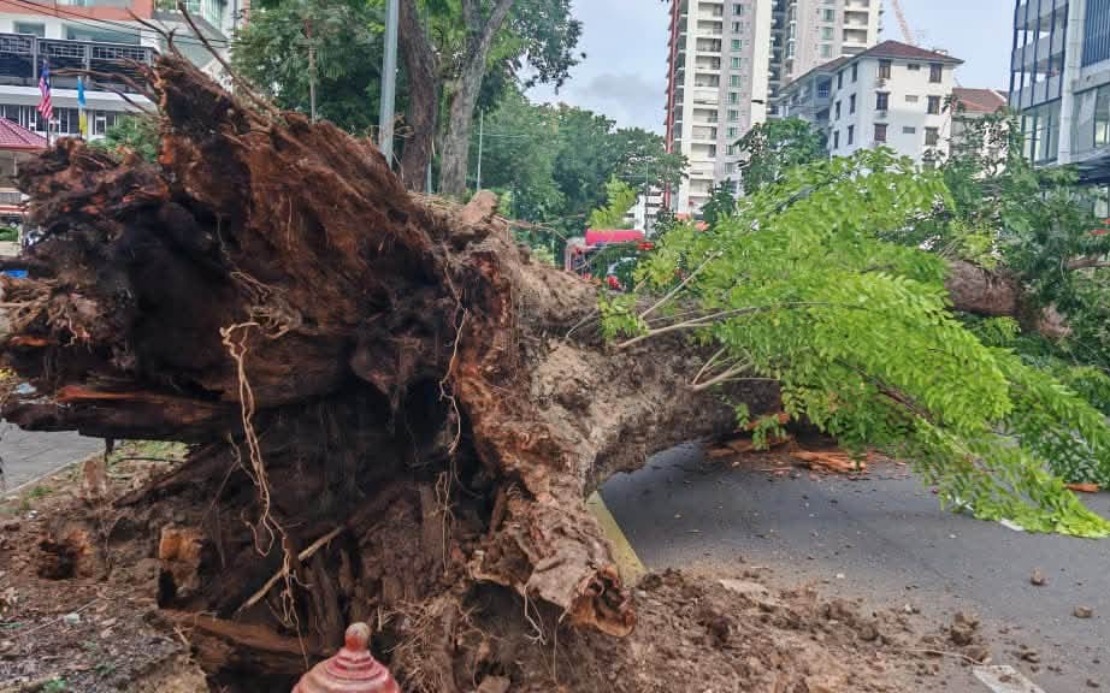
A mature Angsana tree measuring 28 metres tall collapsed on Jalan Macalister in George Town on August 9, crushing a Perodua Ativa sports utility vehicle and injuring three occupants—an elderly couple and their grandchild. According to Datuk A. Rajendran, Mayor of Majlis Bandaraya Pulau Pinang (MBPP), the incident resulted from multiple interconnected factors that progressively weakened the tree's structural integrity over time.
The tree, scientifically identified as Pterocarpus indicus, suffered from approximately 30 per cent root rot affecting its underground support system, while the base of its trunk exhibited cavity decay spanning roughly 40 per cent of its width. These two conditions alone would have substantially compromised stability, but they operated within a broader context of environmental stress. Chronic soil compaction in the surrounding area, combined with severely limited rooting space, prevented the tree from developing the extensive root network necessary to anchor such a tall specimen securely in the ground.
MBPP officials noted that weather conditions did not appear to have triggered the immediate collapse. No reports of heavy rainfall or strong winds preceded or accompanied the failure at approximately 9 am, suggesting the tree's deterioration had reached a critical threshold where it could no longer withstand even normal environmental stresses. The recent infrastructure upgrading works in the vicinity had further compromised the tree's ability to maintain structural equilibrium, adding another layer of risk to an already unstable situation.
Emergency response efforts began promptly after the incident. MBPP commenced removal operations at 9:41 am, and the thoroughfare was fully reopened by 2:20 pm following completion of clearing work. The rapid response highlighted municipal coordination, though the incident raised significant questions about preventive tree management protocols and assessment methodologies employed in major urban areas.
Investigations by MBPP revealed that a comprehensive assessment of mature and aged trees along Jalan Macalister had been conducted during 2024, leading to identification of 13 specimens for removal. All identified trees have subsequently been felled. The municipality also documented that routine maintenance along the street occurred on January 29, 2024, and a remote sensing study conducted the previous year had classified trees in the area as being in good condition with no discernible warning indicators. The disparity between remote sensing findings and the tree's actual structural state raises questions about the sensitivity and reliability of such assessment technologies for detecting internal decay processes.
MBPP's broader tree management programme demonstrates significant activity in urban forestry, though the adequacy of current safeguards remains debatable. During 2024, the municipality identified 2,535 trees requiring attention across various categories: 45 cases involved drainage obstruction, 138 trees were classified as dead, 2,242 fell under risk assessments or other categories, and 110 were associated with development or infrastructure projects. Separately, 179 high-risk trees received approval for felling in 2024, with 148 already removed by the time of the Jalan Macalister incident. Across the first three quarters of the year, 247 trees had been felled for reasons including obstruction of drainage systems, dead or leaning status, collapse risk, development requirements, road and river widening projects, and encroachment on Penang Water Supply Corporation pipeline corridors.
The prevalence of trees identified as posing collapse risks suggests that urban areas throughout Penang may harbour numerous similar hazards. Soil compaction and restricted rooting space, factors that contributed to this particular failure, are common consequences of dense urban development and infrastructure installation. As Southeast Asian cities intensify development, trees planted during earlier urban planning phases increasingly find themselves constrained by hard surfaces, buried utilities, and sidewalk construction that permanently restricts their ability to establish adequate root systems.
Following the August 9 incident, MBPP has instructed its appointed contractors to accelerate work programmes targeting tree height reduction and removal of specimens presenting collapse risks along Jalan Macalister. These operations will be guided by assessments conducted by certified arborists. This reactive approach, while necessary for immediate public safety, underscores a potential gap in proactive risk management—the fact that a tree deteriorating to such an extent apparently escaped detection until catastrophic failure occurred suggests either assessment protocols require enhancement or resources for regular monitoring remain inadequate.
The incident carries implications for other Malaysian municipalities managing ageing urban forest assets. As trees planted decades ago reach advanced age, the combination of structural decay, compromised growing conditions, and infrastructure constraints creates an expanding portfolio of potential hazards. Preventive strategies that integrate soil remediation, root space expansion, and targeted removal of compromised specimens become increasingly critical. The George Town collapse demonstrates that proximity to utilities, narrow planting areas, and compacted soil fundamentally alter how trees age and fail compared to their rural counterparts, requiring municipal authorities to adopt differentiated management approaches rather than applying uniform standards.
For residents and businesses dependent on urban tree cover, the incident presents a sobering reminder of the tension between aesthetic and recreational benefits that mature trees provide and the safety imperatives that govern public space management. While mature trees contribute significantly to livability, air quality, and psychological wellbeing in dense urban environments, their structural integrity demands constant vigilance. Moving forward, Greater George Town and comparable urban centres throughout Malaysia and Southeast Asia must invest in more sophisticated assessment technologies, expand the cadre of certified arborists available for regular inspections, and establish clearer protocols for communicating identified risks to the public before preventable tragedies occur.

