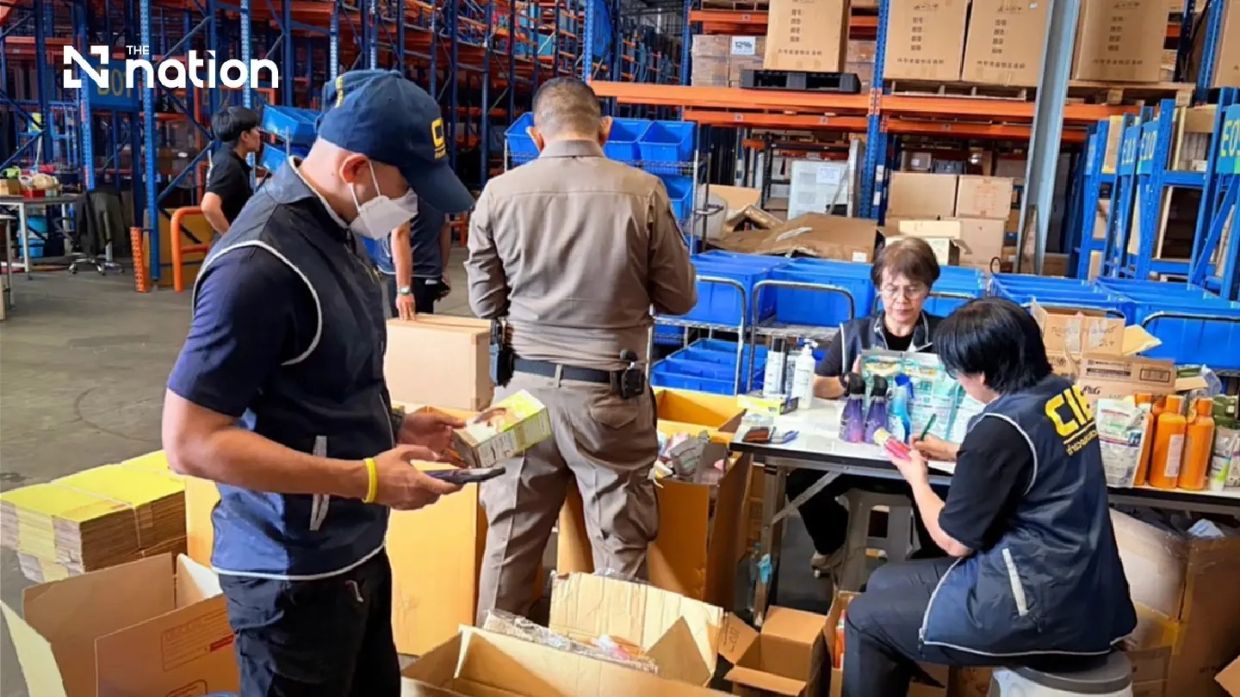
Thai consumer protection authorities have dismantled a significant distribution network operating from a warehouse in Bang Phli district, Samut Prakan, that was channelling unapproved Japanese products to hundreds of online sellers across the country. On August 13, the Consumer Protection Police Division (CPPD), acting under orders from Pol Maj Gen Kongkrit Lertsittikul, conducted a raid that recovered 83,483 items spanning 116 different product types, with a combined market value exceeding 8.34 million baht. The seizure represents one of the more substantial recent operations targeting the illicit distribution of unregulated cosmetics, dietary supplements, and medicinal products that have been proliferating through e-commerce channels throughout Thailand.
The confiscated goods reveal the scope of a sophisticated supply chain that has operated largely undetected for more than four years. The warehouse functioned as both a storage facility and processing centre, with staff handling between 200 and 300 items daily at a packing fee of 10 to 12 baht per box. This operational model allowed the facility to service multiple online businesses simultaneously, distributing products that originated primarily from Japan but had circumvented Thailand's mandatory safety certification and labelling requirements. The scale of daily throughput underscores how such operations can achieve significant volume while remaining hidden within legitimate logistics infrastructure.
What distinguishes this case is the deliberate circumvention of consumer safety protocols. Each product seized lacked proper Thai-language labelling, a fundamental requirement under Thai law designed to ensure consumers can understand ingredients, usage instructions, and potential health warnings. Furthermore, the imported goods had not undergone the required regulatory checks or received certification from Thai health and consumer authorities. This pattern suggests not merely careless compliance lapses but rather a systematic effort to bypass oversight mechanisms that exist to protect public health. Investigators traced complaints to consumers who had purchased these items through various online platforms, discovering that the marketplace had been flooded with uncertified products bearing no transparency regarding their safety status or regulatory approval.
The implications for Southeast Asian e-commerce are significant, as Thailand's experience mirrors challenges facing regional economies grappling with rapid digital retail expansion. The ease with which sellers can establish online storefronts, combined with the opacity of international supply chains, creates opportunities for unscrupulous operators to distribute products that would face immediate seizure if sold through conventional retail channels. For Malaysian and regional consumers, this case demonstrates how purchasing from cross-border online platforms carries inherent risks when products lack local regulatory oversight. The products in question—cosmetics, supplements, and medicines—are categories where safety verification is particularly critical, as consumers typically apply cosmetics directly to skin or ingest supplements and medications that affect bodily systems.
The legal framework under which prosecutions will proceed encompasses multiple statutes reflecting Thailand's comprehensive approach to consumer protection. Those involved will face charges under the Cosmetics Act, Hazardous Substances Act, Food Act, and Drug Act. This multi-statute prosecution strategy signals that authorities view the operation not as a minor regulatory violation but as a serious breach of consumer protection law. For comparable jurisdictions in Southeast Asia, Thailand's approach provides a template for coordinating enforcement across different regulatory domains. The coordination between the CPPD's investigation team and prosecutors demonstrates how specialised consumer protection units can marshal resources to address systemic rather than isolated violations.
The warehouse's evolution from a conventional storage facility into an integrated distribution hub highlights how legitimate infrastructure can be repurposed for illicit activity. Initially established to store imported goods, the facility gradually expanded its services to include packing and processing for online merchants. This incremental transformation may have allowed operators to evade detection by presenting themselves as ordinary logistics providers rather than primary importers or distributors of regulated products. The four-year operational timeline suggests either that authorities were unaware of the activity until recent complaints accumulated or that the operation's distributed nature—serving multiple sellers rather than operating a single branded channel—made it harder to detect through conventional market monitoring.
For Malaysian regulators and consumers, the case carries practical lessons about cross-border purchasing. The products seized originated in Japan, a country with strong manufacturing standards, yet their illegal status in Thailand derived not from defects in manufacturing but from failure to comply with local regulatory requirements. This underscores that product safety in one jurisdiction does not automatically translate to safety in another; regional variations in labelling requirements, certification processes, and regulatory thresholds mean that items legally sold in their country of origin may be prohibited elsewhere. Malaysian consumers purchasing Japanese cosmetics or supplements through Thai online platforms—a common practice given lower pricing and broader selection—potentially face exposure to products that would be seized by Malaysian authorities if discovered in local distribution networks.
The investigation's success in linking the warehouse to multiple online sellers suggests that authorities now possess visibility into a significant portion of the illicit supply chain. This intelligence should enable follow-up operations targeting the retail sellers themselves, who may claim ignorance regarding product sourcing and compliance status. However, the investigation also highlights a structural vulnerability in online retail enforcement: the anonymity and volume inherent in e-commerce make it difficult for regulators to monitor every seller or product listing. This enforcement gap creates incentives for distribution through channels where individual sellers bear plausible deniability regarding their suppliers' compliance status.
Looking forward, the case demonstrates the necessity for regional coordination in consumer protection, particularly regarding cross-border e-commerce. A product seized in Thailand or Malaysia may simply be relisted on platforms serving other Southeast Asian markets where detection remains unlikely. The CPPD's success in identifying and raiding the warehouse represents important tactical success, but systematic prevention requires greater information-sharing between national regulators and greater pressure on e-commerce platforms to verify supplier credentials and product certification across multiple jurisdictions. For Malaysian authorities, the case provides both a cautionary example of how distribution networks operate and a practical demonstration of investigative techniques that could be adapted for domestic enforcement.
The broader consumer protection challenge illustrated by this operation extends beyond cosmetics and supplements to the general principle that regulatory frameworks designed for physical retail have not kept pace with digital commerce. Online platforms operate with minimal friction and verification, enabling sellers to reach consumers who would never encounter uncertified products in traditional retail channels. Thailand's enforcement action, though welcome, represents a reactive response to market failure rather than a preventive system. As Southeast Asian economies continue embracing digital commerce, developing proactive regulatory mechanisms—such as mandatory seller verification, platform-level product certification requirements, and cross-border information-sharing agreements—will become increasingly essential to protect consumers from products that circumvent safety standards.

