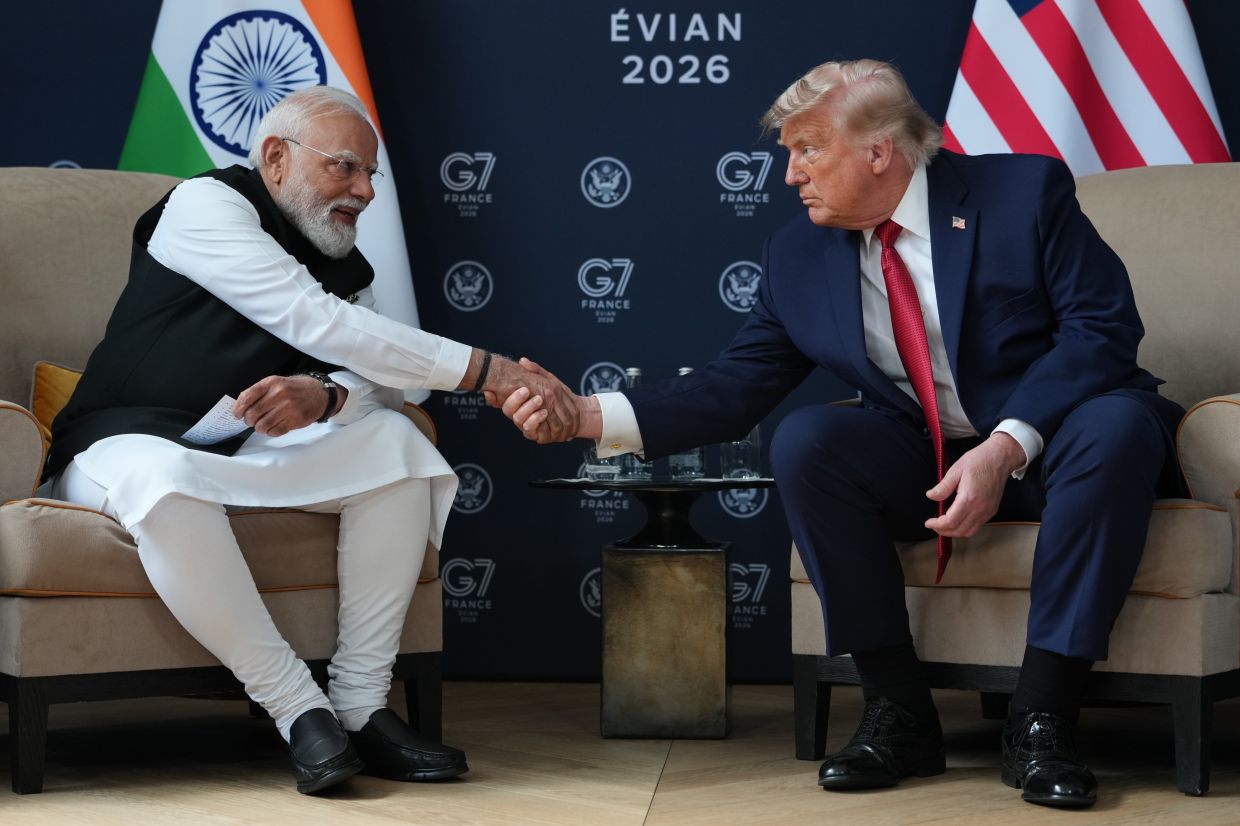
President Donald Trump has demonstrated a striking lack of remorse regarding the deaths of three Indian sailors following a US military strike on the MT Settebello, a Palau-flagged commercial vessel operating in the Strait of Hormuz. During his bilateral meeting with Prime Minister Narendra Modi—their first face-to-face engagement in 16 months—Trump glossed over the incident by framing maritime operations as a naturally hazardous profession, deflecting from the specific circumstances of the attack that triggered considerable backlash in India.
The US missile strike on the MT Settebello last week marked an escalation in American enforcement of its blockade targeting Iranian oil shipments through one of the world's most critical shipping routes. When confronted by reporters about the incident, Trump offered only cursory acknowledgment before pivoting to assertions of US-India cooperation. "I heard about that," he said, notably refraining from extending condolences to the families of the deceased Indian nationals or acknowledging potential culpability. Instead, he attributed the tragedy to the inherent risks of seafaring, suggesting that maritime fatalities have "been happening throughout time" while emphasizing American and Indian personnel are "great people."
The diplomatic tension surrounding the incident became evident in the divergent accounts of a prior conversation between Indian External Affairs Minister S. Jaishankar and US State Department officials. While Jaishankar registered a "strong protest" over the killings, the State Department's official readout reframed the discussion around enforcement of Washington's blockade policies, emphasizing that "violations of the US blockade and the illicit transport of Iranian oil will not be tolerated." This rhetorical positioning effectively subordinated India's humanitarian concerns to American strategic objectives in the Persian Gulf, revealing underlying friction beneath the veneer of partnership.
The American military's targeting of the MT Settebello was not an isolated incident but part of a broader campaign against commercial vessels allegedly connected to Iranian oil trafficking. Two additional merchant ships with Indian crew members faced attack during the same period, operations that US Central Command characterized as necessary enforcement mechanisms against sanctions violations. However, the indiscriminate nature of these strikes—affecting civilian sailors and commercial maritime operations—provoked significant domestic anger across India that the government's muted response appeared unable or unwilling to address adequately.
Public sentiment in India shifted markedly against the Trump administration following the killings, with documented instances of auto rickshaw drivers in Delhi removing posters bearing Trump's image from their vehicles. These banners, distributed by the US embassy as part of an American outreach initiative featuring birthday greetings and Trump's photograph, became symbols of perceived American arrogance and Indian subservience. The grassroots rejection of American propaganda materials underscored growing frustration with the Modi administration's apparent reluctance to challenge Washington forcefully on the matter of the deceased sailors.
Political opposition figures capitalized on the government's restrained response, with Congress leader Rahul Gandhi issuing a scathing critique of Prime Minister Modi's handling of the crisis. Gandhi characterized the Indian government as "compromised," contending that a genuinely independent nation would refuse to acquiesce to American demands and warnings. In a social media statement, he accused Modi of functioning as an "obedient servant" to American interests, highlighting the domestic political vulnerability created by India's strategic alignment with Washington at the cost of protecting its own citizens abroad.
Despite the underlying tensions, Trump and Modi maintained a public facade of cordiality, with the American president describing his Indian counterpart as both a "tough trader" and a "great guy." Trump indicated his intention to visit India at an unspecified future date, signaling continuity in bilateral engagement despite the recent friction. These reassurances appeared designed to contain the diplomatic damage and preserve the strategic partnership, particularly given ongoing negotiations over a bilateral trade agreement that would represent a significant expansion of US-India economic ties.
India's status as one of Washington's earliest trade negotiating partners under the Trump administration reflects the strategic importance both nations place on their relationship. However, the unresolved deaths of the three Indian sailors inject a troubling dimension into these commercial discussions, potentially complicating domestic Indian acceptance of any final trade accord. The willingness of American forces to strike vessels carrying Indian nationals, combined with Trump's dismissive attitude toward those deaths, suggests that Washington prioritizes regional security objectives over considerations for Indian lives caught in the crossfire of Great Power competition.
Secretory of State Marco Rubio subsequently visited India and reinforced American messaging about the bilateral partnership, characterizing India as one of America's "most important strategic partners" while attending related diplomatic functions. This reassurance campaign seeks to stabilize the relationship and prevent the sailors' deaths from derailing broader strategic cooperation, particularly given shared concerns about Chinese expansion in the Indo-Pacific region and the importance of maintaining coordinated responses through the Quad framework of India, Japan, Australia, and the United States.
The fundamental challenge for Indian policymakers lies in reconciling strategic partnership with Washington with the protection of Indian interests and citizens. Trump's refusal to acknowledge responsibility or express regret for the deaths establishes a problematic precedent, suggesting that pursuit of American strategic objectives in the Middle East may supersede concern for Indian personnel operating in contested waters. The lack of apology or compensation discussions signals that the Trump administration views such incidents as acceptable costs of enforcing its preferred regional order, a calculus that appears increasingly difficult for New Delhi to accept without generating further domestic political consequences.
%22%2F%3E%3C%2Fpattern%3E%3C%2Fdefs%3E%3Crect%20width%3D%22100%25%22%20height%3D%22100%25%22%20fill%3D%22url(%23ph216jxg)%22%2F%3E%3Crect%20width%3D%22100%25%22%20height%3D%22100%25%22%20fill%3D%22url(%23ph216jxp)%22%2F%3E%3Ctext%20x%3D%2250%25%22%20y%3D%2250%25%22%20text-anchor%3D%22middle%22%20dominant-baseline%3D%22central%22%20fill%3D%22rgba(255%2C255%2C255%2C0.95)%22%20font-family%3D%22Georgia%2C%20'Times%20New%20Roman'%2C%20serif%22%20font-weight%3D%22700%22%20font-size%3D%22170%22%20letter-spacing%3D%22-0.02em%22%3EMalaysia%3C%2Ftext%3E%3C%2Fsvg%3E)
%22%2F%3E%3C%2Fpattern%3E%3C%2Fdefs%3E%3Crect%20width%3D%22100%25%22%20height%3D%22100%25%22%20fill%3D%22url(%23ph1jlcmg)%22%2F%3E%3Crect%20width%3D%22100%25%22%20height%3D%22100%25%22%20fill%3D%22url(%23ph1jlcmp)%22%2F%3E%3Ctext%20x%3D%2250%25%22%20y%3D%2250%25%22%20text-anchor%3D%22middle%22%20dominant-baseline%3D%22central%22%20fill%3D%22rgba(255%2C255%2C255%2C0.95)%22%20font-family%3D%22Georgia%2C%20'Times%20New%20Roman'%2C%20serif%22%20font-weight%3D%22700%22%20font-size%3D%22320%22%20letter-spacing%3D%22-0.02em%22%3ETV3%3C%2Ftext%3E%3C%2Fsvg%3E)