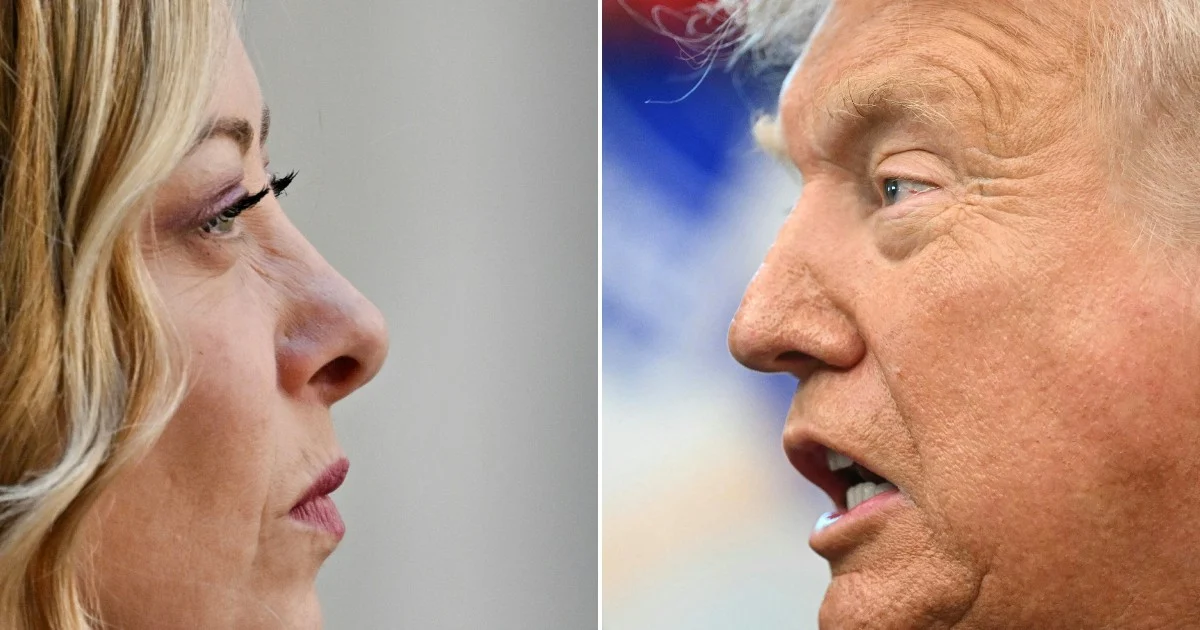
US President Donald Trump has intensified his public criticism of Italian Prime Minister Giorgia Meloni, levelling accusations that she has repeatedly pressed him for photographs during their interactions. The spat, which emerged on Saturday, represents an unusual escalation of tensions between leaders of two closely aligned Western nations and offers a window into the personal dynamics and underlying policy disagreements that shape transatlantic relations at the highest levels.
Trump's allegations regarding Meloni's pursuit of photo opportunities mark a departure from typical diplomatic discourse, where leaders typically avoid airing personal grievances in public forums. By broadcasting the dispute, the American president has drawn attention to what might otherwise have remained a private matter between the two officials. This shift toward personal attacks signals either genuine frustration or a deliberate strategy to project influence within international forums, or possibly both.
The timing of Trump's remarks carries significance for understanding the current state of G7 cohesion. The Group of Seven comprises the world's largest advanced economies and serves as a crucial venue for coordinating responses to global challenges. When tensions emerge between member states, they can complicate efforts to forge consensus on substantive matters. Italy's position within the G7 has become increasingly important as it balances its European commitments with its relationship to the broader Western alliance, making the relationship between Trump and Meloni particularly consequential.
Meloni, who leads a centre-right government in Rome, has generally maintained a more aligned stance with the Trump administration compared to some European counterparts. However, the emerging public dispute suggests that personal friction or differing policy priorities may be straining their working relationship. The Italian leader has navigated complex domestic politics while maintaining Italy's international standing, a balancing act that becomes more difficult when disputes with major allies become public knowledge.
Beyond the surface-level disagreement about photographs, Trump has connected the dispute to weightier matters affecting global security and Western unity. His reference to tensions over Iran and NATO suggests that deeper policy disagreements underlie the personal friction. These two issues represent fundamentally different approaches to international security: Iran policy touches on Middle Eastern stability and regional power balances, while NATO discussions centre on defence spending commitments and the future of the alliance that has underpinned European security for seven decades.
Iran policy has long divided Western leaders, with the United States taking a hardline approach that intensified under Trump's first administration, while some European nations, including Italy, have sought to maintain diplomatic channels. The nuclear question, regional proxy conflicts, and sanctions regimes all create space for disagreement among G7 members about the optimal strategy. Meloni's government has had to balance Italy's membership in Western security structures with economic interests in the Mediterranean and Middle East, a position that occasionally puts Rome at odds with more hawkish American positions.
NATO represents another persistent source of tension within the Western alliance. Trump has long complained about burden-sharing within the alliance, arguing that European members contribute insufficient resources to defence. Italy has gradually increased military spending to meet NATO targets, though Rome faces budgetary constraints that limit how rapidly defence expenditures can rise. The Trump administration's repeated criticism of NATO spending, combined with questions about American commitment to the alliance's Article 5 collective defence provision, has created uncertainty that complicates alliance planning.
The decision to air grievances publicly carries risks for both leaders. Trump's criticism may undermine Meloni's domestic political position if it creates the impression that she is being rebuffed by her American counterpart. For Trump, the dispute risks portraying him as difficult to work with and potentially damaging to the broader Western alliance cohesion that remains important for managing global security challenges. Neither outcome necessarily serves American or Italian interests, suggesting that the public nature of this disagreement may reflect deeper frustrations breaking through diplomatic restraint.
For Southeast Asia and the broader Indo-Pacific region, the visible fracturing of G7 unity carries indirect but meaningful implications. The G7's influence on global governance extends to issues affecting trade, technology standards, and security arrangements that shape the regional environment where Southeast Asian nations operate. When the core Western alliance shows signs of strain, it creates openings for other powers to advance alternative frameworks and reduces the coordinating capacity of traditional Western leadership.
Malaysia and other ASEAN nations watch G7 dynamics closely because the group's positions on China, technology governance, supply chain resilience, and regional security shape the broader landscape in which Southeast Asia must navigate its relationships. A G7 capable of maintaining consensus provides more predictable terms for engagement with Western powers and sometimes provides leverage for regional actors. Conversely, when G7 members become distracted by internal disputes, it can reduce the attention and resources available for Southeast Asian engagement.
The public nature of Trump's criticism also signals something important about contemporary international relations: even alliances traditionally bound by shared interests and values are now subject to personalised diplomacy and public criticism. This pattern suggests that future bilateral relationships within Western circles may become less predictable and more dependent on individual leader personalities and immediate political calculations. For nations like Malaysia that depend on stable, rules-based international arrangements, such volatility introduces complexity into long-term strategic planning.
The dispute remains relatively limited compared to full-scale diplomatic ruptures, and both leaders maintain formal engagement. However, the willingness to publicly criticise each other represents a notable shift in how leaders of allied nations conduct their public relationship. Whether this represents a temporary flare-up or signals deeper cracks in Western alliance cohesion will become clearer as subsequent G7 gatherings and bilateral meetings unfold. The implications for regional stability and international order remain significant.