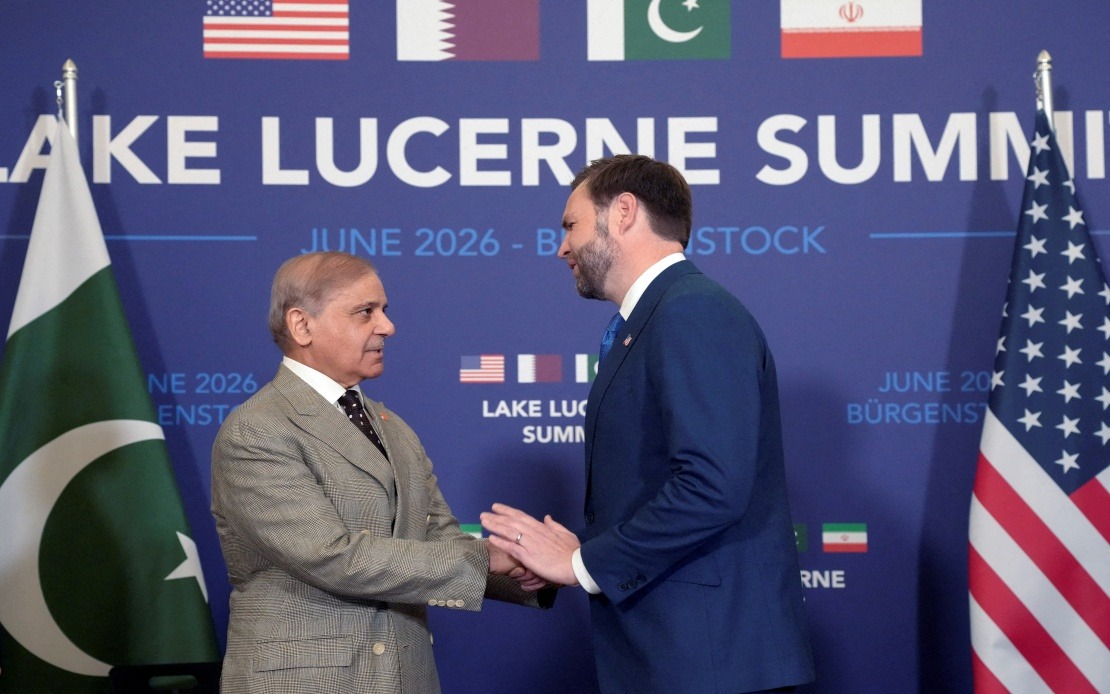
A significant diplomatic gathering took place at the Burgenstock resort in Switzerland on Sunday when high-ranking American and Pakistani officials convened for discussions that underscored the region's pivotal role in Middle Eastern geopolitics. Vice President JD Vance, alongside special envoys Steve Witkoff and Jared Kushner, met with Pakistan's Prime Minister Shehbaz Sharif and Pakistan Army Chief Field Marshal Asim Munir, according to accounts from the White House press pool. The timing of this meeting, conducted on the sidelines of broader US-Iran negotiations, reflects Washington's strategic interest in securing Pakistan's support and input as it navigates complex talks aimed at de-escalating tensions in one of the world's most volatile regions.
For Southeast Asian observers, this development carries significance beyond bilateral US-Pakistan relations. The inclusion of Pakistan—a nation with deep historical ties to the Middle East and a substantial Muslim population—signals that any resolution to the US-Iran standoff will require buy-in from key regional stakeholders. Pakistan's geographic position and its influence across South Asia and Central Asia make it a natural participant in discussions that could reshape Middle Eastern security architecture. The presence of both the Prime Minister and the Army Chief, Pakistan's two most powerful figures, demonstrates the seriousness with which Islamabad approaches these negotiations and suggests that military considerations feature prominently in Pakistan's diplomatic calculations.
The broader context involves a memorandum signed remotely between Iran and the United States overnight on June 18, which represents a preliminary framework for halting military hostilities that commenced on February 28. This agreement establishes specific timelines governing how Washington will dismantle its naval blockade while Tehran commits to reopening shipping corridors through the Strait of Hormuz, a waterway through which vast quantities of global petroleum flow. For Malaysia and other trading nations dependent on Middle Eastern energy supplies and maritime commerce, the restoration of shipping through the Strait of Hormuz carries direct economic implications, as any disruption to this critical chokepoint affects global oil prices and shipping insurance premiums.
A central element of the emerging agreement addresses Iran's nuclear programme, which has long been a flashpoint in international relations. Under the framework, Iran commits to forgoing the acquisition of nuclear weapons, though the technical details governing how this commitment will be verified and maintained remain subject to further negotiation. The parties involved—the United States, Iran, Pakistan, and Qatar as mediators—have established a 60-day window to conclude separate negotiations on the specifics of Iran's nuclear activities. This timeline reflects the complexity of the issues at stake and suggests that both sides recognise the need for careful deliberation rather than rushed conclusions that might later prove unstable.
Pakistan's participation as a mediator and stakeholder carries deeper meaning when considered alongside its own nuclear history. As the world's ninth-largest nuclear power and the sole Muslim-majority nation with confirmed nuclear weapons, Pakistan occupies a unique position in conversations about nuclear proliferation and disarmament in the Islamic world. Its presence at these negotiations underscores the recognition that any framework governing Iran's nuclear programme requires legitimacy and acceptance from other Muslim-majority nations, particularly those with nuclear capabilities or ambitions. Pakistan can speak to the international scrutiny, technical challenges, and security implications of maintaining a nuclear arsenal under constant global pressure and sanctions.
The technical-level negotiations scheduled to commence in Burgenstock on Sunday were expected to proceed behind closed doors, indicating that diplomats sought to avoid public posturing that might complicate discussions. This confidential approach contrasts with much public diplomacy surrounding Middle Eastern affairs and suggests that all parties recognised the fragility of progress achieved so far. Closed-door negotiations allow officials to explore creative compromises and acknowledge concerns without domestic political complications that public statements might trigger. For Pakistan's representatives, this proved particularly important given the domestic sensitivities surrounding any engagement with either the United States or Iran in Pakistan's own complex political environment.
The involvement of Qatar as a co-mediator alongside Pakistan reflects the evolving diplomatic architecture in the Middle East. Qatar, with its substantial financial resources and historical relationships across the region, has increasingly positioned itself as a neutral broker capable of facilitating dialogue between antagonists. Together, Pakistan and Qatar represent a coalition of Muslim-majority nations that can lend credibility to any eventual settlement, particularly in the eyes of constituencies within their respective countries and across the Islamic world that harbour deep suspicions toward American foreign policy. Their joint mediation role suggests that any agreement forged in these negotiations will carry regional legitimacy that American-only mediation could not achieve.
Tehran's primary objective in these negotiations revolves around the lifting of comprehensive economic sanctions that have crippled Iran's economy and isolated its banking sector from international systems. For Iran, sanctions relief represents the true measure of any agreement's success, far more than abstract commitments to nuclear restraint. The United States, conversely, seeks verifiable assurances regarding Iran's nuclear intentions along with restored stability in a region where American interests—particularly regarding oil supply security and support for regional allies—remain paramount. These fundamentally divergent priorities, while not necessarily irreconcilable, require skilled negotiation and compromise from all parties.
For Malaysian policymakers and business leaders, the implications of a successful US-Iran agreement extend across multiple dimensions. Energy security stands foremost: any stabilisation of Middle Eastern tensions typically moderates oil prices and reduces risk premiums that shipping companies build into their rates. Malaysian companies with operations or investments in Iran, currently restricted by American secondary sanctions, might face opportunities for expanded engagement if sanctions are lifted. Regional stability in the Middle East and Persian Gulf directly affects Southeast Asian security architecture, as several Southeast Asian nations maintain substantial economic interests in the region and some host significant expatriate populations working across Middle Eastern industries.
The convergence of these negotiations in Switzerland, a traditional venue for international diplomacy, reflects the old-world tradition of neutral territory hosting sensitive talks. Switzerland's role, refined through centuries of diplomatic hosting, provides an environment stripped of historical baggage that either a Middle Eastern or American venue might carry. The choice of Burgenstock specifically, a resort location rather than a capital city, further emphasises the desire to separate these discussions from the intensity of official governmental settings and national political pressures.
Looking forward, the success of these technical-level talks will depend on whether negotiators can bridge the gap between strategic objectives and operational details. The coming 60 days will prove critical in determining whether the preliminary framework can be transformed into a durable agreement that all parties can present as a victory to their respective domestic constituencies. Pakistan's continued involvement, particularly through its Army Chief's participation, suggests that the military dimensions of any agreement—including confidence-building measures and verification protocols—remain central to the broader diplomatic enterprise.
The gathering at Burgenstock ultimately demonstrates how regional powers like Pakistan have become indispensable to resolving Middle Eastern crises. Where once American diplomacy might have proceeded bilaterally with Iran, contemporary realities require validation and participation from key regional actors. For Southeast Asia, careful monitoring of how these negotiations unfold offers lessons about the evolving nature of great power diplomacy and the increasing importance of regional balance in managing global tensions.
%22%2F%3E%3C%2Fpattern%3E%3C%2Fdefs%3E%3Crect%20width%3D%22100%25%22%20height%3D%22100%25%22%20fill%3D%22url(%23ph5v36dg)%22%2F%3E%3Crect%20width%3D%22100%25%22%20height%3D%22100%25%22%20fill%3D%22url(%23ph5v36dp)%22%2F%3E%3Ctext%20x%3D%2250%25%22%20y%3D%2250%25%22%20text-anchor%3D%22middle%22%20dominant-baseline%3D%22central%22%20fill%3D%22rgba(255%2C255%2C255%2C0.95)%22%20font-family%3D%22Georgia%2C%20'Times%20New%20Roman'%2C%20serif%22%20font-weight%3D%22700%22%20font-size%3D%22151%22%20letter-spacing%3D%22-0.02em%22%3ENorwegian%3C%2Ftext%3E%3C%2Fsvg%3E)
%22%2F%3E%3C%2Fpattern%3E%3C%2Fdefs%3E%3Crect%20width%3D%22100%25%22%20height%3D%22100%25%22%20fill%3D%22url(%23ph34ksng)%22%2F%3E%3Crect%20width%3D%22100%25%22%20height%3D%22100%25%22%20fill%3D%22url(%23ph34ksnp)%22%2F%3E%3Ctext%20x%3D%2250%25%22%20y%3D%2250%25%22%20text-anchor%3D%22middle%22%20dominant-baseline%3D%22central%22%20fill%3D%22rgba(255%2C255%2C255%2C0.95)%22%20font-family%3D%22Georgia%2C%20'Times%20New%20Roman'%2C%20serif%22%20font-weight%3D%22700%22%20font-size%3D%22320%22%20letter-spacing%3D%22-0.02em%22%3EPM%3C%2Ftext%3E%3C%2Fsvg%3E)