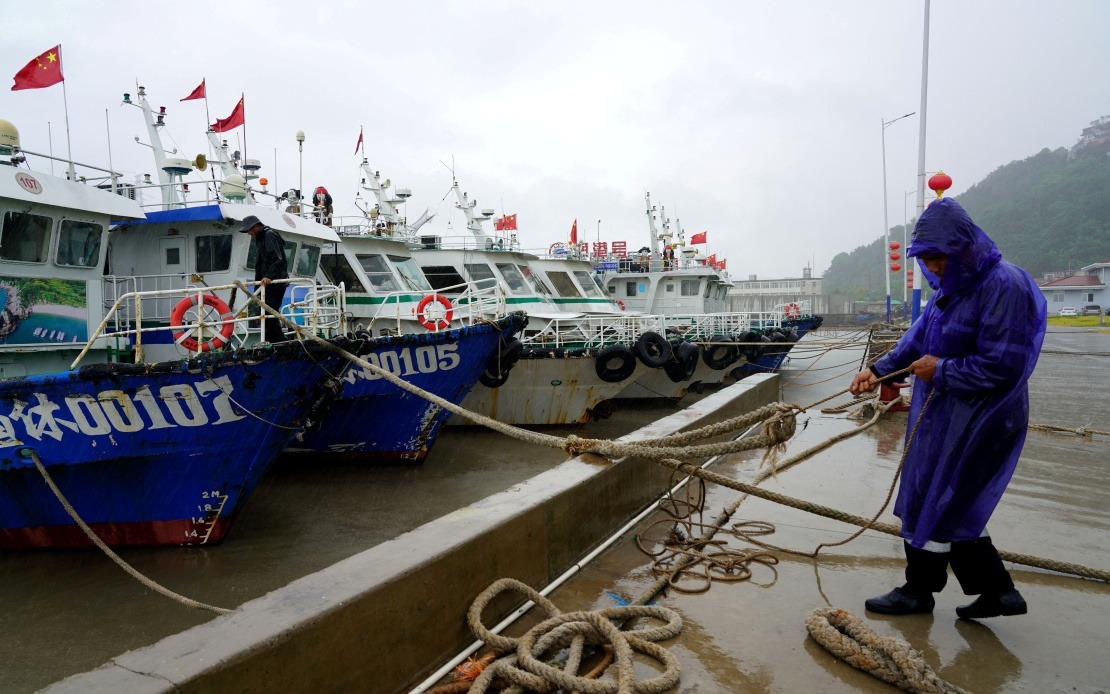
Authorities in Zhejiang Province along China's eastern seaboard have tightened disaster preparations as Typhoon Dolphin edges closer to making landfall this weekend. The regional government upgraded its emergency protocols from Level IV to Level III on Friday midday, signalling intensified coordination across maritime, construction, and civil defence sectors. As the year's 13th typhoon system, Dolphin represents a significant challenge for one of China's most economically vital regions, threatening not only coastal communities but also major commercial hubs including Shanghai and the surrounding industrial belt.
At 8 am on Friday, the storm centre hovered approximately 763 kilometres east of Wenling, a coastal city in Zhejiang, with meteorological forecasters predicting a westward trajectory at speeds between 15 and 20 kilometres per hour. China's National Meteorological Centre issued a yellow-level alert on Thursday evening, estimating that Dolphin would reach the coastline somewhere between Shanghai in the north and Fuqing in Fujian Province to the south, likely arriving on either Sunday or Monday. The timing and positioning have prompted urgent preventative action across the region, as authorities scramble to secure infrastructure and safeguard populations in the storm's projected path.
Zhejiang's geographic location between these two major cities makes it particularly vulnerable, according to Lou Xiaofen, chief forecaster at the Zhejiang Meteorological Observatory. She emphasized that conditions favour a direct hit on Zhejiang itself, which would amplify the typhoon's destructive potential across an already densely populated and economically active zone. The province's concentration of manufacturing facilities, shipping infrastructure, and urban centres means that even a moderate typhoon can cascade into significant disruption and property damage. Heavy rainfall accompanying the system is expected to affect areas stretching northward from wherever the storm makes landfall, extending the zone of concern well beyond the immediate coastal strip.
The intensity outlook remains uncertain but troubling. Meteorologists anticipate Dolphin will maintain its current strength or possibly intensify to severe typhoon classification before impact. This potential escalation has prompted planners to prepare for worst-case scenarios involving widespread flooding, landslides, and infrastructure failures. The storm's forward speed of 15 to 20 kilometres per hour provides a relatively narrow window for final preparations, though authorities had begun contingency measures days in advance.
Maritime and port operations have come to a virtual standstill across the province. All 162 passenger ferry routes have been suspended, stranding thousands of travellers and disrupting regional transportation networks that many communities depend upon for commerce and connectivity. Simultaneously, work has halted at all 193 offshore construction and drilling projects, a precaution that prevents both worker injury and potential environmental catastrophe from unmanned or abandoned installations. The provincial government has also directed 474 construction vessels to seek shelter in protected harbours, reducing the number of vessels exposed to open-water conditions where typhoon waves and winds pose maximum danger.
Maritime authorities have undertaken an intensive communication and surveillance operation in recent days. By Friday morning, they had transmitted 86,000 early warning notifications to vessel operators, port facilities, and fishing communities, ensuring widespread awareness of the approaching threat. Additionally, inspections of 24,000 vessels have been completed or are ongoing, verifying that ships are properly secured, anchored, or sheltered. This systematic approach reflects hard-learned lessons from previous typhoon seasons and demonstrates the scale of coordination required to protect a maritime province of Zhejiang's importance.
Emergency response assets stand ready for rapid deployment. High-powered tugboats capable of assisting vessels in distress are positioned on standby, their crews briefed and fuel-loaded for potential rescue missions. These vessels represent the frontline of maritime emergency response, and their availability signals that authorities anticipate the possibility of ships requiring assistance during the typhoon's passage. Similarly, search-and-rescue teams have been mobilized and equipped to respond to emergencies both at sea and in coastal communities.
The Level III response framework now in effect requires local governments to intensify monitoring of the typhoon's track and intensity through continuous meteorological analysis. Forecast updates will be issued regularly to inform decision-making by downstream agencies and the general public. Evacuation protocols have been activated for populations in identified risk zones, particularly those in low-lying areas susceptible to storm surge or in structures vulnerable to high winds. Authorities are simultaneously providing public guidance through media channels and community networks, helping residents understand risks and appropriate protective actions.
For Malaysia and the broader Southeast Asian region, Typhoon Dolphin's development carries indirect implications. While the storm's primary impact zone lies in eastern China, the broader western Pacific typhoon season influences weather patterns across maritime Southeast Asia. The frequency and intensity of these systems, along with their seasonal distribution, affect shipping corridors, fishing operations, and monsoon patterns that influence weather from Thailand to the Philippines. Malaysian maritime authorities and port operators monitor major typhoon developments in Chinese waters as part of regional risk assessment, particularly given the significant volume of Malaysian shipping that transits Chinese coastal areas.
The escalation from Level IV to Level III alerts also reflects how seriously Chinese authorities treat large-scale natural disasters in economically critical regions. Zhejiang's gross domestic product ranks among China's highest, and its ports handle enormous cargo volumes daily. Disruption to these operations reverberates through global supply chains, affecting manufacturers and traders across Asia-Pacific. The swift response by provincial authorities demonstrates institutional preparedness, yet also underscores the vulnerability of densely developed coastal regions to tropical cyclone impacts, a lesson relevant to similarly positioned cities throughout Southeast Asia including Singapore, Bangkok, and Ho Chi Minh City.
As Typhoon Dolphin completes its approach over the coming 48 to 72 hours, Zhejiang's preparation measures will face their ultimate test. The coordination of ferry suspensions, vessel relocations, construction halts, and evacuation efforts represents one of the largest emergency mobilizations in the province's recent history. Success in minimizing casualties and property loss will depend not only on the storm's eventual intensity and precise landfall location, but also on how effectively the pre-positioned resources and alerted populations respond to real-time conditions as they develop.

