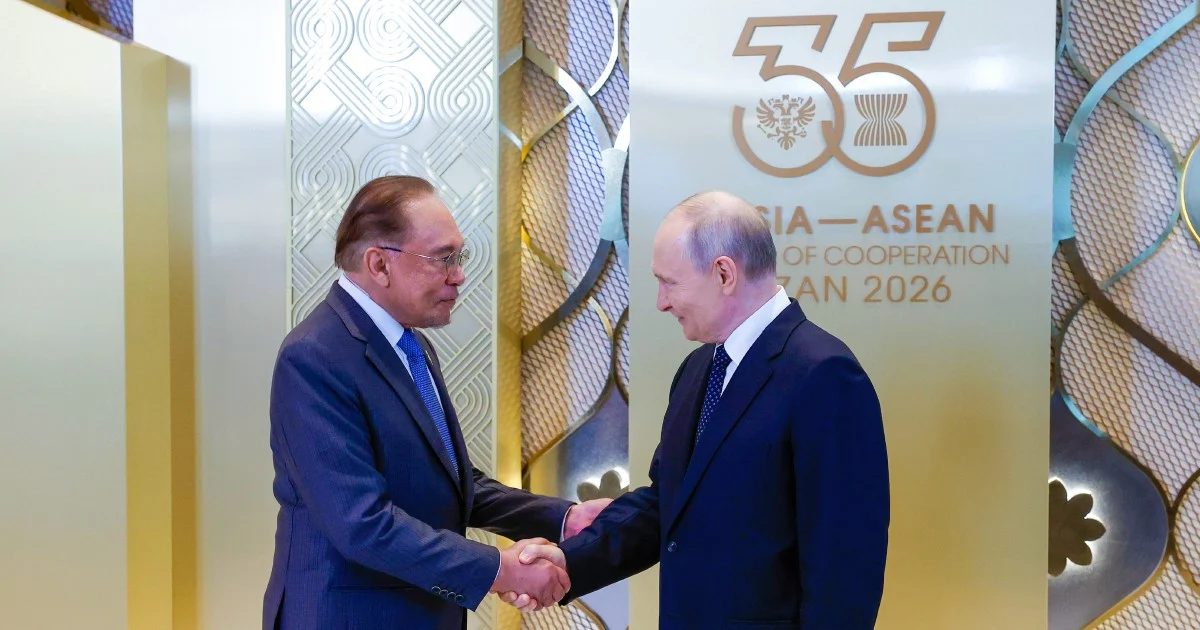
Prime Minister Datuk Seri Anwar Ibrahim and Russian President Vladimir Putin have convened for substantive discussions in Kazan, with energy cooperation and financial innovation taking centre stage in their bilateral engagement. The meeting reflects Malaysia's strategic positioning as it navigates complex regional and international dynamics while maintaining pragmatic relationships across geopolitical divides.
Energy security emerged as a primary focus during the diplomatic encounter. For Malaysia, stable energy supplies remain crucial to sustaining economic growth and industrial competitiveness. Russia, as one of the world's largest energy producers, represents a significant potential partner in diversifying Malaysia's fuel sources beyond traditional Middle Eastern suppliers. The discussion of energy security arrangements signals Malaysia's interest in exploring alternative supply routes and long-term contractual relationships that could insulate the nation from supply disruptions or price volatility in global markets.
The conversation also touched upon expanding overall trade relations between the two nations. Currently, bilateral commerce between Malaysia and Russia operates well below potential given the countries' complementary economic profiles. Malaysia possesses strong manufacturing and services sectors with significant export capacity, while Russia offers energy resources and raw materials. Enhanced trade cooperation could open market access for Malaysian products in the Russian market and its trading partners within the Eurasian Economic Union, a bloc that encompasses several former Soviet states with combined consumer purchasing power.
A particularly noteworthy aspect of the talks involved exploring trade conducted in local currencies rather than relying exclusively on the United States dollar. This approach reflects a broader regional trend, with several Southeast Asian nations increasingly settling bilateral transactions in their own currencies or through alternative payment mechanisms. For Malaysia, transacting in ringgit with partners like Russia reduces exposure to dollar exchange rate fluctuations and decreases dependence on dollar-denominated financial infrastructure, potentially lowering transaction costs and enhancing monetary policy autonomy.
The currency discussion carries broader implications for Malaysia's financial sovereignty and regional integration. As other major Asian economies pursue similar strategies with their own neighbours, Malaysia risks being sidelined if it does not participate actively in these arrangements. The ringgit, as a relatively stable currency backed by Malaysia's substantial foreign exchange reserves, possesses credibility for bilateral settlement purposes. By establishing ringgit-based trading mechanisms with Russia and potentially other partners, Malaysia contributes to international demand for its currency and strengthens its position within emerging alternative financial arrangements.
From Russia's perspective, discussions with Malaysia reflect Moscow's strategic pivot toward Asian markets as Western sanctions limit its engagement with European and North American economies. Malaysia, as the largest economy in ASEAN by nominal GDP after Indonesia, offers Moscow significant commercial and diplomatic opportunities. Strengthening ties with Kuala Lumpur also provides Russia with enhanced influence within Southeast Asia's regional architecture, where Malaysia holds considerable sway through its active participation in ASEAN forums and its historical non-aligned positioning.
The timing of these discussions occurs within a context of evolving geopolitical alignments. Malaysia's approach under Anwar Ibrahim's leadership has consistently emphasised multi-aligned foreign policy, maintaining productive relationships with major powers across diverse ideological and political systems. This pragmatic stance distinguishes Malaysia from some regional peers who have adopted more explicitly aligned positions. By engaging substantively with Russia on energy and trade matters, Malaysia demonstrates its independence and its refusal to permit great power competition to dictate its bilateral relationships.
Energy security holds particular significance for Malaysia's development trajectory. While Malaysia produces crude oil and natural gas, domestic reserves have declined over recent decades, necessitating increasing reliance on imports to meet growing energy demand from expanding manufacturing sectors and rising population needs. Establishing reliable energy partnerships with major suppliers like Russia provides Malaysia with leverage in international energy markets and security against supply disruptions that could undermine industrial productivity and household energy security.
The exploration of alternative currency settlement mechanisms also responds to Malaysia's experience with currency volatility and external financial pressures. The ringgit has historically faced speculative pressure during periods of regional financial stress. By anchoring the currency to bilateral trade flows with major partners, Malaysia creates structural demand that supports the ringgit's value. This approach complements Malaysia's broader financial development strategy, which aims to elevate Kuala Lumpur's status as a regional financial hub capable of facilitating cross-border transactions independently of Western financial infrastructure.
Bilateral cooperation on energy could extend beyond simple supply arrangements to encompass technological collaboration and joint development of energy infrastructure. Malaysia possesses expertise in liquefied natural gas processing and distribution, fields where Russia also has considerable capabilities and global market presence. Joint ventures in third-country markets could create new commercial opportunities for both nations and enhance their competitive positioning in global energy markets.
Looking forward, the outcomes of Anwar and Putin's discussions may establish foundations for expanded institutional arrangements between Malaysia and Russia. Formal energy cooperation agreements, currency swap arrangements, or enhanced diplomatic coordination could follow preliminary discussions. Such developments would signal Malaysia's commitment to building diversified international partnerships while maintaining its fundamental non-aligned orientation.
These conversations underscore Malaysia's navigation of contemporary international relations, where major powers compete for influence and partnership across Asia. By engaging substantively with Russia on mutual interests while maintaining strong relationships with Western partners and regional neighbours, Malaysia exemplifies the pragmatic balancing act that increasingly defines Southeast Asian statecraft. The emphasis on energy security and financial innovation reflects Malaysia's recognition that traditional instruments of power and influence are evolving, requiring new approaches to bilateral engagement.


%22%2F%3E%3C%2Fpattern%3E%3C%2Fdefs%3E%3Crect%20width%3D%22100%25%22%20height%3D%22100%25%22%20fill%3D%22url(%23ph2hy9vg)%22%2F%3E%3Crect%20width%3D%22100%25%22%20height%3D%22100%25%22%20fill%3D%22url(%23ph2hy9vp)%22%2F%3E%3Ctext%20x%3D%2250%25%22%20y%3D%2250%25%22%20text-anchor%3D%22middle%22%20dominant-baseline%3D%22central%22%20fill%3D%22rgba(255%2C255%2C255%2C0.95)%22%20font-family%3D%22Georgia%2C%20'Times%20New%20Roman'%2C%20serif%22%20font-weight%3D%22700%22%20font-size%3D%22272%22%20letter-spacing%3D%22-0.02em%22%3EAnwar%3C%2Ftext%3E%3C%2Fsvg%3E)