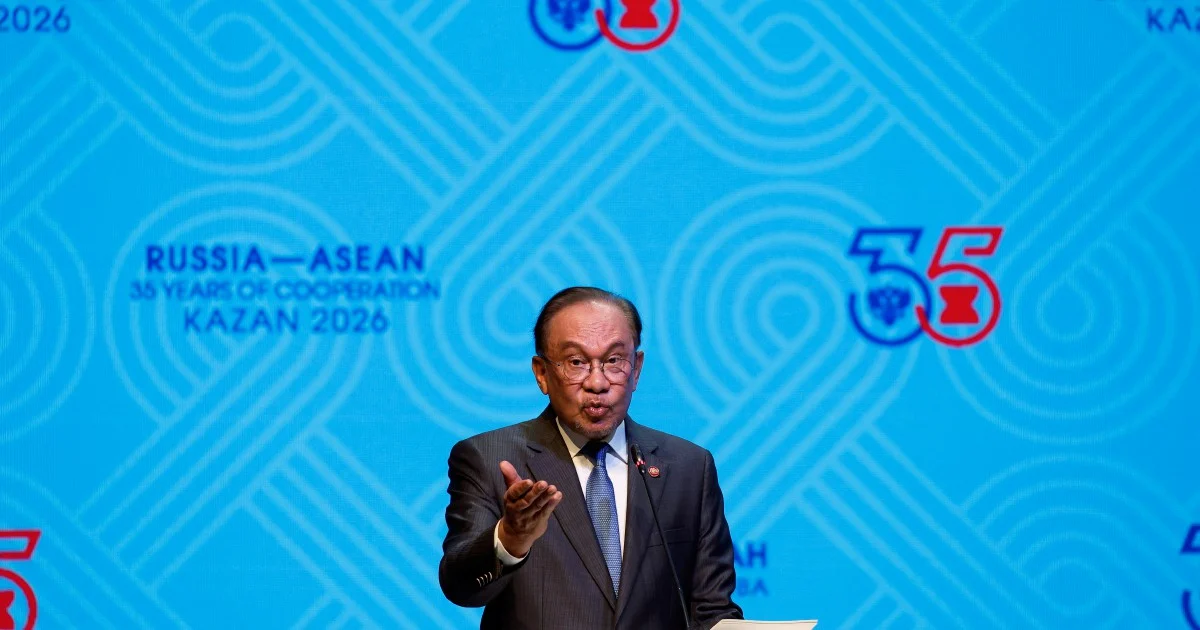
Prime Minister Datuk Seri Anwar Ibrahim has hailed the completion of the Asean-Russia Strategic Programme on Trade and Investment Cooperation 2026-2035 as a meaningful catalyst for elevating bilateral economic relations between Southeast Asia and Moscow. Speaking in Kazan, Anwar framed the finalised roadmap not merely as a symbolic agreement but as a substantive foundation upon which both regions can build deeper commercial and investment partnerships over the next decade.
The timing of this strategic partnership carries particular significance for the region. As Asean navigates a complex geopolitical environment characterised by competing great power interests and shifting trade dynamics, the formalisation of a dedicated framework with Russia provides Southeast Asia with greater leverage in maintaining diverse economic partnerships. For Malaysia specifically, such initiatives underscore the country's commitment to non-aligned principles and the pursuit of mutually beneficial relationships across multiple economic partners rather than dependency on any single bloc.
However, Anwar's remarks carried an implicit acknowledgment that finalising a strategic programme on paper represents only the opening chapter of a longer journey. The Prime Minister's emphasis on the necessity of an "enabling environment" suggests recognition that geopolitical constraints, international sanctions regimes, and logistical challenges present formidable obstacles to translating ambitious targets into tangible trade flows and investment projects. This pragmatic framing distinguishes between the aspiration embodied in formal agreements and the practical realities that determine whether such frameworks yield measurable economic benefits.
The 2026-2035 timeframe itself deserves consideration. A decade-long strategic programme provides both regions with sufficient temporal scope to develop complementary sectors, establish supply chain linkages, and build institutional mechanisms for cooperation. For Asean nations like Malaysia, this extended timeline permits the careful structuring of bilateral arrangements that can generate sustained employment, technology transfer, and revenue streams without creating dangerous dependencies that might compromise strategic autonomy.
Trade cooperation between Asean and Russia has historically remained modest relative to the bloc's engagement with Western economies, China, and Japan, largely due to geographical distance, limited complementarity in certain sectors, and the impact of sanctions regimes on Russian economic activity. The new strategic programme likely addresses these structural challenges by identifying sectors where natural comparative advantages exist—energy, raw materials, processed goods, and selective manufacturing—while exploring avenues for Malaysian and other Southeast Asian enterprises to participate in Russian markets not dominated by larger competitors.
Investment cooperation warrants equal attention. Russian capital inflows to Southeast Asia have been limited, yet opportunities exist in infrastructure development, technology partnerships, and resource extraction ventures. Conversely, Asean investors may find openings in Russia's domestic economy, particularly in sectors requiring international expertise and capital as Moscow seeks to reduce dependency on Western investments and develop alternative economic partnerships. Malaysia's sophisticated financial services and trading houses could potentially serve as bridges facilitating such two-way investment flows.
The enabling environment that Anwar referenced encompasses multiple dimensions. Institutional frameworks must be strengthened through regular ministerial meetings, technical working groups, and dispute resolution mechanisms that instil confidence among business communities in both regions. Financial arrangements—including currency conversion mechanisms, credit facilities, and insurance products tailored to bilateral trade—require development to reduce transaction costs and risks. Moreover, regulatory harmonisation in standards, certifications, and business practices can substantially facilitate commerce between nations with different administrative traditions.
Anwar's comments also implicitly acknowledge the role of external actors and circumstances in determining whether the roadmap succeeds. International sanctions, their tightening or relaxation, materially affect Russia's ability to engage in cross-border commerce and investment. Similarly, shifts in global supply chains, technological developments, and shipping routes all influence whether the bilateral framework can catalyse meaningful economic activity. Framing these external factors rather than placing responsibility solely on Asean or Russian governments reflects diplomatic sophistication.
For Malaysia in particular, the Asean-Russia framework offers opportunities to diversify trade partners and reduce concentration risk in its external economic relations. Given Malaysia's historical role as a bridge between East and West within Asean, and its emphasis on balanced foreign policy, participation in structured cooperation with Russia aligns with long-standing strategic preferences. Enhanced trade with Russia could benefit Malaysian manufacturers seeking new export markets, particularly in energy-intensive sectors and resource-based industries where Southeast Asian competitiveness remains strong.
Looking forward, the success of this strategic programme will be measured not by the elegance of its wording but by whether trading volumes increase, foreign direct investment materialises, and genuine partnerships develop between enterprises on both sides. Anwar's acknowledgment that favourable conditions must be constructed rather than assumed suggests the Malaysian government will engage seriously in this implementation process. Whether Asean collectively matches this commitment will largely determine whether the 2026-2035 roadmap becomes a transformative economic initiative or merely another aspirational document gathering dust on governmental shelves.

%22%2F%3E%3C%2Fpattern%3E%3C%2Fdefs%3E%3Crect%20width%3D%22100%25%22%20height%3D%22100%25%22%20fill%3D%22url(%23ph2hy9vg)%22%2F%3E%3Crect%20width%3D%22100%25%22%20height%3D%22100%25%22%20fill%3D%22url(%23ph2hy9vp)%22%2F%3E%3Ctext%20x%3D%2250%25%22%20y%3D%2250%25%22%20text-anchor%3D%22middle%22%20dominant-baseline%3D%22central%22%20fill%3D%22rgba(255%2C255%2C255%2C0.95)%22%20font-family%3D%22Georgia%2C%20'Times%20New%20Roman'%2C%20serif%22%20font-weight%3D%22700%22%20font-size%3D%22272%22%20letter-spacing%3D%22-0.02em%22%3EAnwar%3C%2Ftext%3E%3C%2Fsvg%3E)