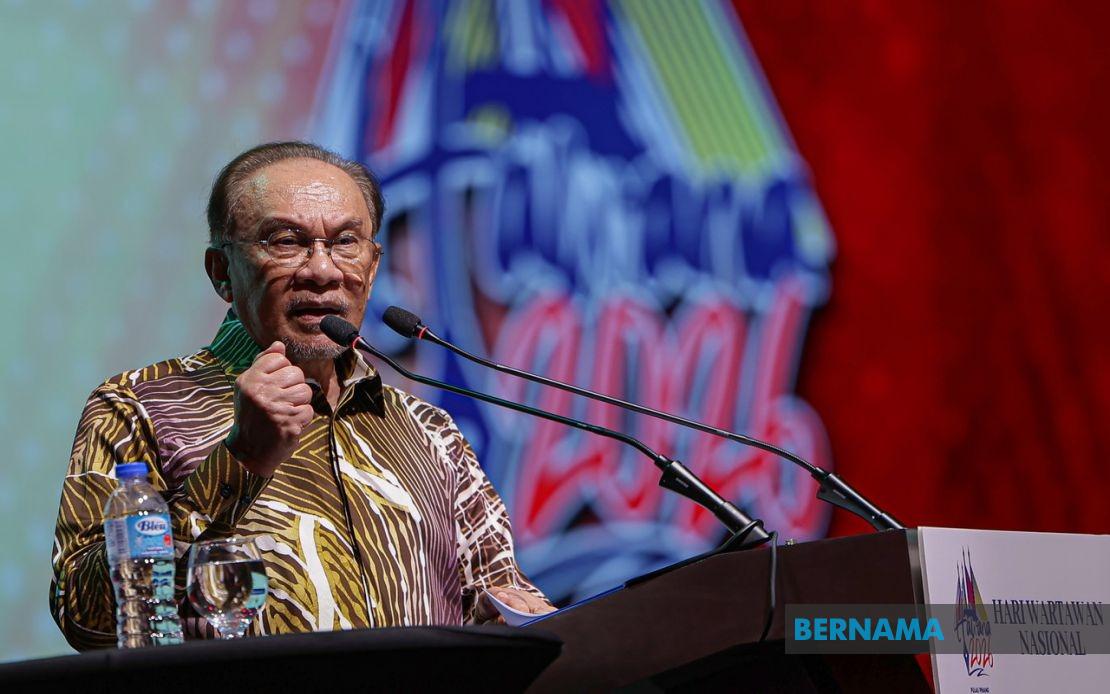
Prime Minister Datuk Seri Anwar Ibrahim has publicly endorsed the appointment of former Federal Court judge Tan Sri Nallini Pathmanathan as chairman of the Malaysian Media Council, signalling the government's confidence in the judicial veteran to restore credibility to the self-regulatory body. Speaking at the National Journalists' Day (HAWANA) 2026 event in Butterworth on June 20, Anwar emphasised that Nallini's distinguished background and impeccable integrity would help elevate the council's standing and strengthen public confidence in its operations. The prime minister's explicit backing underscores the political importance attached to media regulation at a time when press freedom and institutional accountability remain under public scrutiny across Southeast Asia.
Nallini's elevation to the helm of the Malaysian Media Council follows unanimous endorsement from the board during a meeting held on May 26. Her selection reflects a deliberate strategy to inject judicial credibility into an institution that operates under Malaysia's relatively new regulatory framework. The MMC itself was formally established under the Malaysian Media Council Act 2025, marking a significant development in how the country approaches media self-regulation. By appointing someone with Nallini's background rather than a career media figure or politician, the government appears to be signalling a commitment to institutional independence and professional standards, even as it maintains oversight of the sector.
The Malaysian Media Council operates as a self-regulatory body with a mandate spanning multiple critical functions. Beyond managing public complaints against media outlets and journalists, the organisation is tasked with strengthening journalistic standards across the industry, promoting ethical practices, and—perhaps most significantly—safeguarding media freedom as a foundational element of democratic governance. This multifaceted remit places considerable responsibility on the chairman to navigate competing interests between the press, the public, and government stakeholders. Nallini's judicial temperament and experience interpreting complex legal matters could prove valuable in arbitrating disputes and establishing precedent for how media ethics complaints are handled in Malaysia.
Anwar's comments at the HAWANA 2026 event highlight the government's recognition that the MMC requires substantial rehabilitation in public perception. The decision to appoint someone from outside traditional media circles suggests that previous approaches may have suffered from credibility deficits. By recruiting a former Federal Court judge with a track record of integrity, the administration is attempting to create distance between the council and perceptions of political interference or journalistic bias. This approach mirrors strategies employed in other democracies where independent regulatory bodies are deliberately led by figures with unblemished reputations from other professional sectors.
The event itself drew significant attendance from Malaysia's media and communications establishment, with Penang Chief Minister Chow Kon Yeow and Communications Minister Datuk Fahmi Fadzil present alongside senior officials from the Communications Ministry. The attendance of Bernama leadership, including chairman Datuk Seri Wong Chun Wai and CEO Datin Paduka Nur-ul Afida Kamaludin, emphasised the importance of the Malaysian National News Agency in the broader media regulatory ecosystem. This gathering of government and media figures suggested an attempt to project unity around media governance reforms, even as broader questions about press freedom persist in Malaysian public discourse.
Nallini's qualifications as a former Federal Court judge represent a significant departure from typical media council leadership profiles in the region. Her judicial background means she brings experience in interpreting constitutional provisions relating to freedom of speech, understanding the balance between individual rights and public interest, and navigating complex ethical questions with established jurisprudential frameworks. These skills are directly applicable to the substantive work of a media council, which must ultimately make principled judgments about what constitutes ethical journalism and where legitimate regulation ends and censorship begins. The appointment thus signals confidence that legal expertise and judicial reasoning can provide the institutional legitimacy that purely administrative or media-professional leadership might lack.
The creation of the Malaysian Media Council Act 2025 itself represents an evolution in how Malaysia regulates its media landscape. Rather than relying solely on government agencies or legislation with potential for political application, the self-regulatory framework delegates considerable authority to an independent body overseen by industry stakeholders. This model reflects international best practices in media governance, where councils composed of journalists, editors, and public representatives establish codes of conduct and adjudicate complaints. However, the success of such bodies depends critically on how they are perceived by both the industry and the public—a perception that is heavily influenced by leadership credibility.
For Malaysian and Southeast Asian readers, Nallini's appointment holds implications beyond media regulation itself. The Malaysian Media Council's effectiveness will shape how the country's press operates during a period of significant political and social change. Media councils in this region frequently face criticism for being either too deferential to government or too protective of press interests, and finding the proper balance remains elusive. Nallini's judicial experience suggests an attempt to institutionalise that balance through someone trained to weigh competing principles systematically. Whether this approach succeeds will depend not only on her leadership but on the council's operational independence and the industry's willingness to abide by its decisions.
The timing of this appointment and its public endorsement by the prime minister also reflects broader regional trends in media governance. Several Southeast Asian countries have strengthened media regulatory frameworks in recent years, though with varying degrees of success in maintaining public trust. Malaysia's approach—combining legislative reform through the new act with a high-profile judicial appointment—suggests a recognition that institutional credibility cannot be assumed but must be deliberately constructed. This is particularly important given the rapid evolution of media consumption in the region, where traditional concerns about print and broadcast journalism now intersect with digital platforms, social media, and the spread of misinformation.
Anwar's congratulations to Nallini and his articulation of her potential to provide "a new image and confidence for the council" suggest that the government acknowledges previous shortcomings in the MMC's public standing. Building that confidence will require not only judicial competence but also transparent operations, consistent application of principles, and demonstrable independence from political pressure. The prime minister's very public backing paradoxically puts pressure on Nallini to maintain visible distance from executive branch influence, a tension that will likely define her tenure. How she navigates this balancing act will determine whether the investment in judicial credibility yields genuine improvements in media regulation or merely creates the appearance of reform.
%22%2F%3E%3C%2Fpattern%3E%3C%2Fdefs%3E%3Crect%20width%3D%22100%25%22%20height%3D%22100%25%22%20fill%3D%22url(%23ph1jlcmg)%22%2F%3E%3Crect%20width%3D%22100%25%22%20height%3D%22100%25%22%20fill%3D%22url(%23ph1jlcmp)%22%2F%3E%3Ctext%20x%3D%2250%25%22%20y%3D%2250%25%22%20text-anchor%3D%22middle%22%20dominant-baseline%3D%22central%22%20fill%3D%22rgba(255%2C255%2C255%2C0.95)%22%20font-family%3D%22Georgia%2C%20'Times%20New%20Roman'%2C%20serif%22%20font-weight%3D%22700%22%20font-size%3D%22320%22%20letter-spacing%3D%22-0.02em%22%3ETV3%3C%2Ftext%3E%3C%2Fsvg%3E)