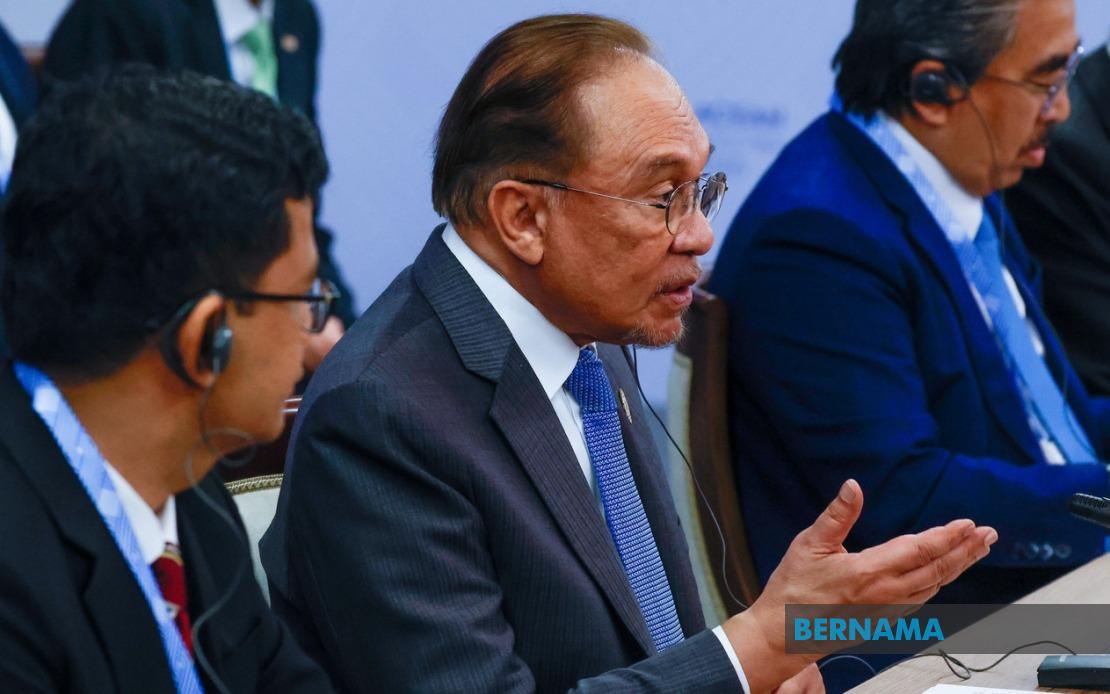
Malaysia's Prime Minister Datuk Seri Anwar Ibrahim met with Russian President Vladimir Putin in Kazan on Wednesday evening to discuss bilateral ties and pressing geopolitical matters. During the encounter, Anwar took particular care to acknowledge what he characterised as Russia's unwavering commitment to coherent positions on two of the Middle East's most consequential flashpoints: the Gaza conflict and the broader regional implications of Iran's role in Middle Eastern affairs.
In his opening remarks, Anwar singled out Russia's diplomatic approach to these intertwined crises for specific commendation. He framed Moscow's conduct not merely as tactical positioning but as adherence to principle—language that carries particular weight when deployed by a leader of a significant Asian nation with its own complex Middle Eastern relationships. The Malaysian Prime Minister's emphasis on consistency and conviction suggests he views Russia's approach as reflecting a long-term strategic vision rather than opportunistic manoeuvring.
The timing and venue of this statement merit consideration within broader Southeast Asian diplomatic currents. Malaysia has historically maintained a delicate balance between engagement with Western powers and cultivation of ties with non-aligned nations, including Russia. Anwar's explicit endorsement of Russian Middle East policy represents a notable articulation of this positioning, signalling to both Moscow and the broader international community that Malaysia sees value in Russia's approach to regional stability. His reference to "Malaysians and many others" amplifies the personal commendation into something approaching a collective voice of support.
Russia's consistent advocacy for Gaza ceasefires and humanitarian access to Palestinian territories aligns with stated Malaysian positions, which have historically emphasised Palestinian rights and cautioned against civilian suffering in armed conflict. Moscow's repeated calls for diplomatic resolution rather than military escalation resonate with Malaysia's own diplomatic philosophy, which privileges negotiated settlements and multilateral dialogue. This convergence of perspectives provides genuine common ground between Kuala Lumpur and Moscow, extending beyond mere courtesy to reflect shared strategic interests in regional conflict resolution.
The Iranian dimension of Anwar's remarks carries additional significance for Malaysia and the broader Asian region. Russia's maintenance of close bilateral relations with Tehran, combined with its advocacy for dialogue over confrontation, represents a counterweight to Western pressure and sanctions regimes. For Malaysia, which conducts substantial trade and maintains diplomatic relations with Iran despite international tensions, Russia's principled refusal to subordinate bilateral ties to Western strategic objectives holds practical appeal. The stability of Iranian relations affects shipping lanes, energy markets, and regional security architecture that directly impact Southeast Asian interests.
Russia's geopolitical positioning on these Middle Eastern questions differs markedly from Western approaches, creating space for nations like Malaysia to articulate independent foreign policy perspectives. By explicitly commending Russian consistency, Anwar simultaneously articulates Malaysia's own commitment to non-alignment—the principle that developing nations should maintain strategic autonomy rather than gravitating reflexively toward any single power bloc. This represents continuity with Malaysia's historical diplomatic tradition while adapting that tradition to contemporary multipolarity.
The broader context of Russian-Malaysian relations encompasses trade, investment, and security cooperation that extend well beyond Middle Eastern affairs. Yet Anwar's specific focus on Gaza and Iran suggests these issues carry particular importance in the bilateral relationship at present. Russia's increasing engagement with Asian nations as Western relations deteriorate has made Middle East diplomacy a terrain where Moscow and Asian powers can demonstrate shared perspectives and coordinate messaging.
For Malaysia's domestic politics and international standing, Anwar's statements reflect a deliberate effort to position the nation as a thoughtful actor on global affairs rather than a passive participant in international power struggles. His comments affirm Malaysia's commitment to principles—support for humanitarian action, preference for dialogue, protection of sovereign relationships—that transcend any particular alignment. This approach allows Malaysia to maintain substantive engagement with Russia without appearing to abandon Western relationships or fundamental commitments to international law and human rights.
The geopolitical landscape that prompted this bilateral meeting remains fluid and contested. Gaza's humanitarian crisis continues to dominate Middle Eastern affairs, while regional tensions involving Iran persist as a source of profound uncertainty. Russia's positioning on these questions, characterised by Anwar as principled and consistent, offers an alternative to various Western and Chinese approaches. For Malaysia, which navigates complex relationships across multiple power centres, recognising Russia's diplomatic stance serves practical purposes while demonstrating that Southeast Asian nations possess analytical capacity to evaluate great power behaviour independently.
Moving forward, the implications of this meeting extend beyond immediate bilateral arrangements. Anwar's public commendation of Russian policy suggests Malaysia will continue engaging Moscow substantively on Middle Eastern questions, potentially coordinating positions within multilateral forums. This dynamic reflects broader patterns of Asian nations seeking greater autonomy in foreign policy while maintaining pragmatic relationships with all major powers. For Malaysia specifically, the Kazan meeting underscores commitment to independent diplomacy and principled international engagement as defining characteristics of the nation's approach to global affairs.

%22%2F%3E%3C%2Fpattern%3E%3C%2Fdefs%3E%3Crect%20width%3D%22100%25%22%20height%3D%22100%25%22%20fill%3D%22url(%23ph2hy9vg)%22%2F%3E%3Crect%20width%3D%22100%25%22%20height%3D%22100%25%22%20fill%3D%22url(%23ph2hy9vp)%22%2F%3E%3Ctext%20x%3D%2250%25%22%20y%3D%2250%25%22%20text-anchor%3D%22middle%22%20dominant-baseline%3D%22central%22%20fill%3D%22rgba(255%2C255%2C255%2C0.95)%22%20font-family%3D%22Georgia%2C%20'Times%20New%20Roman'%2C%20serif%22%20font-weight%3D%22700%22%20font-size%3D%22272%22%20letter-spacing%3D%22-0.02em%22%3EAnwar%3C%2Ftext%3E%3C%2Fsvg%3E)