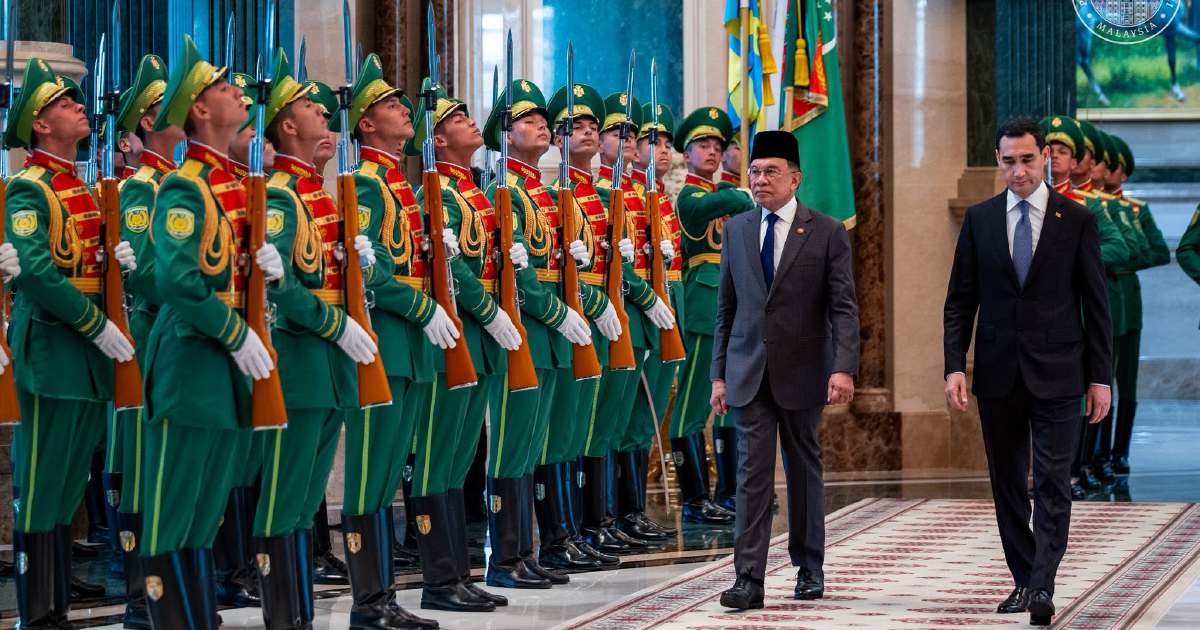
Prime Minister Datuk Seri Anwar Ibrahim arrived in Ashgabat today for a historic diplomatic mission, becoming the focus of an elaborate state reception at Turkmenistan's Presidential Palace. The ceremonial welcome underscores the significance both nations attach to strengthening bilateral relations in an era when Malaysia is actively expanding its footprint across emerging markets and strategic regions beyond Southeast Asia's conventional sphere.
This inaugural official visit since Anwar assumed office represents a calculated step in Malaysia's diversification strategy. Central Asia has become increasingly important to Kuala Lumpur's foreign policy calculations, particularly as the country seeks new partnerships to bolster trade opportunities, secure energy supplies, and establish diplomatic channels with resource-rich nations that offer complementary economic interests. Turkmenistan, as one of the world's leading natural gas producers with significant oil reserves, occupies a pivotal position in regional geopolitics and possesses commodities that Asian economies require for sustained development.
The opulence of the state reception reflects Ashgabat's deliberate attention to the Malaysian premier's arrival. Such ceremonial protocols are rarely extended without careful consideration of the relationship's potential trajectory and the visitor's standing. For Anwar, this treatment signals Turkmenistan's willingness to engage Malaysia at the highest levels, suggesting that preliminary discussions between diplomatic channels have been productive and that both governments see mutual benefit in deeper engagement across multiple sectors.
Malaysia's engagement with Central Asia traditionally remained limited compared to its diplomatic presence in the Middle East or Southeast Asia proper. However, the recent push to visit nations like Turkmenistan demonstrates a recalibrated approach to international relations, one that recognises the strategic value of constructing relationships across geographical divides. For Malaysian businesses, such visits often serve as catalysts for trade missions, investment explorations, and sector-specific partnerships that might not materialise without high-level political validation.
The timing of this visit merits consideration within the broader context of Malaysia's foreign policy priorities. As the nation seeks to navigate complex geopolitical currents—balancing relationships with traditional Western partners, managing ties with China, and fostering cooperation across the Islamic world—engagement with Central Asian nations provides Malaysia with additional diplomatic leeway and reduces its reliance on any single strategic partnership. Turkmenistan's position as a non-aligned nation, coupled with its energy wealth, makes it an attractive partner for countries pursuing diversified international portfolios.
For Turkmenistan, receiving Malaysia's Prime Minister carries its own symbolic weight. The nation has invested considerable resources in cultivating relationships with countries across Asia, seeking to establish itself as a central hub for energy security in a multipolar world. Malaysia's diplomatic outreach signals recognition of Turkmenistan's importance and suggests that Southeast Asian nations increasingly view Central Asian states as integral to regional stability and economic prosperity.
Trade potential between the two nations remains largely untapped despite their complementary economic profiles. Malaysia's expertise in petrochemicals, manufacturing, and financial services could find receptive markets in Turkmenistan, while Malaysian companies operating across Southeast Asia might leverage Central Asian connections for logistics and distribution networks. The Presidential Palace ceremony, while ceremonial in nature, typically precedes substantive negotiations on trade agreements, investment frameworks, and cultural exchanges that translate diplomatic courtesy into tangible economic benefits.
The visit also carries significance for regional observers monitoring Malaysia's strategic orientation. By expanding its engagement beyond traditional zones of influence, Anwar demonstrates commitment to an internationalist agenda that broadens the nation's options in an increasingly multipolar world. This approach appeals to Malaysian business interests seeking new markets and investors seeking stable, geopolitically strategic destinations for capital deployment.
Bilateral cooperation frameworks established during such high-level visits often extend across multiple dimensions. Beyond energy and trade, discussions typically encompass education exchanges, technological cooperation, cultural initiatives, and security arrangements. For Malaysia, building institutional linkages with Central Asian nations creates long-term value extending well beyond immediate economic transactions, establishing frameworks that younger generations of policymakers and business leaders can develop further.
The Presidential Palace setting adds weight to the occasion, as such venues typically host only the most significant state interactions. This choice of location suggests that Turkmenistan intends this engagement with Malaysia to set a precedent for future cooperation. The ceremonial aspects of the welcome—formal protocols, official photography, and protocol-driven interactions—establish the tone for substantive negotiations that likely followed or will follow in subsequent bilateral meetings scheduled during the visit.
From a broader Southeast Asian perspective, Malaysia's Central Asian initiatives influence how other regional nations calculate their own engagement strategies. As ASEAN members increasingly pursue bilateral relationships outside the formal bloc framework, Malaysian initiatives may inspire comparable outreach from neighbours, eventually reshaping patterns of regional diplomatic competition and cooperation. Turkmenistan benefits from this trend by gaining access to multiple Southeast Asian pathways for establishing relationships and securing partnerships.
The visit represents more than ceremonial diplomacy; it reflects evolving calculations about global economic geography and strategic positioning. For Malaysia, cultivating relationships in energy-rich Central Asia addresses long-term developmental needs while demonstrating diplomatic sophistication to international audiences. For Turkmenistan, engagement with substantial Southeast Asian economies like Malaysia reinforces its standing as a nation of international significance and expands its network of reliable partners across diverse regions and cultural contexts.

%22%2F%3E%3C%2Fpattern%3E%3C%2Fdefs%3E%3Crect%20width%3D%22100%25%22%20height%3D%22100%25%22%20fill%3D%22url(%23ph2hy9vg)%22%2F%3E%3Crect%20width%3D%22100%25%22%20height%3D%22100%25%22%20fill%3D%22url(%23ph2hy9vp)%22%2F%3E%3Ctext%20x%3D%2250%25%22%20y%3D%2250%25%22%20text-anchor%3D%22middle%22%20dominant-baseline%3D%22central%22%20fill%3D%22rgba(255%2C255%2C255%2C0.95)%22%20font-family%3D%22Georgia%2C%20'Times%20New%20Roman'%2C%20serif%22%20font-weight%3D%22700%22%20font-size%3D%22272%22%20letter-spacing%3D%22-0.02em%22%3EAnwar%3C%2Ftext%3E%3C%2Fsvg%3E)