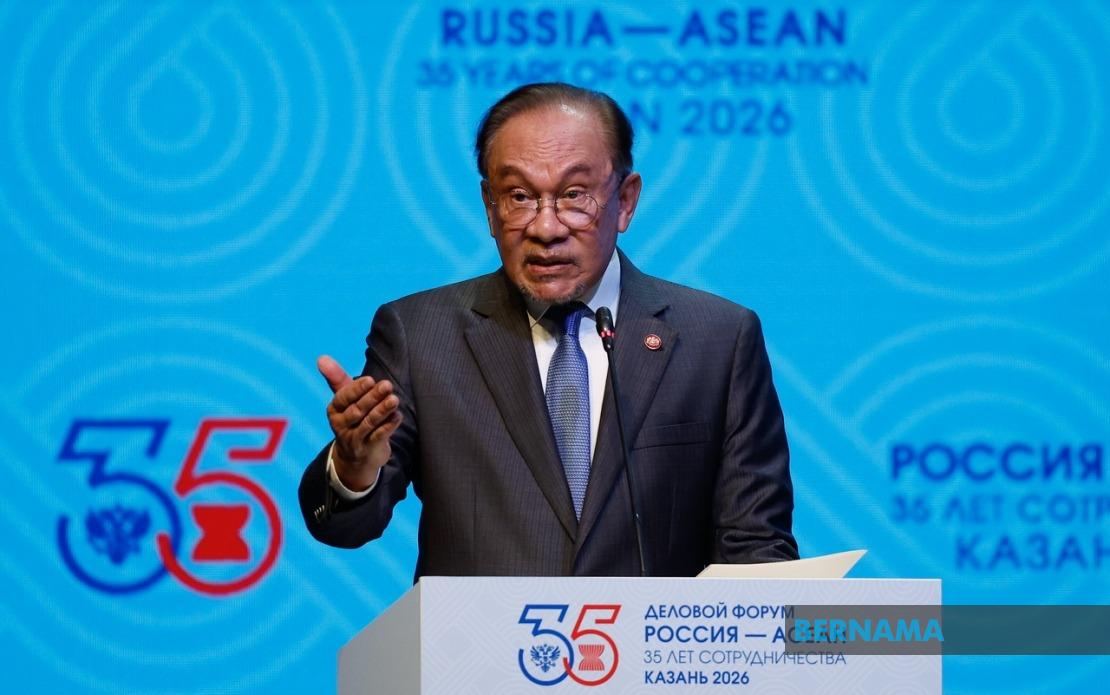
Prime Minister Datuk Seri Anwar Ibrahim has painted an ambitious picture of future ASEAN-Russia relations, arguing that the two sides have barely scratched the surface of their potential cooperation. Speaking at the ASEAN-Russia Business Forum in Kazan on June 17, Anwar outlined how platforms such as the gathering serve as crucial bridges for fostering understanding and deepening engagement between the bloc and Moscow at a time when both face shifting global dynamics.
The central thrust of Anwar's remarks centered on the disparity between ASEAN's mature economic partnerships with established powers and its comparatively underdeveloped relationship with Russia. He noted that while the bloc maintains robust trade and investment ties with the United States, China, and India, Moscow remains largely unexploited as an economic partner. This observation carries significant weight for Malaysian policymakers and business leaders seeking diversification opportunities beyond traditional markets, particularly as supply chain vulnerabilities and geopolitical tensions continue reshaping global commerce.
Anwar identified several sectors ripe for deepened collaboration between ASEAN and Russia. Energy security emerged as a paramount concern, reflecting the region's dependence on stable fuel supplies and Russia's substantial hydrocarbon reserves. Beyond energy, he highlighted cybersecurity, agricultural development, digital innovation, scientific research, and higher education as domains where mutual benefit could be realized. For Malaysia specifically, which sits at the crossroads of regional trade and technology development, such partnerships could enhance technological capabilities and provide alternative knowledge-sharing pathways independent of Western-dominated frameworks.
The Prime Minister drew particular attention to Tatarstan's rapid advancement in technology, science, research, education, and defence sectors. This focus on the Russian republic rather than exclusive engagement with Moscow proper underscores a pragmatic approach to bilateral relations, recognizing that innovation and development often concentrate in regional hubs rather than capital cities. Tatarstan's experience in rapid modernization could offer valuable lessons for Malaysian states seeking to accelerate their own development trajectories.
Anwar's recent conversation with Russian President Vladimir Putin was characterized as productive, with economic cooperation and energy security dominating the agenda. The timing of this engagement is noteworthy, occurring amid broader Western sanctions and geopolitical realignment following Russia's actions in Ukraine. For ASEAN nations navigating their traditional non-alignment principles while adapting to contemporary superpower competition, such high-level dialogues demonstrate the bloc's commitment to maintaining balanced relationships rather than taking hardline stances.
The discussion took an unexpected cultural turn when journalists inquired about the Russian songs frequently appearing on Anwar's Instagram account, including traditional pieces such as Matushka, Zemlya, and Kalinka Malinka. Rather than deflecting, Anwar embraced the lighter moment, explaining his genuine enjoyment of Russian music and noting that his family had similarly embraced these melodies. This candid response humanizes diplomatic engagement and suggests a personal dimension to official relations that extends beyond institutional frameworks.
When pressed further on musical preferences, Anwar pivoted to discussing his deep appreciation for Russian literature and poetry, citing his admiration for titans of the Russian literary canon including Leo Tolstoy, Anton Chekhov, and Boris Pasternak. He emphasized that many of these monumental works had been translated into Malay, making them accessible to Malaysian audiences and suggesting a long-standing cultural bridge between the nations that predates contemporary politics. His observation carries implications for how cultural diplomacy can support broader bilateral objectives, creating emotional and intellectual connections that transcend transactional relationships.
Crucially, Anwar articulated a holistic vision of statecraft in which culture, poetry, and literature hold equal standing alongside technology and economic cooperation. He contended that cultural exchanges generate the affection and mutual understanding necessary for genuine partnership, preventing purely mercenary or instrumental relationships. This perspective challenges the predominantly economic framing of modern international relations and suggests that sustainable partnerships require foundation in shared human experiences and intellectual traditions. For Southeast Asian nations balancing pragmatic commercial needs with deeper regional integration, this cultural dimension warrants greater attention.
Opening his forum remarks with a verse from celebrated Tatar poet Abdullah Tukay demonstrated Anwar's willingness to honor local cultural figures and demonstrate respect for regional heritage. Such gestures, though seemingly ceremonial, carry diplomatic weight by signaling genuine engagement with the host nation's identity rather than generic multilateral participation.
The conversation subsequently broadened to encompass pressing international challenges. Anwar referenced his communications with Iranian President Masoud Pezeshkian, Pakistani Prime Minister Shehbaz Sharif, Egyptian President Abdel Fattah El-Sisi, and Turkish President Recep Tayyip Erdogan, all of whom he characterized as seeking peaceful resolutions to escalating Iran-United States tensions. This multilateral networking reveals how middle-power nations like Malaysia maintain diplomatic activism by convening diverse stakeholders around shared peace objectives, positioning ASEAN and its leaders as potential mediators in conflicts extending beyond the region.
The session concluded with Anwar addressing the Gaza humanitarian crisis, an issue on which he has consistently advocated forcefully. He castigated what he termed a failure of the international community to uphold universal humanitarian principles, criticizing apparent double standards in how democratic values and human rights protections are selectively applied depending on geopolitical interests. His assertion that systematic violence against civilian populations, particularly children and women, cannot be reconciled with claimed commitment to human rights principles reflects growing frustration within the Global South regarding perceived inconsistency in international justice and accountability standards.
Anwar's characterization of the Gaza situation as revealing fundamental hypocrisy in the international system resonates across Muslim-majority nations and developing economies that perceive Western-led institutions as serving narrow great-power interests. This public stance, delivered during a high-profile international forum, reinforces Malaysia's positioning as a voice for the Global South on issues of conscience while simultaneously demonstrating how economic engagement and principled advocacy can coexist rather than contradict one another.
The two-day working visit to Kazan for the ASEAN-Russia Commemorative Summit provided Anwar a platform to advance multiple diplomatic objectives simultaneously: deepening economic partnerships, emphasizing ASEAN's non-aligned posture, articulating concerns about global justice, and demonstrating Malaysia's role as a thoughtful steward of regional interests within the broader international order. His multifaceted engagement suggests that contemporary diplomacy requires navigating economic realities, cultural affinities, security considerations, and moral imperatives simultaneously.
%22%2F%3E%3C%2Fpattern%3E%3C%2Fdefs%3E%3Crect%20width%3D%22100%25%22%20height%3D%22100%25%22%20fill%3D%22url(%23ph2hy9vg)%22%2F%3E%3Crect%20width%3D%22100%25%22%20height%3D%22100%25%22%20fill%3D%22url(%23ph2hy9vp)%22%2F%3E%3Ctext%20x%3D%2250%25%22%20y%3D%2250%25%22%20text-anchor%3D%22middle%22%20dominant-baseline%3D%22central%22%20fill%3D%22rgba(255%2C255%2C255%2C0.95)%22%20font-family%3D%22Georgia%2C%20'Times%20New%20Roman'%2C%20serif%22%20font-weight%3D%22700%22%20font-size%3D%22272%22%20letter-spacing%3D%22-0.02em%22%3EAnwar%3C%2Ftext%3E%3C%2Fsvg%3E)