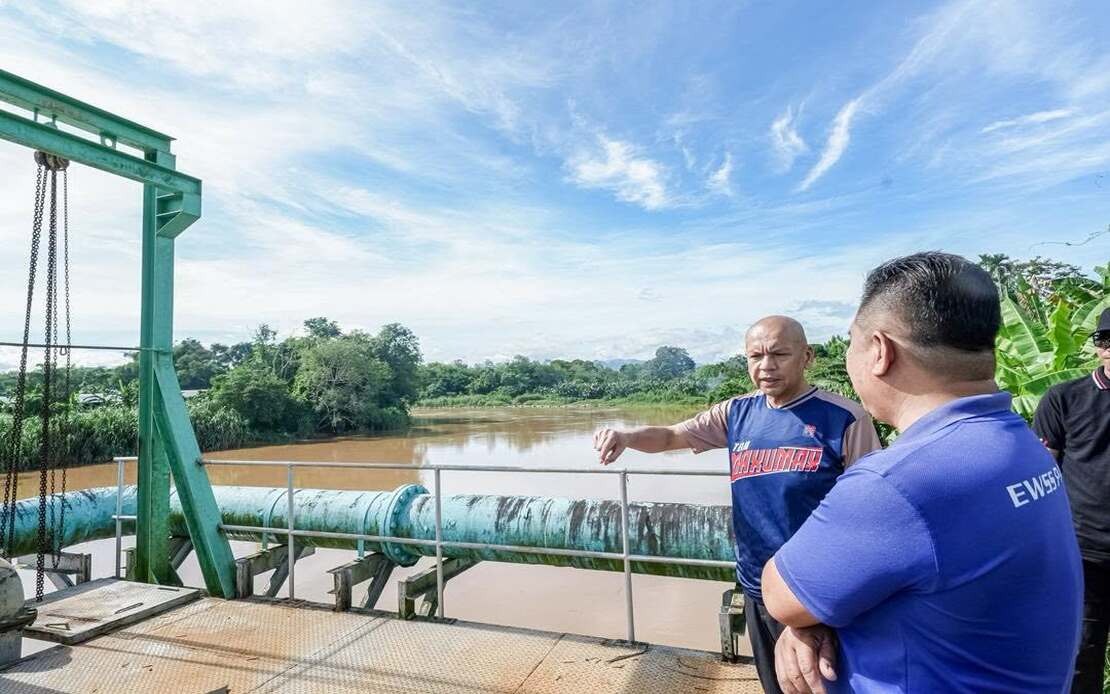
Datuk Armizan Mohd Ali, who serves as both Domestic Trade and Cost of Living Minister and Member of Parliament for Papar, has undertaken a detailed review of the district's water supply infrastructure to gauge progress on critical stabilisation initiatives. The inspection comes in the wake of a June 15 coordinating meeting that assessed the implementation status of several water projects designed to alleviate persistent supply constraints affecting residents across the district.
Two major upgrade schemes are currently advancing in Papar. The first involves expanding the Kogopon Water Treatment Plant's daily processing capacity from 40 million litres to 80 million litres—a doubling of output that reflects the rapid increase in demand the district has experienced. The second undertaking centres on upgrading the Kampung Kabang intake facility, which serves as a critical collection point for raw water entering the treatment system. Together, these projects represent a substantial commitment to enhancing both the volume and operational resilience of Papar's water infrastructure.
Water supply challenges in Papar have intensified as the district's population and economic activity have expanded, straining facilities designed for lower demand. The upgrade initiatives are framed as essential measures to bridge the widening gap between current supply capacity and actual consumption patterns. For Malaysian readers familiar with similar infrastructure pressures in rapidly developing regions, these expansions underscore the ongoing challenge of synchronising utility investment with demographic and economic growth.
During his inspection, Armizan also assessed two operational facilities—the EWSS Plant and the JETAMA Limbahau Plant—which had both experienced temporary shutdowns in the preceding week. The disruptions stemmed from elevated nephelometric turbidity unit (NTU) values in the raw water entering these plants. Turbidity, which measures suspended particles and sediment in water, is a critical quality parameter; excessively high levels can overwhelm treatment processes and compromise the safety of the final product delivered to consumers.
The temporary closures of both plants underscored an immediate vulnerability in Papar's water supply chain. When multiple facilities simultaneously encounter raw water quality degradation, the redundancy built into the system is severely tested, leaving residents with reduced supply and potential service interruptions. The incidents highlighted how external factors—such as seasonal variations, upstream erosion, or industrial discharge—can cascade through the distribution network and create service gaps that affect thousands of households and businesses.
Armizan's decision to conduct direct on-site monitoring reflects an operational approach that prioritises first-hand assessment over reliance on routine reports. By observing treatment plant operations, inspection protocols, and response procedures in real time, senior officials can identify bottlenecks and implementation gaps that might not be apparent from administrative documentation alone. This methodology has become increasingly common in Malaysian water management, where visibility into field-level challenges informs policy adjustments and resource allocation decisions.
The minister's statement emphasised that such field engagement is vital for obtaining an accurate understanding of the challenges confronting Papar's water infrastructure. Beyond the technical specifications of the upgrade projects, officials must also navigate operational realities—including staff capabilities, maintenance schedules, and coordination with upstream water sources. These practical dimensions often determine whether expansions of capacity actually translate into improved consumer experience.
For Papar residents and businesses, the combination of ongoing plant upgrades and recent supply disruptions creates a transitional period marked by both promise and uncertainty. The Kogopon plant expansion should eventually deliver more consistent supply, but the timeline for completion and the pace at which it brings relief remain critical questions. Meanwhile, the raw water turbidity incidents suggest that even as capacity increases, the district must simultaneously address quality and source management challenges.
The inspection also signals broader departmental attention to Sabah's water sector, which has long struggled with infrastructure limitations relative to the peninsula's major urban centres. Papar's proximity to Kota Kinabalu and its role as a growing commercial hub have amplified the urgency of these interventions. Success in stabilising supply here could inform approaches to water challenges in other East Malaysian districts facing similar developmental pressures.
Armizan's involvement as both MP and minister provides Papar constituents with dual channels of advocacy and oversight. The political accountability attached to his constituency role, combined with his ministerial authority over cost-of-living issues—which include water tariffs and service reliability—creates potential leverage for pressing improvements across multiple fronts. This convergence of roles often accelerates administrative responses to infrastructure issues, particularly when public attention is sustained.
The two projects now under implementation will require sustained coordination among federal and state agencies, contractors, and water authorities. Progress benchmarks and realistic completion dates will need to be communicated transparently to residents who have endured service disruptions. The June 15 meeting and subsequent field inspection suggest that oversight mechanisms are being activated, though the durability of such attention and the adequacy of allocated resources remain to be demonstrated through tangible improvements in supply reliability and treatment capacity.
Looking ahead, Papar's experience with the current stabilisation projects and recent operational challenges will yield important lessons for Malaysian water management more broadly. As climate variability, population growth, and industrial development converge to stress water systems across the region, districts like Papar serve as test cases for infrastructure investment strategies and operational adaptation. The extent to which these initiatives succeed will partly determine public confidence in Malaysia's ability to manage one of the most essential utilities, even as demand continues to rise.


%22%2F%3E%3C%2Fpattern%3E%3C%2Fdefs%3E%3Crect%20width%3D%22100%25%22%20height%3D%22100%25%22%20fill%3D%22url(%23ph2hy9vg)%22%2F%3E%3Crect%20width%3D%22100%25%22%20height%3D%22100%25%22%20fill%3D%22url(%23ph2hy9vp)%22%2F%3E%3Ctext%20x%3D%2250%25%22%20y%3D%2250%25%22%20text-anchor%3D%22middle%22%20dominant-baseline%3D%22central%22%20fill%3D%22rgba(255%2C255%2C255%2C0.95)%22%20font-family%3D%22Georgia%2C%20'Times%20New%20Roman'%2C%20serif%22%20font-weight%3D%22700%22%20font-size%3D%22272%22%20letter-spacing%3D%22-0.02em%22%3EAnwar%3C%2Ftext%3E%3C%2Fsvg%3E)