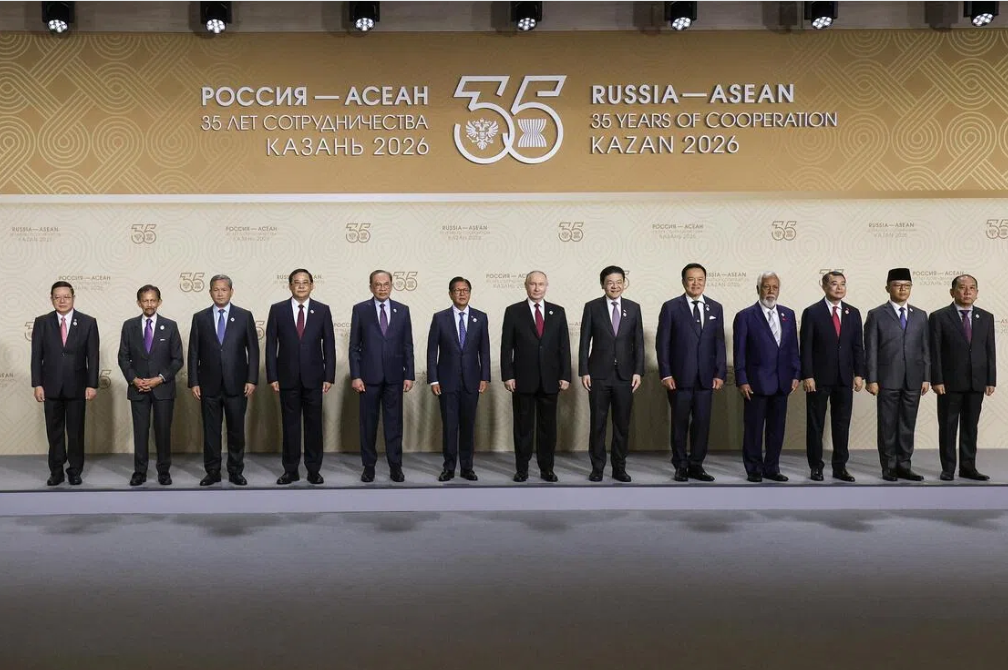
Regional leaders gathered in Kazan this week to reinvigorate partnership between Asean and Russia, marking three and a half decades of diplomatic engagement through a series of formal commitments designed to broaden cooperation across multiple strategic domains. The Asean-Russia Commemorative Summit, convened on June 17 and 18 under the patronage of Russian President Vladimir Putin, served as both a retrospective on shared achievements and a blueprint for intensified collaboration through 2030, underscoring Moscow's continuing interest in maintaining meaningful dialogue with Southeast Asia despite geopolitical tensions elsewhere.
Three major documents emerged from the gathering, each addressing different dimensions of the bilateral relationship. The Kazan Declaration represents the most comprehensive instrument, functioning as a formal review of three decades of Asean-Russia Dialogue Partnership alongside the broader 35-year arc of state-to-state relations. Beyond ceremonial acknowledgment, this declaration explicitly identifies priority sectors for enhanced engagement, encompassing maritime cooperation, trade and investment flows, energy partnerships, infrastructure connectivity, security coordination, educational exchanges, and cultural initiatives. These designations carry practical significance for the region, as they signal areas where Southeast Asian governments and Russian counterparts will direct institutional resources and diplomatic attention.
Complementing the overarching declaration, negotiators adopted a Joint Statement on Cultural Cooperation that prioritises strengthening interpersonal connections between Russian and Southeast Asian populations. This framework recognizes that sustainable international relations depend not merely on governmental transactions but on deeper societal bonds cultivated through educational mobility, artistic exchange, and civil society interaction. The agreement equally underscores recognition that Russia possesses distinctive cultural and intellectual resources valuable to Asean member states, a consideration that transcends current geopolitical polarization.
The third instrument, the Asean-Russia Comprehensive Plan of Action spanning 2026 to 2030, operationalizes broad aspirations into concrete programmatic elements. This five-year roadmap transforms abstract commitments into measurable initiatives with defined timelines, responsible institutions, and performance metrics. For Malaysian policymakers and business leaders monitoring regional dynamics, such structured planning frameworks indicate stability and predictability in bilateral government-to-government engagement, potentially creating opportunities for private sector partnerships in designated cooperation zones.
Singapore's Prime Minister Lawrence Wong articulated a notably nuanced position during summit proceedings, emphasizing that pragmatic cooperation should flourish in domains where interests naturally converge, particularly disaster management coordination and narcotics trafficking suppression. These specific mentions carry particular resonance throughout Southeast Asia, where transnational challenges routinely overwhelm individual state capacities. Wong simultaneously reaffirmed Asean's foundational principle of centrality, validating Russia's sustained participation in region-led multilateral mechanisms including the Asean Regional Forum and East Asia Summit, institutional structures that Russia has historically valued as platforms for maintaining influence in Asian affairs.
Wong's remarks also illuminated the delicate diplomatic balance Asean nations, including Malaysia, must navigate when engaging major powers with whom they maintain fundamentally different strategic orientations. His reference to consistent advocacy for principles of sovereignty, territorial integrity, and peaceful dispute resolution—coupled with acknowledgment of Singapore's sanctions against Russia over Ukraine—demonstrates how regional states can maintain principled positions on international law while simultaneously preserving practical diplomatic channels. This approach differs markedly from Cold War-era alignment models, instead reflecting contemporary Southeast Asian pragmatism where nations refuse binary choices between competing blocs.
The educational dimension warrants particular attention for its implications across the region. Wong's observation that Russian officials regularly participate in civil service training programmes throughout Asean, including Singapore's institutions, points to a often-overlooked mechanism for cultivating long-term bilateral understanding. Similar programmes involving Malaysian civil servants, academics, and emerging policymakers create cadres of officials whose formative professional experiences included exposure to Russian perspectives on governance, security, and regional order. These networks, accumulating over decades, generate soft power effects considerably more subtle yet potentially more durable than formal diplomatic protocols.
Singapore's emphasis on its forthcoming rotational chairmanship of Asean during 2027 carries strategic implications for Russia's continuing regional role. By explicitly inviting Russian participation in leadership-level forums during Singapore's tenure, Wong signaled that maintaining Moscow's constructive engagement with Asean constitutes a priority transcending current geopolitical friction. Malaysia's own experience with Asean leadership rotations demonstrates how chair nations leverage institutional authority to shape regional agendas and deepen partnerships with strategic partners, a precedent Singapore appears poised to replicate regarding Russia relations.
Wong's bilateral engagement with President Putin himself, conducted at the Russian leader's initiative, suggests Moscow's deliberate intention to maintain high-level communication channels with significant Southeast Asian actors. Such personal diplomacy, occurring within the formal summit structure, allows both sides to address concerns beyond public declarations while reinforcing commitment to dialogue over confrontation. The separate meeting between Wong and Tatarstan's Rais Rustam Minnikhanov further illustrates the multi-layered character of Asean-Russia relations, extending beyond federal structures to encompass regional governments within Russia possessing distinct economic and cultural interests in Southeast Asian engagement.
The timing and substance of this summit reflect evolving regional dynamics wherein Southeast Asian nations increasingly resist pressure to choose between competing geopolitical visions, instead cultivating deliberate relationships with diverse partners across ideological spectrums. For Malaysia specifically, the Kazan gathering provides instructive example of how to maintain substantive cooperation with Russia across noncontroversial domains while preserving critical distance regarding contested international issues. Energy collaboration, maritime security, educational exchange, and cultural promotion offer genuine mutual benefits without requiring Southeast Asian endorsement of Russian foreign policy preferences elsewhere.
Looking forward, the 2026-2030 action plan will determine whether these diplomatic reaffirmations translate into tangible institutional development and increased bilateral transaction volume. Success metrics will emerge in subsequent years as Asean and Russian entities implement specific projects across designated cooperation sectors. For Malaysian observers, particular attention should focus on how Russia's energy sector participation evolves in Southeast Asia, whether educational exchange numbers grow measurably, and whether maritime security cooperation produces concrete operational outcomes benefiting regional stability.
The summit ultimately illustrates Asean's continuing capacity to engage major powers on terms reflecting regional interests rather than great power competition. By simultaneously welcoming Russia's participation in institution-building while maintaining principled positions on international law violations, Asean demonstrates diplomatic maturity that transcends simplistic alliance formation. This sophisticated approach, exemplified through Singapore's articulated positions, represents the strategic orientation increasingly necessary for Southeast Asian nations navigating multipolar international environments where rigid alignment proves counterproductive to regional prosperity and security.

%22%2F%3E%3C%2Fpattern%3E%3C%2Fdefs%3E%3Crect%20width%3D%22100%25%22%20height%3D%22100%25%22%20fill%3D%22url(%23ph2hy9vg)%22%2F%3E%3Crect%20width%3D%22100%25%22%20height%3D%22100%25%22%20fill%3D%22url(%23ph2hy9vp)%22%2F%3E%3Ctext%20x%3D%2250%25%22%20y%3D%2250%25%22%20text-anchor%3D%22middle%22%20dominant-baseline%3D%22central%22%20fill%3D%22rgba(255%2C255%2C255%2C0.95)%22%20font-family%3D%22Georgia%2C%20'Times%20New%20Roman'%2C%20serif%22%20font-weight%3D%22700%22%20font-size%3D%22272%22%20letter-spacing%3D%22-0.02em%22%3EAnwar%3C%2Ftext%3E%3C%2Fsvg%3E)