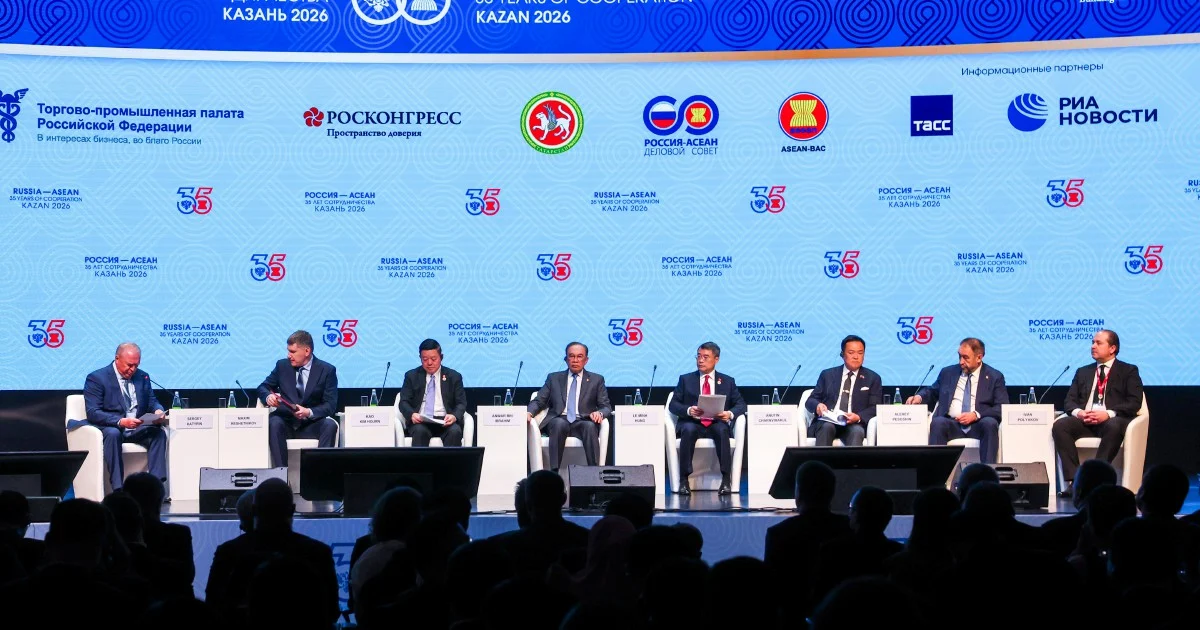
Prime Minister Datuk Seri Anwar Ibrahim has called for Asean and Russia to significantly broaden their engagement across multiple strategic sectors, signalling Malaysia's commitment to fostering closer ties between the regional bloc and Moscow during a visit to Kazan. The appeal highlights an important shift in regional diplomacy as Southeast Asia seeks to maintain balanced relationships with major powers amid shifting geopolitical currents in the Indo-Pacific.
Anwar's remarks underscore growing recognition within Asean capitals that strengthened cooperation with Russia could help address pressing challenges facing the region. The emphasis on food security reflects concerns that have intensified following global supply chain disruptions in recent years. Southeast Asia, home to more than 650 million people, remains vulnerable to fluctuations in grain and food commodity markets, particularly as the region's agricultural sectors face mounting pressure from climate change, urbanisation and land scarcity. Expanded partnerships with Russia, a major exporter of grains and fertilisers, could offer greater stability and diversification for countries seeking to reduce over-dependence on traditional suppliers from North America and Europe.
The energy dimension carries particular weight for Asean economies grappling with rising demand and the dual imperatives of affordability and sustainability. Russia's hydrocarbon resources and advanced energy technologies represent potential sources of supply diversification, though such engagement must be calibrated carefully given Western sanctions regimes and their potential complications for regional trade. For energy-importing nations within Asean, including Malaysia, Singapore and Thailand, exploring alternative energy suppliers and technological partnerships becomes increasingly relevant as global energy markets remain volatile and contested.
Beyond commodities and conventional resources, Anwar's agenda encompassing advanced manufacturing and digital technologies suggests a forward-looking approach to regional development. Asean nations are competing to position themselves within global supply chains and technological ecosystems. Russia's capabilities in aerospace, advanced manufacturing, information technology and industrial automation could complement Asean's labour-intensive sectors and emerging tech hubs, creating complementary partnerships rather than zero-sum competition.
The inclusion of education within this cooperation framework reflects understanding that durable partnerships require human capital development and institutional knowledge exchange. Educational collaboration between Asean universities and Russian institutions could produce skilled workforces capable of managing increasingly complex technological and industrial challenges. Such programmes also create long-term diplomatic goodwill and soft power benefits that transcend immediate economic transactions.
Anwar's positioning of this agenda from Kazan, Russia's major city in the Volga region, carries symbolic weight. The location underscores that engagement is not confined to bilateral Malaysia-Russia relations but extends to broader Asean-Russia mechanisms and forums. This multilateral framing distinguishes such cooperation from purely transactional bilateral agreements and suggests movement toward institutionalised frameworks for ongoing coordination.
For Malaysia specifically, deeper Asean-Russia cooperation holds several implications. As a middle-income country with diversified economic interests spanning energy, manufacturing, finance and technology, Malaysia stands to benefit from expanded access to Russian markets and technical expertise. Malaysian companies in petrochemicals, palm oil refining and electronics manufacturing could potentially find new opportunities within Russian markets and supply chains, particularly if Western sanctions push Russia toward Asian partners.
However, Asean nations must navigate these partnerships with awareness of geopolitical sensitivities. Southeast Asia's strategic location and resources make the region a focus for major powers including the United States, China, India and Japan. Expanded Russia ties must be pursued through frameworks that reinforce rather than undermine Asean centrality and strategic autonomy. The bloc's fundamental principle of equidistance and non-alignment remains essential for maintaining regional stability and preventing the region from becoming a proxy battlefield for great power competition.
The emphasis on expanding cooperation across diverse sectors rather than focusing narrowly on any single area suggests a comprehensive approach to bilateral relations. This breadth demonstrates that Asean-Russia engagement transcends traditional Cold War categories or simple transactional frameworks. Instead, it reflects mutual recognition of shared interests in addressing complex, multidimensional challenges ranging from climate adaptation to technological advancement.
Moving forward, the practical implementation of these cooperation initiatives will determine their significance. Asean and Russia will need to establish concrete mechanisms, funding frameworks, and institutional arrangements to translate diplomatic rhetoric into tangible outcomes. Trade data, investment flows, technology transfers, and educational exchange numbers will ultimately measure the success of such initiatives.
For Malaysia and other Asean members, this engagement with Russia represents an opportunity to pursue independent foreign policy positioning that serves regional interests while maintaining the strategic flexibility necessary in an increasingly complex Indo-Pacific environment. The challenge lies in deepening beneficial partnerships while ensuring that such cooperation strengthens rather than fractures regional cohesion and association principles.

%22%2F%3E%3C%2Fpattern%3E%3C%2Fdefs%3E%3Crect%20width%3D%22100%25%22%20height%3D%22100%25%22%20fill%3D%22url(%23ph2hy9vg)%22%2F%3E%3Crect%20width%3D%22100%25%22%20height%3D%22100%25%22%20fill%3D%22url(%23ph2hy9vp)%22%2F%3E%3Ctext%20x%3D%2250%25%22%20y%3D%2250%25%22%20text-anchor%3D%22middle%22%20dominant-baseline%3D%22central%22%20fill%3D%22rgba(255%2C255%2C255%2C0.95)%22%20font-family%3D%22Georgia%2C%20'Times%20New%20Roman'%2C%20serif%22%20font-weight%3D%22700%22%20font-size%3D%22272%22%20letter-spacing%3D%22-0.02em%22%3EAnwar%3C%2Ftext%3E%3C%2Fsvg%3E)