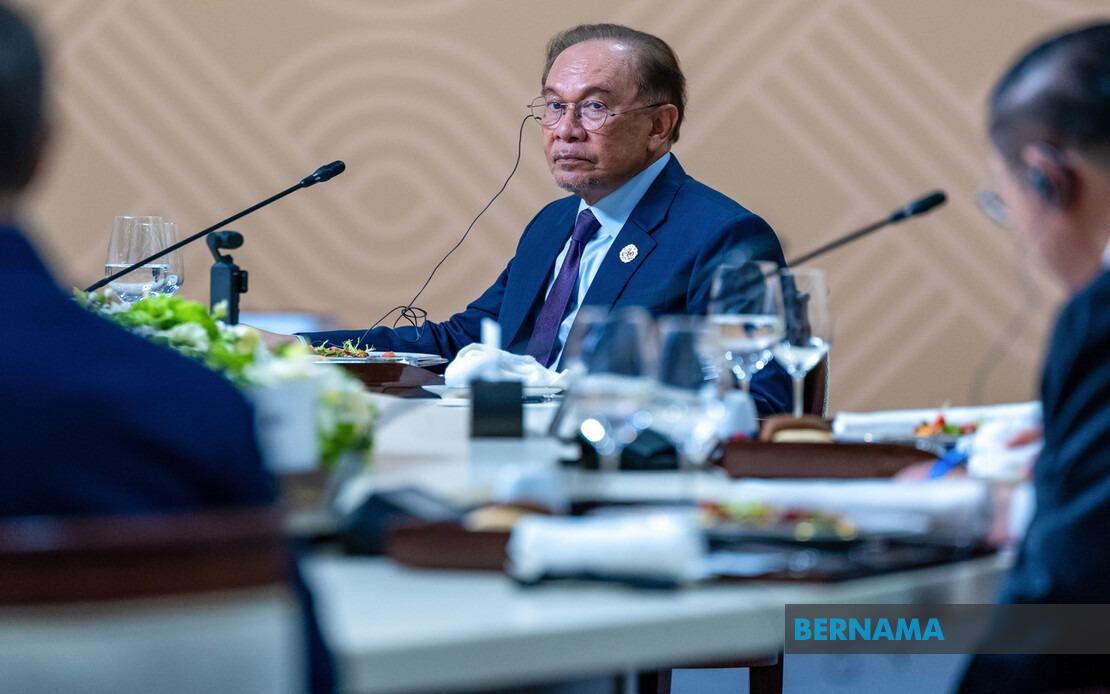
Prime Minister Datuk Seri Anwar Ibrahim has called for the Association of Southeast Asian Nations and the Shanghai Cooperation Organisation to marshal their collective strength against transnational crime and energy insecurity, arguing that neither challenge can be effectively addressed through isolated national efforts alone. Speaking during an ASEAN-Russia working lunch in Kazan on June 18, the Prime Minister underscored that both organizations possess the institutional frameworks necessary to deepen cooperation and drive meaningful progress on these critical fronts.
The two blocs already rest on a solid foundation established through their 2005 memorandum of understanding, which explicitly encompasses counter-terrorism initiatives, narcotics control, money laundering prevention, and economic and financial cooperation. This existing architecture provides the legal and diplomatic scaffolding upon which more ambitious collaboration can be constructed. Rather than creating entirely new mechanisms, Anwar advocated for leveraging and strengthening these established pathways, directing resources and political attention toward concrete deliverables that can be measured and assessed within realistic timeframes.
The challenge posed by cross-border criminal networks has grown more acute as digital connectivity and porous borders enable illicit actors to move faster than government enforcement responses. Online fraud schemes, sophisticated money laundering operations, and human trafficking networks increasingly transcend national jurisdictions, creating enforcement gaps that individual nations struggle to close independently. Anwar stressed that shared intelligence platforms and capacity-building initiatives would generate substantial mutual benefits, allowing member states to respond more swiftly and effectively to criminal activity that respects no borders. By establishing information-sharing mechanisms and harmonizing investigative procedures, ASEAN and SCO nations could substantially raise the costs for transnational criminal enterprises.
On energy matters, Anwar highlighted the structural advantages that the SCO alliance possesses. The organization unites major hydrocarbon producers with advanced technological expertise in energy systems, creating opportunities for practical cooperation on energy security during a period of global transition toward lower-carbon sources. The SCO's membership includes significant energy players such as Russia, Kazakhstan, and Iran, alongside emerging economies with expanding energy demands like India and Pakistan. This combination of supply, demand, and technical capacity offers a powerful platform for constructing resilient regional energy networks.
Malaysia's vision for energy cooperation extends beyond conventional hydrocarbon trading toward a sophisticated agenda encompassing efficiency improvements, grid modernization, liquefied natural gas expansion, and renewable energy integration. Anwar, who doubles as Finance Minister, positioned technological knowledge-sharing on safety protocols and system resilience as essential components of this broader energy partnership. Such cooperation would benefit member states facing similar infrastructure challenges and climatic pressures, allowing them to learn from one another's experiences and avoid costly mistakes in deploying new technologies.
The SCO itself represents a substantial geopolitical and economic entity, having evolved since its 2001 establishment into a multifaceted organization spanning political, economic, and security dimensions. The ten full member states and two observer nations encompass more than three billion people and collectively represent significant portions of global GDP and energy reserves. This scope means that cooperation frameworks developed within SCO structures possess implications extending far beyond the organization itself, potentially influencing regional stability and economic patterns across much of Asia and beyond.
Anwar extended his cooperative vision to encompass the Eurasian Economic Union, another major regional bloc with which ASEAN already maintains formal frameworks. He argued that existing agreements between ASEAN and the EAEU should serve as platforms for intensified business engagement and commercial cooperation, rather than remaining merely symbolic diplomatic instruments. Such activation would require deliberate steps to boost private sector interaction across both regions, enabling companies to participate in trade events and investment forums while building awareness of opportunities on both sides.
Small and medium-sized enterprises in both ASEAN and EAEU nations face particular barriers when seeking to operate across the other region, including unfamiliar regulatory environments, technological gaps, and limited market knowledge. Anwar identified targeted support mechanisms for these smaller firms as a priority, encompassing preferential market access arrangements, technology transfer initiatives, and skills development programs. Such support would distribute the benefits of expanded regional cooperation more equitably across enterprise populations rather than concentrating advantages among large multinational corporations.
Future collaboration opportunities extend into domains that barely existed during previous decades of regional cooperation frameworks. The digital economy represents an increasingly vital sector for both ASEAN and EAEU nations, yet cross-regional competition in artificial intelligence, e-commerce, and digital payments remains largely uncoordinated. Cybersecurity concerns accompany this digital expansion, as interconnected systems create vulnerabilities that transcend traditional boundaries. Additionally, food security—highlighted by recent global supply chain disruptions and climate variability—demands coordinated approaches to agricultural productivity, logistics, and emergency reserves across regions that collectively feed billions of people.
The Prime Minister undertook his Kazan visit to participate in the ASEAN-Russia Commemorative Summit, a gathering reflecting the deepening engagement between the Southeast Asian bloc and Moscow despite broader geopolitical tensions. Such high-level diplomatic engagement demonstrates commitment to maintaining regional dialogue channels and exploring practical cooperation avenues even amid complex international relations. For Malaysia specifically, positioned as a bridge economy with interests across multiple regional alignments, such multilateral engagement reinforces the nation's role as a participant in diverse cooperative frameworks rather than aligning exclusively with any single bloc.
Anwar's emphasis on pooling resources and building on existing institutional foundations reflects a pragmatic approach to regional cooperation that acknowledges resource constraints and decision-making complexities within multilateral organizations. Rather than proposing ambitious new initiatives requiring extensive consensus-building, his framework focuses on activating dormant capabilities and redirecting existing organizational machinery toward priority challenges. This incrementalist strategy, while potentially less transformative than comprehensive institutional reforms, offers greater likelihood of achieving measurable progress and demonstrating concrete benefits to member state populations.

%22%2F%3E%3C%2Fpattern%3E%3C%2Fdefs%3E%3Crect%20width%3D%22100%25%22%20height%3D%22100%25%22%20fill%3D%22url(%23ph2hy9vg)%22%2F%3E%3Crect%20width%3D%22100%25%22%20height%3D%22100%25%22%20fill%3D%22url(%23ph2hy9vp)%22%2F%3E%3Ctext%20x%3D%2250%25%22%20y%3D%2250%25%22%20text-anchor%3D%22middle%22%20dominant-baseline%3D%22central%22%20fill%3D%22rgba(255%2C255%2C255%2C0.95)%22%20font-family%3D%22Georgia%2C%20'Times%20New%20Roman'%2C%20serif%22%20font-weight%3D%22700%22%20font-size%3D%22272%22%20letter-spacing%3D%22-0.02em%22%3EAnwar%3C%2Ftext%3E%3C%2Fsvg%3E)