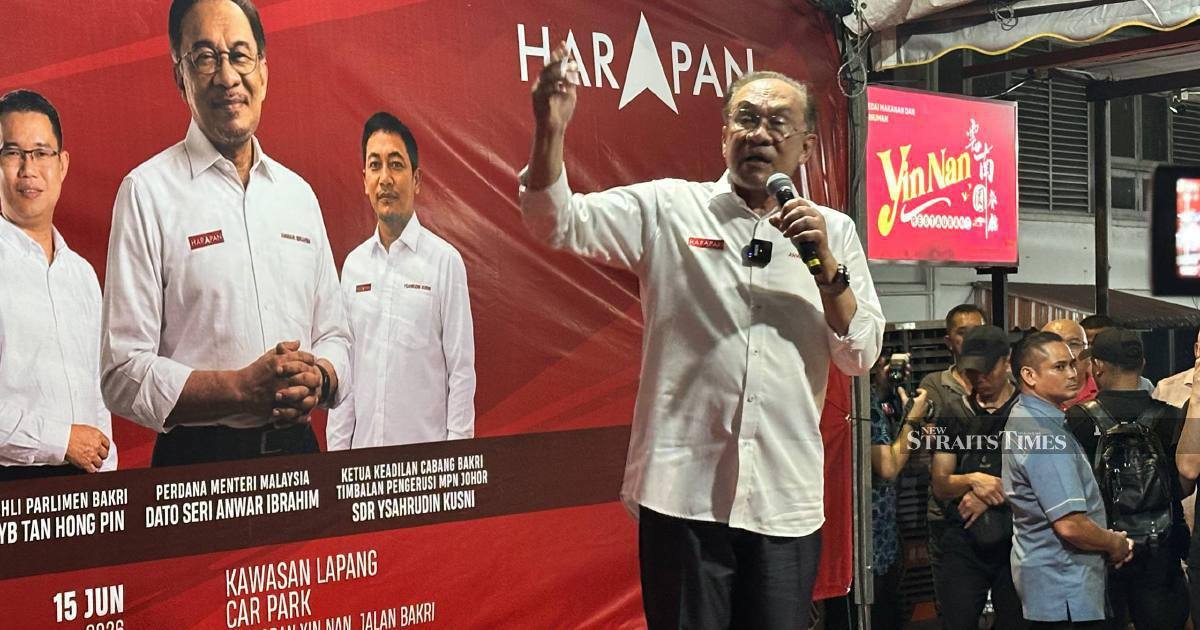
Prime Minister Datuk Seri Anwar Ibrahim has moved to address concerns about Malaysia's foreign policy independence, emphasizing that maintaining strong diplomatic relations with global heavyweights China and the United States does not erode the nation's principled stance on international matters. Speaking in Muar, Anwar sought to clarify the government's approach to managing relationships with competing superpowers while preserving Malaysia's distinct identity and values in global affairs.
The Prime Minister's remarks come at a particularly sensitive time in Southeast Asian geopolitics, where smaller nations face increasing pressure to align with one or another major power. Malaysia's position as a non-aligned country with significant economic and security interests spanning both the Indo-Pacific and the broader Asia-Pacific region has long required careful diplomatic choreography. Anwar's comments appear designed to reassure both domestic stakeholders and international partners that Malaysia will not compromise its autonomy or principles in pursuit of closer bilateral relations.
For Malaysia, the challenge of managing great power relations is not merely abstract. The country sits at a geographic and economic crossroads, with crucial maritime trade routes passing through its waters and territories. China's growing economic influence and military presence in the region, coupled with the United States' sustained strategic interest in maintaining its traditional role as a stabilizing force in Southeast Asia, creates a complex environment where Malaysia must navigate between competing interests. The government's ability to articulate a clear message about maintaining principle-based foreign policy is thus critical for both domestic confidence and regional stability.
Anwar's assertion reflects a broader Malaysian perspective that the nation can maintain substantive partnerships with different powers without forfeiting its fundamental values. This approach aligns with historical Malaysian practice of balancing external relationships while preserving domestic and regional autonomy. The government appears to be signalling that economic cooperation, defense partnerships, and diplomatic engagement with Beijing and Washington need not come at the cost of Malaysia's positions on matters such as human rights, maritime sovereignty, or regional development.
The timing of these remarks also speaks to domestic political considerations. Opposition figures and civil society organizations in Malaysia have periodically raised concerns about the country's growing economic dependence on China, particularly regarding investments in major infrastructure projects and manufacturing. By explicitly stating that diplomatic proximity does not translate to compromised principles, Anwar provides reassurance to constituents worried about Malaysia's strategic autonomy and decision-making independence.
From a regional perspective, Malaysia's framing of its diplomatic approach carries significance for other Southeast Asian nations facing similar dilemmas. Countries like Vietnam, Indonesia, and the Philippines grapple with comparable challenges in maintaining balanced relationships with competing powers. Malaysia's articulation of a principled, non-aligned approach could influence how ASEAN as a collective body continues to navigate great power competition while seeking to preserve the regional centrality that member states have traditionally claimed.
The distinction Anwar draws between maintaining good relations and compromising principles reflects an important diplomatic sophistication. Many developing nations have historically discovered that economic partnerships can create subtle pressures toward political accommodation or acquiescence on matters of international principle. Malaysia's experience over recent decades has included periods where closer ties to particular powers were followed by concerns about decision-making autonomy. The Prime Minister's explicit clarification suggests the government is conscious of these historical patterns and determined to chart a course that avoids them.
In practical terms, Anwar's message suggests Malaysia will continue to pursue economic and security partnerships with both China and the United States while reserving the right to take independent positions on international issues according to national interest and established principles. This includes Malaysia's traditional emphasis on respect for international law, national sovereignty, and peaceful resolution of disputes—positions that do not necessarily align completely with either Beijing's or Washington's stated preferences in every regional dispute.
The government's clarity on this matter also matters for Malaysia's role within ASEAN. The regional grouping has repeatedly affirmed its commitment to centrality in Asian geopolitics and to maintaining unity in its engagement with external powers. Individual member states positioning themselves as aligned with one major power or another threatens this collective stance. By reaffirming Malaysia's commitment to principle-guided foreign policy independent of great power preference, Anwar buttresses ASEAN's collective diplomatic posture.
Looking forward, how Malaysia manages its relationships with China and the United States will likely define much of Southeast Asia's geopolitical trajectory over the coming decade. The region's stability depends on smaller nations being able to benefit from engagement with multiple powers while retaining sufficient autonomy to shape their own futures. Anwar's remarks signal that the Malaysian government understands this critical balance and intends to maintain it, regardless of the attractions or pressures that come with closer ties to either Washington or Beijing.

%22%2F%3E%3C%2Fpattern%3E%3C%2Fdefs%3E%3Crect%20width%3D%22100%25%22%20height%3D%22100%25%22%20fill%3D%22url(%23ph2hy9vg)%22%2F%3E%3Crect%20width%3D%22100%25%22%20height%3D%22100%25%22%20fill%3D%22url(%23ph2hy9vp)%22%2F%3E%3Ctext%20x%3D%2250%25%22%20y%3D%2250%25%22%20text-anchor%3D%22middle%22%20dominant-baseline%3D%22central%22%20fill%3D%22rgba(255%2C255%2C255%2C0.95)%22%20font-family%3D%22Georgia%2C%20'Times%20New%20Roman'%2C%20serif%22%20font-weight%3D%22700%22%20font-size%3D%22272%22%20letter-spacing%3D%22-0.02em%22%3EAnwar%3C%2Ftext%3E%3C%2Fsvg%3E)