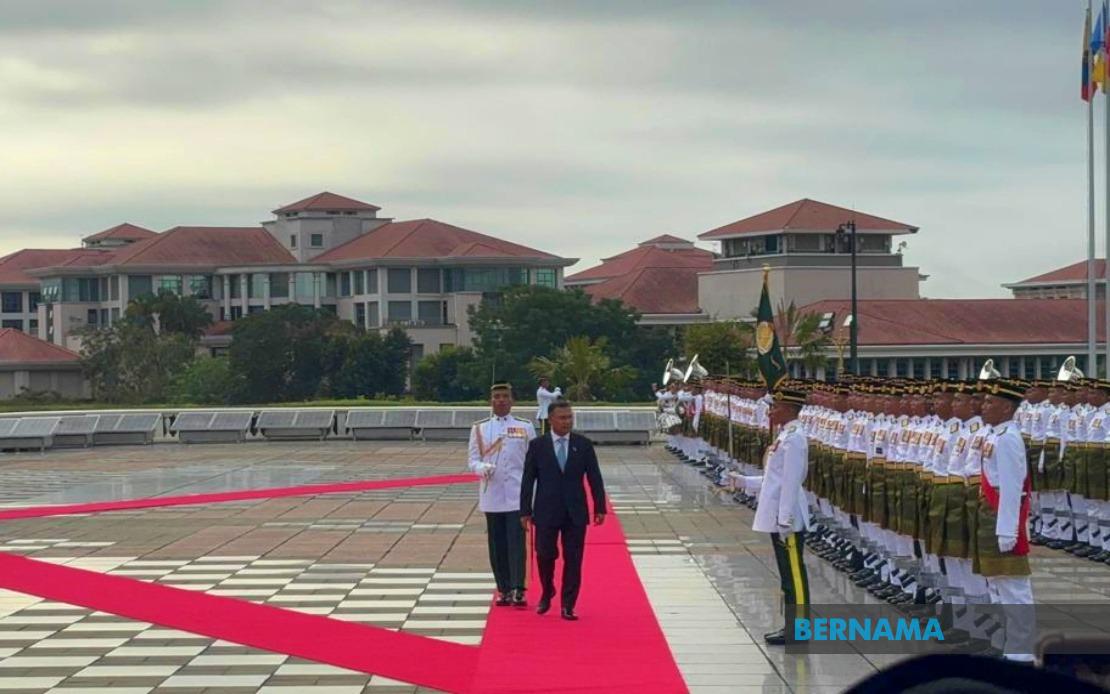
Bangladesh Prime Minister Tarique Rahman stepped onto Malaysian soil on June 22 for a high-level two-day state visit, marking another milestone in the deepening diplomatic relationship between Kuala Lumpur and Dhaka. The distinguished visitor received the full ceremonial treatment at Putrajaya's Perdana Putra Complex, where he was warmly received by Prime Minister Datuk Seri Anwar Ibrahim in a gesture underscoring the importance Malaysia places on its South Asian partnerships.
The morning reception unfolded with traditional protocol, beginning with Tarique's 9 am arrival and his greeting by the Prime Minister. National anthems of both nations rang out across the complex before a formal guard of honour ceremony, comprising three officers and 103 personnel from the First Battalion of the Royal Ranger Regiment under Major Nur Ahmad Zaim Zahari's command. The presence of high-ranking officials—including Deputy Prime Minister Datuk Seri Dr Ahmad Zahid Hamidi, Foreign Minister Datuk Seri Mohamad Hasan, and Home Minister Datuk Seri Saifuddin Nasution Ismail—demonstrated the Malaysian government's commitment to leveraging this visit for substantive dialogue on matters of mutual strategic interest.
Following the ceremonial formalities, Tarique proceeded to a one-on-one session with Anwar, creating an opportunity for the two leaders to engage in candid discussion before the wider bilateral talks involving senior ministers and officials from both countries. These conversations are expected to canvass the full spectrum of Malaysia-Bangladesh relations, examining progress on existing initiatives while identifying fresh avenues for collaboration. The bilateral agenda is notably expansive, touching on traditional areas such as trade and investment alongside emerging sectors like semiconductors and renewable energy—domains where both nations see mutual benefit.
The scope of potential cooperation reflects the sophisticated nature of modern bilateral relations. Human resource management has taken on particular relevance given Bangladesh's substantial workforce and Malaysia's ongoing need for skilled labour across multiple industries. Energy cooperation assumes heightened importance as both nations navigate the transition toward sustainable power sources, while agricultural collaboration opens possibilities for technology transfer and market access. The education sector, too, figures prominently in discussions, with Malaysia's established universities attracting thousands of Bangladeshi students annually and offering pathways for academic and research partnerships.
Regional and international matters will also feature in the conversations, allowing both leaders to align positions on issues affecting South Asia, Southeast Asia, and the broader global stage. This dimension of the talks recognises that economic partnerships thrive best within a framework of shared diplomatic perspectives and coordinated regional strategies. Bangladesh, as a major player in South Asian politics and a significant voice in the Indian Ocean region, brings valuable insights that can inform Malaysian foreign policy deliberations.
The visit will culminate in the signing of formal agreements designed to institutionalise cooperation. One Memorandum of Understanding on Cultural Cooperation will lay groundwork for people-to-people exchanges and cultural promotion, fostering deeper mutual understanding between Malaysian and Bangladeshi societies. Two Exchanges of Notes will address counter-terrorism research—a critical concern in an era of evolving security threats—and investment promotion and facilitation, creating clearer frameworks for business engagement between the two countries. Following these signings, Anwar will host an official luncheon honouring Tarique, providing an intimate setting for continued dialogue away from the formality of the conference table.
The economic dimension of the Malaysia-Bangladesh relationship has expanded substantially in recent years. In 2025, bilateral trade reached RM12.18 billion (USD2.84 billion), making Bangladesh a significant trading partner for Malaysia. Malaysian exports to Bangladesh, valued at RM10.08 billion (USD2.35 billion), are dominated by petroleum products—a sector deeply linked to Malaysia's energy infrastructure and export capabilities. This export orientation reflects Malaysia's historical comparative advantage in hydrocarbon production and refining, though it also highlights Bangladesh's growing energy demands as its economy expands and its population approaches 170 million people.
Imports flowing from Bangladesh into Malaysia tell a different story, emphasising the complementarity of the two economies. Bangladeshi goods worth RM2.10 billion (USD0.50 billion) entered Malaysia, predominantly comprising textiles, apparel, and footwear—sectors where Bangladesh has established itself as a global manufacturing powerhouse. The prominence of these labour-intensive industries underscores Bangladesh's competitive advantages in labour-cost categories and demonstrates how bilateral trade patterns reflect each nation's comparative strengths. This asymmetry is not unusual between a middle-income country and a lower-middle-income nation, yet it provides scope for value-chain integration and industrial cooperation.
Globally, Bangladesh ranks as Malaysia's 28th largest trading partner, a position that masks the nation's strategic significance within Southeast Asia's broader economic architecture. More tellingly, Bangladesh stands as Malaysia's second most important trading partner within South Asia, trailing only India. This standing reflects not merely the size of bilateral exchange but the mutual importance both governments attach to the relationship. As India dominates South Asian trade patterns through sheer economic scale, Bangladesh's position as Malaysia's primary South Asian trading partner after New Delhi speaks to the depth of Malaysia-Bangladesh economic engagement and the historical ties underpinning commercial relationships.
Tarique's entourage includes his spouse Dr Zubaida Rahman, Foreign Minister Dr Khalilur Rahman, and senior government officials—a delegation composition signalling Bangladesh's seriousness in these negotiations. The inclusion of the Foreign Minister ensures continuity in diplomatic efforts and suggests that discussions may venture beyond the economic realm into deeper geopolitical considerations. The two-day schedule allows sufficient time for both the ceremonial obligations and substantive working sessions, providing space for frank exchanges that might not be possible during hastily arranged visits.
For Malaysia, this visit represents an opportunity to deepen ties with a neighbour that plays an increasingly prominent role in South Asian and global affairs. Bangladesh's geographic position, substantial population, and growing economic clout make it a natural partner for Malaysian interests in the region. For Bangladesh, engagement with Malaysia offers access to capital, technology, and strategic partnerships that support its development aspirations. The timing of the visit, in mid-2025, comes at a moment when both countries are reassessing their regional strategies in light of shifting global dynamics and the need to coordinate responses to transnational challenges ranging from climate change to maritime security.

%22%2F%3E%3C%2Fpattern%3E%3C%2Fdefs%3E%3Crect%20width%3D%22100%25%22%20height%3D%22100%25%22%20fill%3D%22url(%23phz7hyg)%22%2F%3E%3Crect%20width%3D%22100%25%22%20height%3D%22100%25%22%20fill%3D%22url(%23phz7hyp)%22%2F%3E%3Ctext%20x%3D%2250%25%22%20y%3D%2250%25%22%20text-anchor%3D%22middle%22%20dominant-baseline%3D%22central%22%20fill%3D%22rgba(255%2C255%2C255%2C0.95)%22%20font-family%3D%22Georgia%2C%20'Times%20New%20Roman'%2C%20serif%22%20font-weight%3D%22700%22%20font-size%3D%22272%22%20letter-spacing%3D%22-0.02em%22%3EAnwar%3C%2Ftext%3E%3C%2Fsvg%3E)