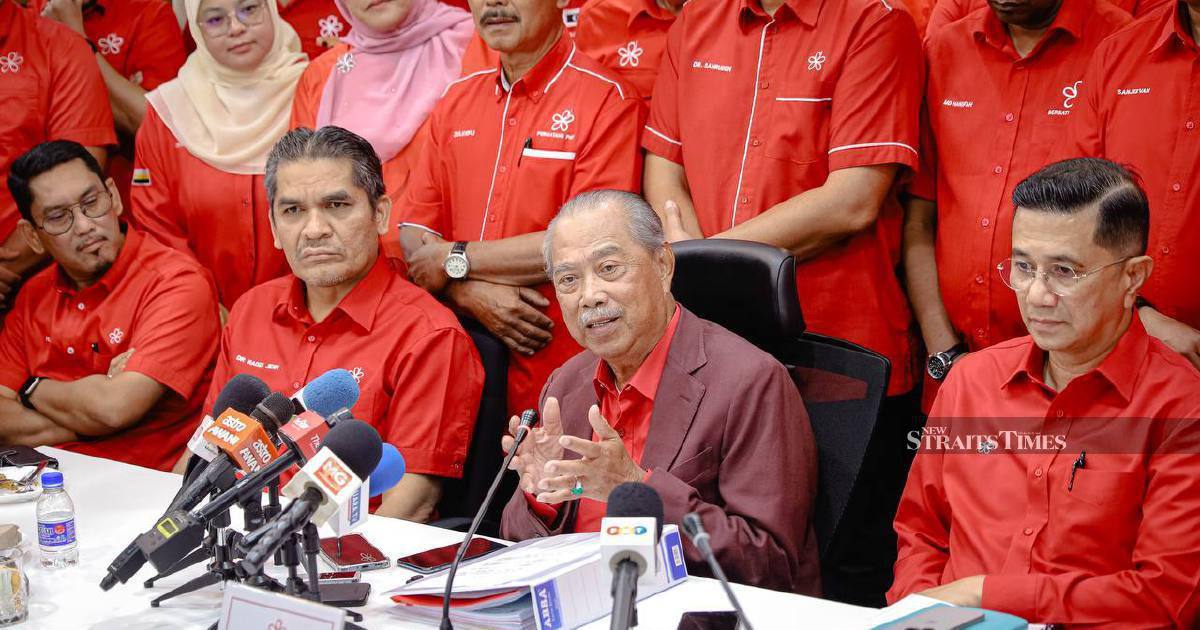
Bersatu is prepared to contest directly against PAS in Johor's upcoming state election if the two Islamic-aligned parties cannot reach a seat-sharing agreement, according to party president Tan Sri Muhyiddin Yassin. The statement reflects the growing complexity within the Perikatan Nasional (PN) coalition, where both Bersatu and PAS have become significant players vying for influence and representation in Malaysia's third-largest state by population.
Muhyiddin's willingness to openly acknowledge potential electoral competition with PAS marks a notable shift in the political positioning of Bersatu, which has historically sought to position itself as a pragmatic coalition partner despite ideological differences within the PN framework. The remark suggests that internal negotiations over constituency divisions have reached a critical juncture, with neither party apparently willing to cede significant ground to the other in what has traditionally been a PAS stronghold.
For Malaysian political observers, the significance of this statement lies not merely in the prospect of a three-cornered fight in Johor constituencies, but in what it reveals about the underlying fault lines within the PN coalition. Bersatu, despite its relatively smaller electoral footprint compared to PAS, has positioned itself as essential to PN's broader political strategy across multiple states. The party's increased confidence suggests it believes it possesses sufficient ground organisation and voter appeal to contest PAS directly without catastrophic consequences.
Johor has historically represented a crucial strategic prize in Malaysian politics, representing the second-largest economy within the federation and serving as a political laboratory where different coalition experiments have been tested. The state's voting patterns have often foreshadowed national political trends, making any electoral contest there particularly significant for both Bersatu and PAS as they seek to establish dominance within the Malay-Muslim political space.
The implications for Bersatu's electoral strategy are substantial. Should the party proceed with contesting seats against PAS, it would face the considerable challenge of persuading traditionally PAS-inclined voters—primarily conservative Malay-Muslims who have supported the party for decades—that Bersatu offers a superior alternative. This would require Bersatu to either emphasise its track record of governance or differentiate itself through policy positioning, a task complicated by both parties' similar ideological foundations within the PN framework.
PAS, for its part, maintains several structural advantages in Johor that could offset Bersatu's challenge. The party possesses deeper roots in the state's rural constituencies, stronger grassroots organisation cultivated over decades, and established relationships with local community leaders. However, PAS has also faced criticism in certain quarters for governance issues and administration challenges, potentially creating openings for Bersatu to exploit in more urbanised constituencies where voters may prioritise competence and development over purely religious considerations.
The statement from Muhyiddin should be understood within the broader context of PN coalition dynamics. While Bersatu and PAS have maintained a strategic alliance, tensions periodically surface regarding resource allocation, ministerial positions, and electoral seat distributions. The PN coalition, which emerged as a political force following the 2020 general election, has positioned itself as an alternative to Barisan Nasional while maintaining support from segments of the Malay-Muslim electorate who view themselves as distinct from both Umno-led and opposition forces.
For Johor voters, the prospect of three-cornered contests presents both opportunities and risks. Competition between Bersatu and PAS could result in greater policy differentiation and increased political engagement among the electorate. Conversely, it could lead to fragmentation of votes, potentially disadvantaging both parties against any stronger opposition contestant and creating uncertain outcomes that previous state elections might not fully predict.
The timing of Muhyiddin's statement carries additional weight given ongoing discussions about state-level elections across Malaysia and the federal government's current political composition. Bersatu's public acknowledgement of preparedness for electoral competition with PAS may serve multiple purposes: signalling strength to party supporters, establishing a negotiating position in ongoing seat discussions, and positioning Bersatu as an independent political force rather than merely PAS's junior coalition partner.
Regional implications extend beyond Johor's borders, as any significant shift in Bersatu-PAS dynamics could influence political calculations in other states where both parties maintain presence and influence. Kelantan, Terengganu, and other states with substantial PN presence would closely monitor how negotiations and potential contests unfold in Johor, recognising that outcomes there could establish precedents for coalition management elsewhere.
Muhyiddin's readiness to publicly discuss electoral competition with PAS, rather than emphasising coalition unity, suggests either genuine confidence in Bersatu's competitive capacity or calculated political messaging designed to strengthen the party's hand in ongoing negotiations. Either interpretation indicates that PN's internal equilibrium remains in flux, with constituent parties actively manoeuvring to establish clearer spheres of political influence and electoral territory. The coming weeks will prove crucial in determining whether Bersatu and PAS can reconcile their respective ambitions through negotiated seat arrangements or whether Johor will indeed become a testing ground for direct competition between these two significant Malaysian political forces.


%22%2F%3E%3C%2Fpattern%3E%3C%2Fdefs%3E%3Crect%20width%3D%22100%25%22%20height%3D%22100%25%22%20fill%3D%22url(%23ph2hy9vg)%22%2F%3E%3Crect%20width%3D%22100%25%22%20height%3D%22100%25%22%20fill%3D%22url(%23ph2hy9vp)%22%2F%3E%3Ctext%20x%3D%2250%25%22%20y%3D%2250%25%22%20text-anchor%3D%22middle%22%20dominant-baseline%3D%22central%22%20fill%3D%22rgba(255%2C255%2C255%2C0.95)%22%20font-family%3D%22Georgia%2C%20'Times%20New%20Roman'%2C%20serif%22%20font-weight%3D%22700%22%20font-size%3D%22272%22%20letter-spacing%3D%22-0.02em%22%3EAnwar%3C%2Ftext%3E%3C%2Fsvg%3E)