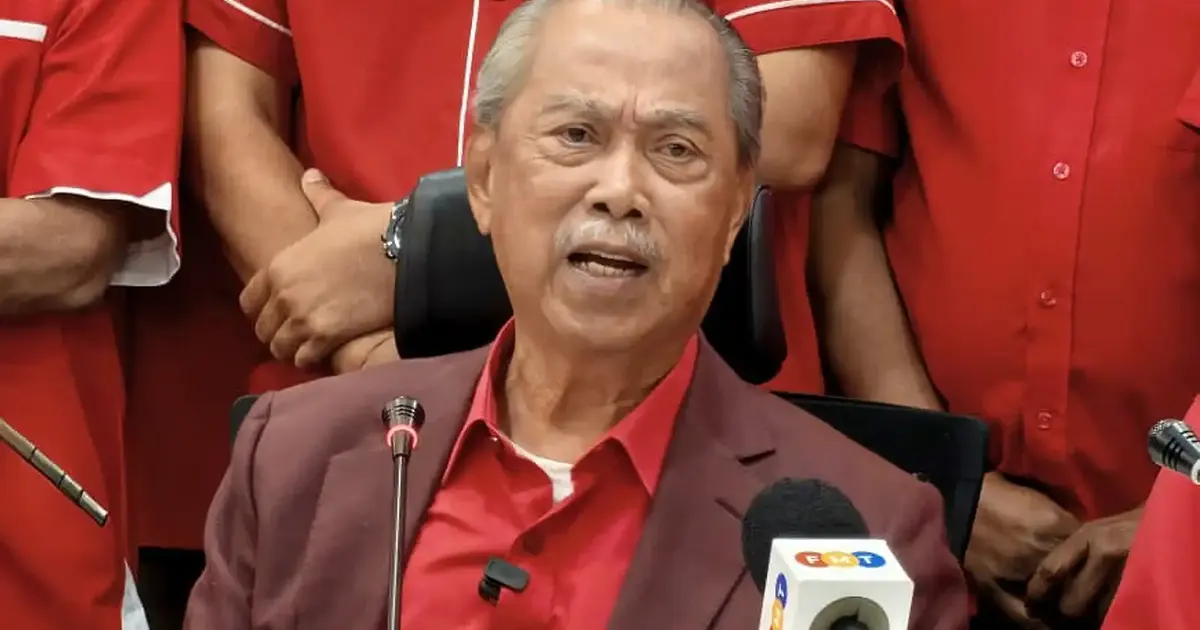
Bersatu's leadership has signalled a combative stance towards rival coalition partner PAS, with former prime minister Muhyiddin Yassin declaring the party's readiness to engage the Islamist party across multiple political battlegrounds. The declaration marks a significant shift in the fractious relationship between two components of the Perikatan Nasional coalition, which has grown increasingly strained in recent months over policy direction and seat allocation in state elections.
Muhyiddin's pronouncement comes as both parties prepare for critical electoral contests in Johor and Negeri Sembilan, where the coalition's internal cohesion will face its most severe test yet. Rather than maintaining the façade of unity that traditionally characterizes coalition politics in Malaysia, the Bersatu leader has chosen to articulate his party's competitive ambitions openly, suggesting that local contests may become arenas for resolving broader strategic disagreements within PN.
The positioning reflects Bersatu's determination to retain political relevance and parliamentary representation following years of electoral volatility. Since its establishment in 2016, the party has navigated multiple realignments, from spearheading the 2018 general election victory as part of the Pakatan Harapan coalition to subsequently playing a central role in the 2020 political upheaval that brought PN to power. This history of flux has instilled in Bersatu's leadership a acute sensitivity to any threat to its political standing.
PAS, by contrast, has leveraged Islamic populism and institutional consolidation to strengthen its grip on the Malay-Muslim vote, particularly in rural constituencies where traditional appeals to religious identity carry substantial weight. The party's organizational maturity and deep roots in certain states present a formidable challenge to Bersatu's expansion ambitions, particularly as PN seeks to establish itself as a durable third force in Malaysian politics beyond temporary electoral alliances.
The upcoming contests in Johor and Negeri Sembilan will serve as litmus tests for PN's electoral viability as an integrated political formation. Johor, historically a Barisan Nasional stronghold with significant electoral magnitude, represents particularly strategic terrain where coalition performance will reverberate across regional politics. Negeri Sembilan, meanwhile, offers a more compact battleground where internal coalition dynamics can be more readily observed and analyzed by political observers.
Muhyiddin's combative rhetoric suggests Bersatu believes it possesses adequate organizational capacity and grassroots support to compete effectively against PAS without requiring the larger party's cooperation or goodwill. This confidence derives partly from Bersatu's recent electoral successes in certain constituencies and its cultivation of a political base that transcends purely religious or ethnic classifications, appealing instead to swing voters concerned with governance competence and anti-corruption positioning.
The broader implications for Malaysian politics extend beyond mere intra-coalition jockeying. The willingness of PN components to contest against each other signals potential fragmentation within what was envisioned as a unified political alternative to both Pakatan Harapan and Barisan Nasional. Such fragmentation could benefit the currently fractious Pakatan coalition, which faces its own internal cohesion challenges but maintains greater structural separation between component parties' electoral territories.
Regional analysts note that Southeast Asian coalition politics increasingly features such intra-alliance contestation, particularly as electoral competition intensifies and parties seek to maximize individual representation. Thailand's experience with competing factions within broader coalitions illustrates how such internal competition can either strengthen democratic representation through voter choice or weaken governance capacity through divided leadership. Malaysia's trajectory will depend significantly on how Bersatu and PAS manage their rivalry without triggering complete coalition collapse.
For Malaysian voters, particularly in Johor and Negeri Sembilan, the development offers genuine electoral choice within the PN framework, challenging the traditional binary framework of Malaysian politics. Constituents will encounter competing PN candidates articulating distinct party priorities and leadership visions, complicating the conventional coalition-based voting calculus that has traditionally structured Malaysian electoral behavior.
Muhyiddin's declaration also reflects deeper strategic positioning ahead of the next general election, anticipated within the coming two years. As parties calculate their respective strengths and vulnerabilities, decisions made regarding state-level contests will inform broader coalition realignments at the federal level. A strong Bersatu showing in Johor and Negeri Sembilan could enhance the party's bargaining position in any future PN renegotiation, while poor performance might necessitate strategic reassessment.
The standoff between Bersatu and PAS underscores the fluid nature of Malaysian coalition politics, where ideological proximity and formal alliance structures frequently yield to pragmatic calculations regarding electoral viability and political survival. Neither party can afford electoral losses to its rival, yet neither can sustain coalition breakdown without suffering severely in broader political calculations. This tension between competition and cooperation will define the character of the coming state elections and provide valuable indicators of Malaysia's coalition politics trajectory.

%22%2F%3E%3C%2Fpattern%3E%3C%2Fdefs%3E%3Crect%20width%3D%22100%25%22%20height%3D%22100%25%22%20fill%3D%22url(%23ph2hy9vg)%22%2F%3E%3Crect%20width%3D%22100%25%22%20height%3D%22100%25%22%20fill%3D%22url(%23ph2hy9vp)%22%2F%3E%3Ctext%20x%3D%2250%25%22%20y%3D%2250%25%22%20text-anchor%3D%22middle%22%20dominant-baseline%3D%22central%22%20fill%3D%22rgba(255%2C255%2C255%2C0.95)%22%20font-family%3D%22Georgia%2C%20'Times%20New%20Roman'%2C%20serif%22%20font-weight%3D%22700%22%20font-size%3D%22272%22%20letter-spacing%3D%22-0.02em%22%3EAnwar%3C%2Ftext%3E%3C%2Fsvg%3E)