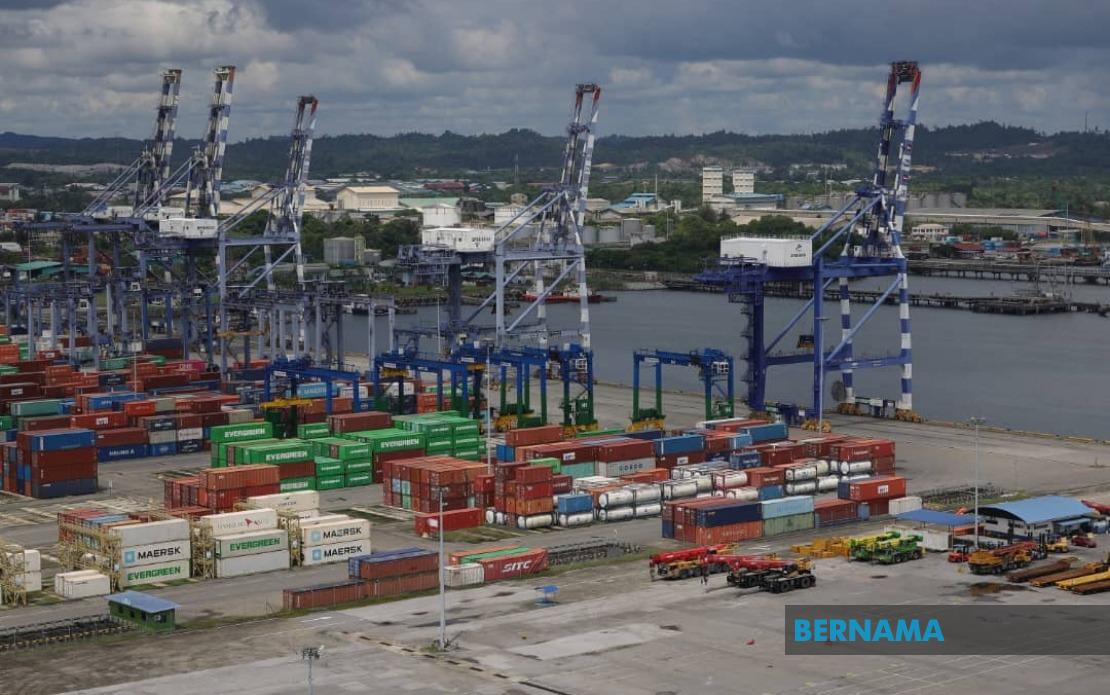
The transfer of Bintulu Port's regulatory authority from federal to Sarawak state control has been lauded as a watershed moment in advancing the Malaysia Agreement 1963, with officials framing the shift as validation of the state's constitutional standing within the federation. During a ceremony in Bintulu attended by Prime Minister Datuk Seri Anwar Ibrahim and Sarawak Premier Tan Sri Abang Johari Tun Openg, the port officially transitioned from a federal port to a state port, a development that government representatives characterize as demonstrating renewed commitment to cooperative federalism.
Minister in the Prime Minister's Department (Sabah and Sarawak) Datuk Mustapha Sakmud positioned the handover as emblematic of how MA63 can yield mutually beneficial outcomes when implemented through genuine partnership between Kuala Lumpur and the state capitals. He emphasized that the measure reflects recognition of Sarawak's historical claim as a founding member of the Malaysian federation, a status that carries specific constitutional rights regarding autonomy over particular sectors and resources. This framing carries significance beyond port management, suggesting a broader recalibration of centre-state relations that observers have tracked closely in recent years.
The strategic importance of Bintulu Port extends considerably beyond its current function as the primary export gateway for Malaysia's liquefied natural gas sector. Officials note that the facility is diversifying into complementary industrial activities, positioning itself as a multifunctional logistics and industrial hub rather than a single-commodity export terminal. This evolution reflects global trends toward integrated marine-industrial complexes that can support manufacturing, distribution, warehousing and value-added processing across multiple sectors simultaneously.
Sarawak's abundant renewable energy resources—particularly its substantial hydroelectric generation capacity—create a compelling investment narrative for companies pursuing decarbonization. The combination of port infrastructure, clean power supply and strategic regional location positions Bintulu as an increasingly attractive destination for industrial operations seeking to minimize carbon footprints while maintaining access to regional markets. For multinational corporations establishing low-carbon manufacturing facilities, such integrated advantages prove more attractive than ports offering infrastructure alone without complementary renewable energy availability.
The green economy angle carries particular resonance across Southeast Asia, where governments face mounting pressure to reconcile economic growth with climate commitments. Bintulu's emergence as a potential clean energy and green manufacturing hub could reshape investment patterns within the region, particularly if Sarawak successfully markets its capacity to host integrated low-carbon industrial clusters. This positioning directly challenges the historical perception of Malaysian ports as primarily serving commodity export functions, instead positioning Bintulu within the higher-value manufacturing and clean technology sectors.
For Malaysian investors and companies, the port's transition to state control may signal improved responsiveness to local business needs and potentially faster decision-making on port infrastructure investments or operational adjustments. State-level port management sometimes enables more nimble adaptation to changing customer requirements compared to federally managed facilities operating under national protocols. The proximity of decision-makers to port operations and local industry may facilitate smoother coordination on infrastructure expansion, cargo-handling procedures and facility maintenance.
Government messaging regarding the handover deliberately avoids characterizing the transfer as a diminishment of federal authority, instead framing MA63 implementation as strengthening the overall Malaysian federation through enhanced recognition of Sabah and Sarawak's constitutional roles and economic contributions. This rhetorical approach addresses longstanding sensitivities within both states regarding the degree of autonomy and resource control they have exercised since 1963, issues that have periodically generated political tensions in Kuala Lumpur-Sarawak relations.
The Bintulu Port transition also carries implications for ongoing negotiations between the federal government and both Sabah and Sarawak regarding MA63 implementation more broadly. Various clauses within the agreement have remained subject to interpretation or incomplete execution for decades, creating potential avenues for expanded state jurisdiction over additional sectors and resources. The relatively smooth transfer of port control, executed with visible participation from senior federal and state leadership, may establish a template for handling other contested MA63 provisions with similar emphasis on cooperation and mutual benefit.
Investors monitoring Malaysian port development will likely assess whether the state-level management of Bintulu Port generates operational efficiencies or presents complications compared to the previous federal oversight. Port performance metrics—including cargo throughput, vessel turnaround times, operational cost structures and infrastructure investment pace—will provide concrete measures of whether decentralized management delivers tangible advantages. Regional port operators may also pay attention to whether Sarawak's assumption of Bintulu Port control influences competitive positioning within Malaysia's broader port network, which includes major facilities at Port Klang, Tanjung Pelepas and Penang.
The ceremony's participation by both the Prime Minister and Sarawak Premier underscores the political significance assigned to the handover within federal and state governments. Such high-level attendance typically signals that both administrations view the agreement as demonstrating the possibility of resolving longstanding constitutional questions through dialogue rather than litigation or confrontation. For Malaysian federalism more broadly, the event contributes to a narrative of strengthened partnership between the centre and the two East Malaysian states, though observers will continue monitoring whether substantive implementation of additional MA63 provisions follows at a comparable pace.
Looking forward, Sarawak authorities face the practical challenge of maintaining Bintulu Port's competitiveness while executing their own investment agenda for infrastructure expansion and operational modernization. The state's renewable energy advantages and commitment to green industries provide a compelling development narrative, yet converting strategic positioning into sustained investment flows and employment generation requires sustained execution across multiple policy domains, including workforce development, regulatory frameworks, and infrastructure coordination with federal authorities on matters touching national interests.