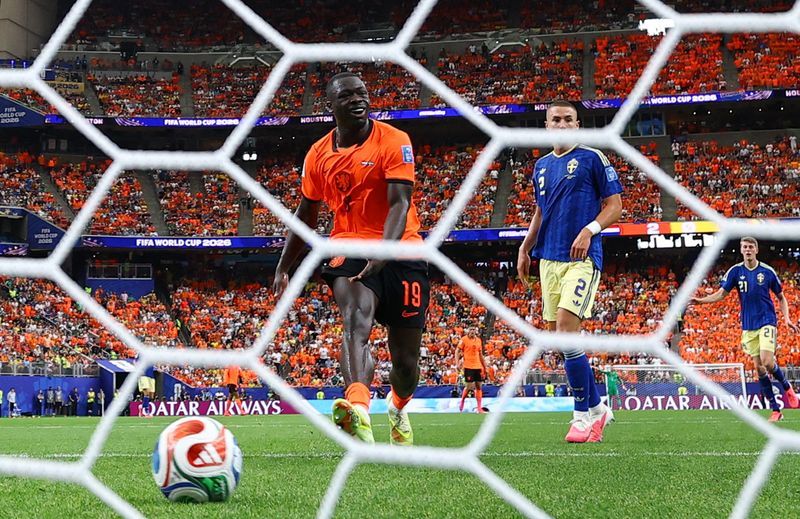
Ronald Koeman's tactical gamble paid off handsomely when the Netherlands demolished Sweden 5-1 in their second World Cup Group F match, a result that vindicated the Dutch coach's decision to start Brian Brobbey in attack despite the forward's relatively marginal status within the squad. The stark contrast to the previous match, where Netherlands had laboured to a frustrating 2-2 draw against Japan in Dallas, underscored just how consequential team selection can be in elite football. Where Koeman's substitutions in that opening fixture drew widespread criticism for failing to shift the momentum, his choice to deploy Brobbey proved revelatory, transforming the attacking threat and ultimately serving as the catalyst for a commanding performance that propelled the Dutch to the summit of their group.
The 24-year-old's impact was immediate and decisive. Brobbey netted twice within the opening seventeen minutes against the Swedes, effectively settling the contest before it had truly begun and establishing a platform upon which the Netherlands would construct an emphatic victory. These were not fortunate strikes born of defensive errors or goalkeeper mistakes; they represented clinical finishing and intelligent positioning from a player who appeared to have shed the inconsistency that had previously limited his impact at the highest level. His performance raised fundamental questions about the forward options available to Koeman heading into the tournament's knockout stages and highlighted the importance of giving players opportunities to prove themselves when the stakes are highest.
Brobbey's pathway to this breakthrough moment has been far from straightforward. Prior to his recall to the squad in March following a year's absence, he had occupied an increasingly peripheral role, overlooked in qualifying fixtures for the 2026 World Cup and seemingly destined for a minor supporting part in the international setup. His absence from the squad had seemed to reflect a broader lack of confidence in his ability to deliver consistently at senior level, a perception that lingered despite his undoubted technical qualities. The Dutch coaching staff's decision to reintegrate him into the group suggested they had identified something worth developing, though whether this was borne of genuine belief or merely pragmatic roster management remained uncertain until his performance against Sweden answered the question emphatically.
Much of Brobbey's renewed confidence can be attributed to his spell in the English Premier League with Sunderland, an experience that has visibly elevated his overall game. The physical and tactical demands of English football are renowned for their intensity, and the young forward has emerged from this trial strengthened in multiple dimensions. Speaking at the Dutch training camp earlier in the month, he articulated this evolution, describing himself as a more rounded striker who combines the physical aspects of his game with improved movement, spatial awareness, and the ability to create opportunities through intelligent off-ball positioning. This development from a one-dimensional player who relied primarily on physical confrontation with opponents into a more nuanced forward capable of varying his approach represents precisely the type of maturation that elite international football demands.
The Netherlands have been acutely conscious of the need to identify a successor to Memphis Depay, their all-time leading international goalscorer, given that the veteran forward's career trajectory suggests his days as the primary attacking focal point are waning. Depay himself has recently returned from a significant injury layoff, and while he remains an important player for Koeman's setup, he no longer possesses the sharpness and explosive athleticism that characterised his peak years. The vacancy created by this transition has weighed on the collective consciousness of the Dutch football establishment, knowing that failure to cultivate a credible replacement could undermine their attacking potency in future campaigns. Brobbey's performance against Sweden has effectively thrust himself to the forefront of the conversation surrounding this succession, having demonstrated in a single match the finishing prowess and positional intelligence required for the role.
The supporting cast surrounding Brobbey offers considerable encouragement for his prospects as the designated lead attacker. Cody Gakpo, operating on the left flank, has provided quality service consistent with his form at club level, whilst Denzel Dumfries' willingness to venture forward from right-back creates additional attacking width and overload opportunities. The introduction of Crysencio Summerville as a newcomer to the squad adds further creative potential to the attacking apparatus. These varied sources of chance creation suggest that the Netherlands possess sufficient attacking resources to sustain Brobbey in the lead role, provided he continues to demonstrate the finishing ability and positioning he showed against Sweden. The infrastructure supporting the forward position is sufficiently robust that his primary requirement moving forward is to maintain consistency and continue converting the opportunities that will inevitably come his way.
Brobbey's elevation to prominence also reflects broader patterns within international football regarding the delayed blossoming of young talent. At 24, he arrives at this moment of opportunity having traversed the conventional pathway of domestic football before his temporary departure from contention. His eventual reinstatement, contingent upon improved performances and visible development, exemplifies the patience required to properly develop strikers whose potential may not manifest immediately. For Malaysian and Southeast Asian observers, Brobbey's arc serves as a reminder that international football careers are rarely linear, and that redemption and resurgence remain possible even after apparent rejection or marginalization. The quality of player development often depends on finding the appropriate environment and competitive level at which individual talents can flourish, a lesson relevant across football cultures.
Koeman's rehabilitation following the criticism directed at his team selection against Japan demonstrates the volatility of managerial reputation in the modern sporting environment. Within the span of days, the same decision-maker can transition from being portrayed as tactically inadequate to masterminding a comprehensive victory through astute personnel choices. This serves as a cautionary tale regarding the over-interpretation of single matches or performances and the danger of premature judgments about team direction or coaching competence. The Dutch coach's willingness to make bold changes and his ability to learn from setbacks, evidenced by his willingness to admit publicly that his earlier substitutions had not achieved their intended effect, may ultimately prove more valuable to his side's tournament prospects than any single tactical formation or lineup decision.
Looking forward, Brobbey's status as the frontrunner for the Netherlands' centre-forward position will likely consolidate if he maintains the standard demonstrated against Sweden. The question now becomes not whether he is capable of playing at this level, which his two-goal performance has definitively answered, but whether he possesses the temperament and consistency to sustain this form across multiple matches and different opposing approaches. International football at World Cup level presents progressively more challenging defensive blocks as tournaments advance, and Brobbey will face sophisticated defensive schemes designed to minimize space and time on the ball. His capacity to adapt to these elevated challenges whilst preserving the sharpness evident against Sweden will determine whether this moment represents the beginning of his emergence as a long-term solution to the Netherlands' striker vacancy or merely a flash of form soon to be superseded by doubt and inconsistency.
%22%2F%3E%3C%2Fpattern%3E%3C%2Fdefs%3E%3Crect%20width%3D%22100%25%22%20height%3D%22100%25%22%20fill%3D%22url(%23ph4yddrg)%22%2F%3E%3Crect%20width%3D%22100%25%22%20height%3D%22100%25%22%20fill%3D%22url(%23ph4yddrp)%22%2F%3E%3Ctext%20x%3D%2250%25%22%20y%3D%2250%25%22%20text-anchor%3D%22middle%22%20dominant-baseline%3D%22central%22%20fill%3D%22rgba(255%2C255%2C255%2C0.95)%22%20font-family%3D%22Georgia%2C%20'Times%20New%20Roman'%2C%20serif%22%20font-weight%3D%22700%22%20font-size%3D%22194%22%20letter-spacing%3D%22-0.02em%22%3ERefugee%3C%2Ftext%3E%3C%2Fsvg%3E)