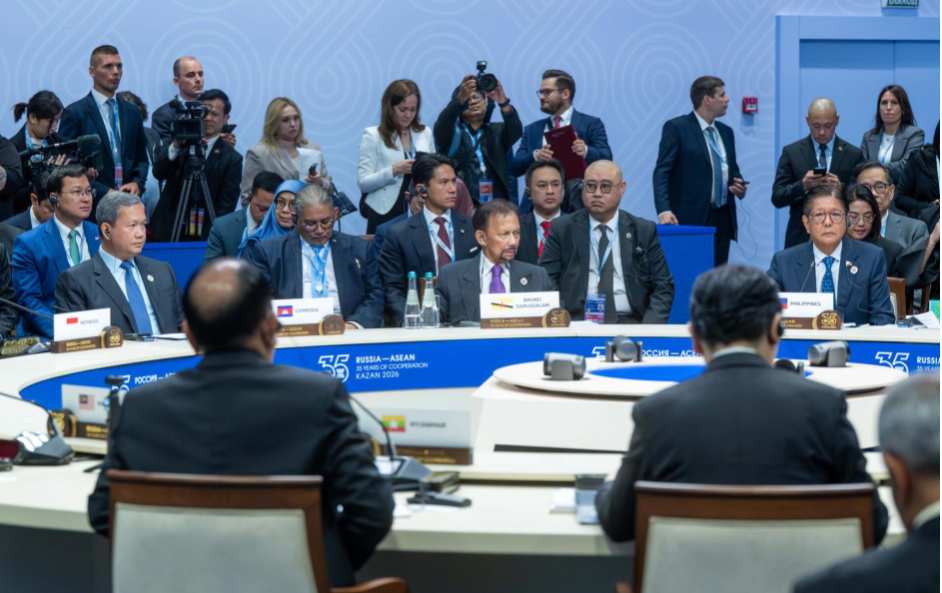
Sultan Hassanal Bolkiah attended the Asean-Russia Commemorative Summit in Kazan, Russia on Thursday, June 18, where he articulated a vision for strengthening ties between the ten-nation bloc and Moscow as both navigate an increasingly complex geopolitical landscape. The Brunei monarch, accompanied by Foreign Minister Prince 'Abdul Mateen, expressed gratitude to Russian President Vladimir Putin and regional hosts for facilitating what has become a significant diplomatic gathering in Southeast Asia's relationship with a major Eurasian power. His participation underscores Brunei's commitment to maintaining Asean's central role in regional dialogue, even as the bloc grapples with internal differences on various foreign policy matters.
Reflecting on more than three decades of formal engagement, the Sultan positioned the Asean-Russia relationship as a model of diplomatic resilience that has withstood substantial shifts in international affairs. Since establishing its Dialogue Partnership in 1996, the association has gradually expanded collaborative frameworks across multiple sectors, demonstrating what both sides characterize as sustained commitment despite episodic tensions in global affairs. The Sultan's framing of this partnership as demonstrating "resilience and growing importance" carries particular weight given recent geopolitical tensions involving Russia and its implications for Southeast Asian countries navigating complex great-power dynamics.
The monarch highlighted how cooperation has extended across all three pillars of the Asean Community architecture—the political-security pillar, the economic pillar, and the social-cultural pillar. This comprehensive approach signals Asean's multifaceted engagement strategy with Russia, moving beyond traditional diplomatic channels to encompass trade relationships, people-to-people exchanges, and collaborative responses to transnational challenges. For Malaysian observers, this expansion reflects broader Asean efforts to maintain pragmatic engagement with diverse external partners while preserving strategic autonomy.
Looking ahead to Asean's Vision 2045 agenda, the Sultan stressed that cooperation with Russia will prove increasingly essential for addressing interconnected global problems. Political tensions, fragmentation of international economic systems, accelerating climate change, and rapid technological advancement represent challenges that no single nation or regional grouping can effectively tackle alone. This perspective aligns with Malaysia's own emphasis on multilateralism and inclusive regional frameworks that accommodate multiple stakeholders.
Energy and food security emerged as particularly important focal points in the Sultan's remarks, areas where Asean-Russia collaboration carries tangible economic implications for Southeast Asia. Russia's position as a major energy exporter and agricultural producer makes it a natural partner for a region increasingly concerned about supply chain vulnerabilities and resource sustainability. For Malaysia, with its own energy interests and regional trade dependencies, strengthened Asean coordination with Russia on these matters could influence regional economic dynamics and pricing structures.
Disaster management and non-traditional security challenges featured prominently in the Sultan's address, reflecting shared vulnerability to transnational threats ranging from maritime piracy to pandemics. The inclusion of these domains in the partnership framework demonstrates how contemporary security cooperation extends beyond traditional military considerations to encompass humanitarian concerns and civilian resilience. Southeast Asia's experience with natural disasters and disease outbreaks makes such collaboration particularly relevant for the region's long-term stability.
Human capital development received specific emphasis, with the Sultan advocating for expanded educational exchanges and training programmes. Building professional networks and transferring knowledge between Southeast Asian and Russian institutions creates lasting bonds beyond formal government-to-government relations. These initiatives seed future understanding and cooperation at grassroots and institutional levels, potentially moderating misperceptions and fostering genuine partnerships that survive political fluctuations.
The formal adoption of the Kazan Declaration 2026 and accompanying outcome documents provides concrete institutional anchors for the relationship. The Comprehensive Plan of Action outlining strategic partnership through 2030, combined with specific agreements on energy and cultural cooperation, establishes measurable frameworks for deepening ties. These instruments suggest both Asean and Russia view their relationship as worthy of systematic planning and resource allocation rather than ad hoc engagement.
The working lunch session on Eurasian integration processes, featuring contributions from the Shanghai Cooperation Organisation and Eurasian Economic Commission, positioned the Asean-Russia relationship within broader regional architecture discussions. This framing suggests that Asean sees value in understanding how other regional groupings organize cooperation, potentially informing its own integration efforts. For Malaysia, participation in these discussions offers opportunities to influence how different regional frameworks interact and prevent fragmentation.
The parallel Asean-Russia Business Forum, held as a summit side event, underscores economic dimensions of the partnership that often receive less diplomatic attention than security matters. Business engagement creates constituencies within both Asean member states and Russia with vested interests in maintaining and expanding relations, providing bottom-up support for government-level initiatives. Malaysian businesses with regional presence could benefit from expanded trade and investment opportunities emerging from strengthened institutional frameworks.
The Sultan's mention of conveying condolences regarding Thailand's Princess Bajrakitiyabha's passing demonstrated how diplomatic gatherings serve multiple functions, allowing leaders to address shared human experiences and reinforce solidarity within the Asean family. These personal moments, though often overlooked in formal analyses, contribute to the trust that undergirds successful multilateral cooperation.
The summit's outcomes collectively signal that despite geopolitical tensions and competing great-power interests in Southeast Asia, Asean intends to maintain diversified external partnerships that serve member states' interests. Brunei's leadership in articulating this vision reflects the sultanate's traditional diplomatic role within the bloc and its commitment to consensus-building. For Malaysia and other Asean members, the Kazan summit reinforces that strategic autonomy—the ability to engage multiple partners without surrendering core interests—remains achievable through coordinated regional diplomacy.

%22%2F%3E%3C%2Fpattern%3E%3C%2Fdefs%3E%3Crect%20width%3D%22100%25%22%20height%3D%22100%25%22%20fill%3D%22url(%23ph2hy9vg)%22%2F%3E%3Crect%20width%3D%22100%25%22%20height%3D%22100%25%22%20fill%3D%22url(%23ph2hy9vp)%22%2F%3E%3Ctext%20x%3D%2250%25%22%20y%3D%2250%25%22%20text-anchor%3D%22middle%22%20dominant-baseline%3D%22central%22%20fill%3D%22rgba(255%2C255%2C255%2C0.95)%22%20font-family%3D%22Georgia%2C%20'Times%20New%20Roman'%2C%20serif%22%20font-weight%3D%22700%22%20font-size%3D%22272%22%20letter-spacing%3D%22-0.02em%22%3EAnwar%3C%2Ftext%3E%3C%2Fsvg%3E)