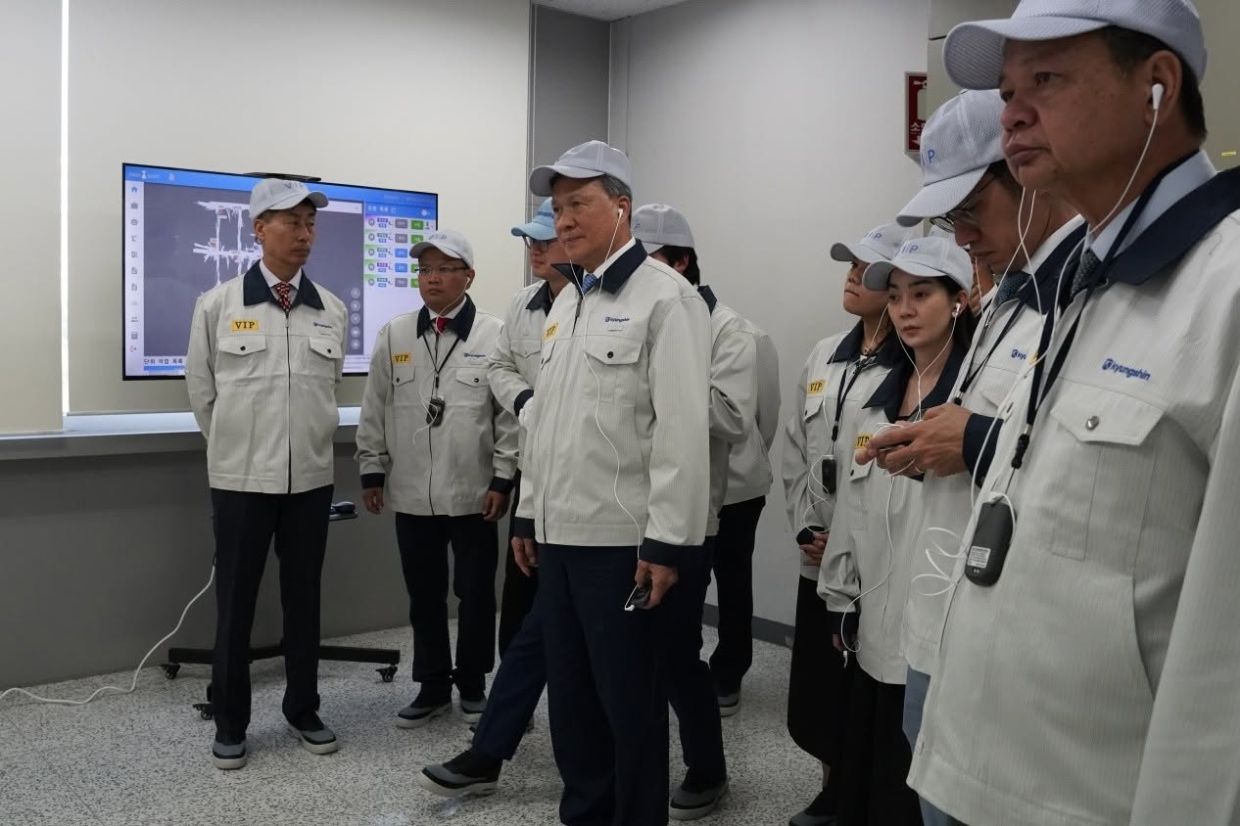
Cambodia's economic transformation ambitions took concrete shape when Deputy Prime Minister Sun Chanthol led a high-level investment delegation to South Korea in June, deliberately targeting sectors that represent a generational pivot from the nation's garment-dependent past. The "door-knock mission" to Incheon, featuring company visits and a formal investment roadshow, underscores how seriously Phnom Penh views the imperative to upgrade its industrial base and capture higher-value manufacturing opportunities in an increasingly competitive regional economy.
The economic rationale behind this strategic realignment is straightforward yet pressing. For three decades, Cambodia's manufacturing sector has relied overwhelmingly on garments, footwear, and travel goods—sectors that generate employment but offer limited wage growth and remain vulnerable to global supply-chain shifts. With labour costs rising across Southeast Asia and automation threatening low-skill assembly work, Cambodian policymakers recognise that the nation's economic future depends on attracting investment in technology-intensive industries that can support sustained productivity growth and command premium prices in global markets.
South Korea represents an ideal partner for this transition. The country has already embedded itself within Cambodia's manufacturing ecosystem through established companies like Daejoo KC Group, which operates through subsidiaries including Camko Motor. That firm assembles Hyundai vehicles domestically and manufactures automotive wire harnesses for export, generating roughly 500 jobs while demonstrating the viability of higher-value production in the Kingdom. By targeting existing Korean investors for expansion rather than starting from scratch, Cambodia's government strategy leverages existing relationships and institutional knowledge to accelerate sector growth.
The automotive components sector particularly exemplifies Cambodia's ambitions. Kyungshin Co., Ltd., a major Korean manufacturer of automotive electronic components and wire harnesses, has maintained operations in Cambodia since 2012 through a facility in Kandal province. The company's US$20 million investment and workforce of 1,467 employees provide tangible proof that Cambodia can support complex manufacturing. More significantly, as global automakers accelerate the shift toward electric vehicles, Kyungshin's expertise in EV electrical systems positions Cambodia to become integrated into emerging regional supply chains rather than remaining stuck in mature, commoditised garment production.
The government's promotional efforts carry institutional weight. Deputy Prime Minister Chanthol, serving as first vice-chairman of the Council for the Development of Cambodia, personally visited major Korean conglomerates to present investment opportunities and encourage expansion into sectors where these companies already operate globally. This hands-on engagement from the highest levels signals that Cambodia views this transformation not as a peripheral policy matter but as central to national development strategy. The participation of the Cambodian ambassador to South Korea, Commerce Ministry officials, and various chambers of commerce underlined how fully the state apparatus has mobilised behind the investment drive.
Heathcare and medical technology emerged as unexpected but revealing pillars of Cambodia's pitch to Korean investors. Deputy Prime Minister Chanthol's visit to Incheon Baek Hospital, a leading South Korean medical institution, shifted focus from manufacturing floors to hospital wards and diagnostic centres. The government's explicit interest in attracting international-standard healthcare facilities, digital healthcare management systems, and medical technology transfer reflects a sophisticated understanding that economic development requires complementary investments in human capital and public welfare. By positioning Cambodia not merely as a production base but as a market for advanced services and technology, officials are attempting to broaden the appeal to Korean firms beyond simple labour arbitrage.
The framework supporting this investment push has also been modernised. Cambodia's updated "Law on Investment of the Kingdom of Cambodia" offers incentive packages, fiscal benefits, macroeconomic stability assurances, and investment protection mechanisms designed to reassure foreign capital. These legal reforms, promoted during the Incheon roadshow, address investor concerns about regulatory clarity and contract enforcement—prerequisites for firms considering significant capital commitments in sectors like automotive electronics or healthcare technology where quality standards and supply-chain reliability are non-negotiable.
For Malaysian and Southeast Asian observers, Cambodia's strategy carries important implications. The region faces common pressures as low-cost manufacturing shifts toward automation and as geopolitical competition intensifies over higher-value production clusters. Cambodia's explicit focus on attracting Korean automotive and EV component manufacturers suggests that individual Southeast Asian nations increasingly recognise they must compete not just on labour costs but on ecosystem sophistication. The fact that Cambodia is targeting established Korean operators for expansion rather than attempting to poach greenfield investments indicates realistic assessment of competitive positioning within ASEAN.
The timing of this initiative also reflects broader regional economic dynamics. Electric vehicle manufacturing represents perhaps the most dynamically growing industrial cluster in Asia, with significant capacity already concentrated in Thailand and Vietnam. By positioning itself as a satellite production location for Korean EV component suppliers, Cambodia seeks to capture portion of this growth without attempting to compete directly with established hubs. This differentiated strategy—building on Korean investor relationships while filling specific niches in emerging supply chains—offers a potentially more sustainable model than attempting wholesale industrial transformation.
Yet significant challenges remain. Cambodia's infrastructure, skilled labour availability, and port facilities, while adequate for garment production, require substantial upgrades to support automotive electronics manufacturing or precision healthcare technology. The nation's investment law reforms, though improved, still operate within an institutional context where governance and rule-of-law concerns periodically surface in international assessments. Korean companies evaluating long-term commitments will scrutinise beyond written incentives to assess operational realities and policy consistency across changing political cycles.
The government's multisectoral approach—combining automotive components with healthcare, logistics, energy, and digital technology—acknowledges that economic diversification cannot succeed through single-sector focus. By presenting multiple opportunities, Cambodian officials increase the probability of attracting varied Korean investors with different risk tolerances and investment horizons. A healthcare technology partner might have lower infrastructure requirements than an automotive supplier, while a logistics firm addresses a need that spans multiple sectors.
Cambodia's investment mission ultimately represents a realistic if ambitious bet on its economic future. Rather than pursuing fantasies of immediate technological leadership or attempting to replicate Vietnam's manufacturing prowess, the Kingdom is leveraging existing Korean investor relationships to gradually upgrade its industrial base. Success will depend on sustained government commitment to implementing promised reforms, maintaining macroeconomic stability, and continuing to invest in human capital development. For South Korean companies, Cambodia offers an established presence, supportive government, and strategic positioning within supply chains that remain geographically dispersed across Southeast Asia.

%22%2F%3E%3C%2Fpattern%3E%3C%2Fdefs%3E%3Crect%20width%3D%22100%25%22%20height%3D%22100%25%22%20fill%3D%22url(%23ph2hy9vg)%22%2F%3E%3Crect%20width%3D%22100%25%22%20height%3D%22100%25%22%20fill%3D%22url(%23ph2hy9vp)%22%2F%3E%3Ctext%20x%3D%2250%25%22%20y%3D%2250%25%22%20text-anchor%3D%22middle%22%20dominant-baseline%3D%22central%22%20fill%3D%22rgba(255%2C255%2C255%2C0.95)%22%20font-family%3D%22Georgia%2C%20'Times%20New%20Roman'%2C%20serif%22%20font-weight%3D%22700%22%20font-size%3D%22272%22%20letter-spacing%3D%22-0.02em%22%3EAnwar%3C%2Ftext%3E%3C%2Fsvg%3E)