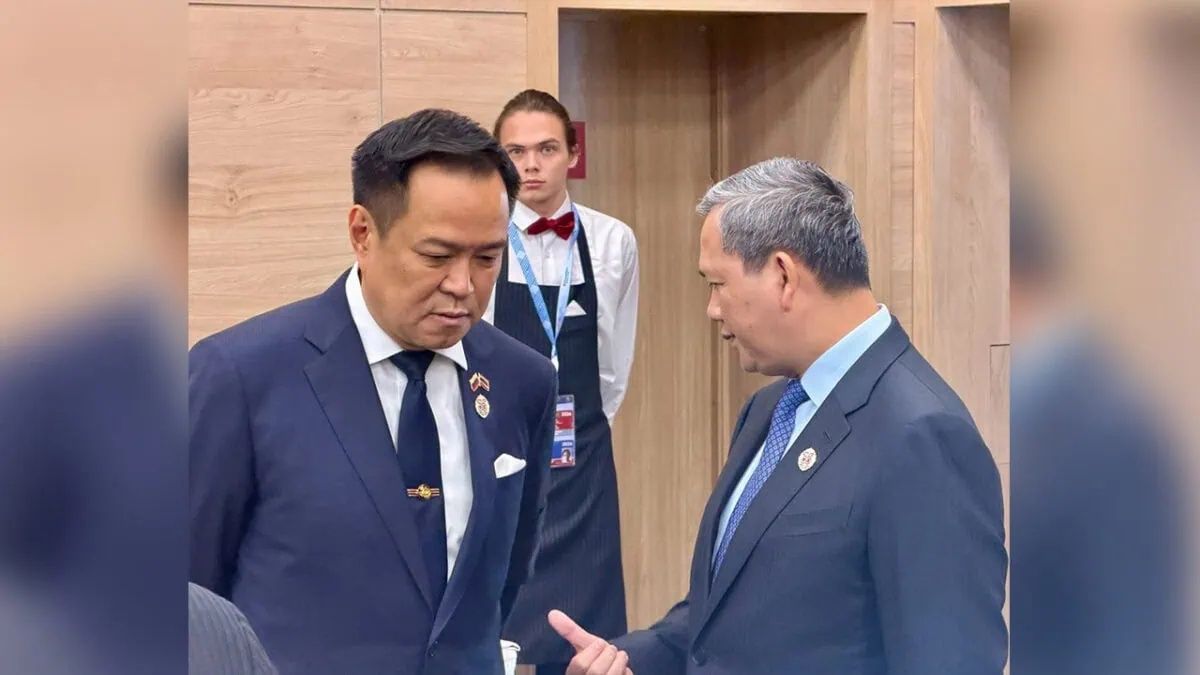
Cambodia's Prime Minister Hun Manet has called on Thailand to move forward with appointing a chief for the Joint Boundary Commission and resuming border survey operations that have long remained stalled. The appeal emerged from a brief conversation between Manet and Thai counterpart Anutin Charnvirakul held on the sidelines of an Asean-Russia engagement in Kazan, Russia, where the two leaders reaffirmed their respective nations' dedication to resolving outstanding boundary questions through peaceful and legally sound mechanisms.
The Cambodian premier outlined his position in a social media post on Friday, June 19, emphasizing that Phnom Penh continues to view bilateral negotiation as the preferred pathway for managing terrestrial border matters. Central to this approach is the Joint Boundary Commission, which both countries established to handle demarcation and survey responsibilities. However, Manet made clear that Cambodia expects Thailand to take concrete action by naming its representative to lead the JBC and commencing the delayed surveying and demarcation work, citing a joint statement dated December 27, 2025 that commits both sides to such activities.
The exchange underscores a delicate diplomatic balance both capitals are attempting to maintain. While publicly stressing commitment to peaceful resolution, Cambodia has adopted a multi-layered strategy that combines bilateral mechanisms for land boundary issues with international legal processes for maritime disputes. This dual approach reflects the complexity of Cambodia-Thailand border relations, which touch on sensitive nationalist sentiments in both countries and remain subjects of considerable public attention and concern.
On the maritime front, Cambodia has engaged Thailand in a compulsory conciliation process under the UN Convention on the Law of the Sea, a framework both nations have ratified. This mechanism operates independently of bilateral negotiations and provides a structured international forum for addressing disagreements over ocean boundaries and resource rights in the Gulf of Thailand. By simultaneously pursuing both channels—bilateral diplomacy for land boundaries and multilateral legal processes for maritime zones—Cambodia seeks to advance its positions while maintaining the appearance of restraint and preference for established frameworks.
Thailand's account of the Kazan conversation, provided by Anutin to Thai media, painted a picture of a casual and fleeting exchange rather than a substantive negotiation session. The Thai Prime Minister characterized the interaction as merely "pulling each other aside by the elbow," suggesting the discussion was hastily arranged given the constraints of the international conference schedule. Anutin confirmed that both leaders expressed mutual disinterest in conflict and acknowledged the various diplomatic and legal mechanisms available for managing their boundary differences, including the JBC, the General Border Committee, and UNCLOS frameworks.
A particularly revealing moment came when Anutin was asked whether border checkpoint reopenings had featured in the conversation. He laughed off the suggestion, noting that raising such a topic would provoke fury among the Thai public. This candid response illuminates the domestic political sensitivities surrounding border issues in Thailand, where constituencies harbour deep concerns about territorial matters and cross-border security. The Thai government's apparent reluctance to discuss reopening checkpoints indicates that neither capital views this as a near-term possibility, despite the economic and practical benefits such moves could generate for border communities.
The differing public characterizations offered by the two capitals reveal nuanced positioning rather than fundamental disagreement. While Manet placed greater emphasis on Cambodia's expectations for Thai action on JBC matters, and Anutin stressed the casual nature of the exchange, both leaders articulated support for peaceful management of disputes and reliance on established legal and diplomatic channels. This convergence suggests that beneath surface-level rhetorical differences, the two governments share a commitment to preventing escalation and maintaining the status quo along their shared frontier.
Cambodia's push for Thailand to name a JBC chief carries particular significance given the commission's long-stalled condition. Without full leadership on both sides, the commission cannot effectively conduct the surveys and demarcation work necessary to clarify boundary lines in disputed areas. This gridlock has frustrated Cambodia, which views appointment of a Thai JBC head as an essential first step toward tangible progress. By making this demand public through Manet's social media announcement, Cambodia appears to be applying gentle pressure on Bangkok while simultaneously demonstrating to its domestic audience that the government is actively pursuing national interests through proper channels.
The Kazan meeting also reflects the broader diplomatic ecosystem in Southeast Asia, where regional gatherings increasingly serve as venues for bilateral conversations conducted at the margins of larger multilateral events. The Asean-Russia engagement provided both leaders with a forum to meet outside formal bilateral settings, allowing for candid discussions presented as informal rather than official state business. This format offers plausible deniability and flexibility while enabling substantive exchanges on sensitive matters that might provoke controversy if addressed through formal diplomatic channels.
Border disputes between Cambodia and Thailand remain deeply embedded in the national consciousness of both countries, with historical grievances and competing claims generating periodic public concern. The governments' careful management of border rhetoric and their emphasis on peaceful mechanisms reflect an understanding that inflammatory statements or aggressive posturing could undermine broader regional stability and damage bilateral economic relationships. Cambodia's significant dependence on Thai trade and investment, coupled with Thailand's concerns about regional security and its relationships with other Mekong neighbours, creates mutual incentives for restraint.
Looking forward, the success of Cambodia's appeals for Thai action on JBC matters will likely determine the pace of border demarcation progress. If Thailand appoints a JBC chief and initiates survey work as Manet requested, the two countries could begin making concrete progress on clarifying boundary lines in disputed terrestrial areas. Conversely, continued Thai hesitation would perpetuate the existing stalemate and potentially test Cambodia's patience with bilateral mechanisms, possibly strengthening arguments within Phnom Penh for escalating disputes through international legal forums. For now, both capitals appear committed to the measured diplomatic approach exemplified in their Kazan exchange, prioritizing stability and procedural correctness over dramatic announcements or confrontational posturing.

%22%2F%3E%3C%2Fpattern%3E%3C%2Fdefs%3E%3Crect%20width%3D%22100%25%22%20height%3D%22100%25%22%20fill%3D%22url(%23ph2hy9vg)%22%2F%3E%3Crect%20width%3D%22100%25%22%20height%3D%22100%25%22%20fill%3D%22url(%23ph2hy9vp)%22%2F%3E%3Ctext%20x%3D%2250%25%22%20y%3D%2250%25%22%20text-anchor%3D%22middle%22%20dominant-baseline%3D%22central%22%20fill%3D%22rgba(255%2C255%2C255%2C0.95)%22%20font-family%3D%22Georgia%2C%20'Times%20New%20Roman'%2C%20serif%22%20font-weight%3D%22700%22%20font-size%3D%22272%22%20letter-spacing%3D%22-0.02em%22%3EAnwar%3C%2Ftext%3E%3C%2Fsvg%3E)