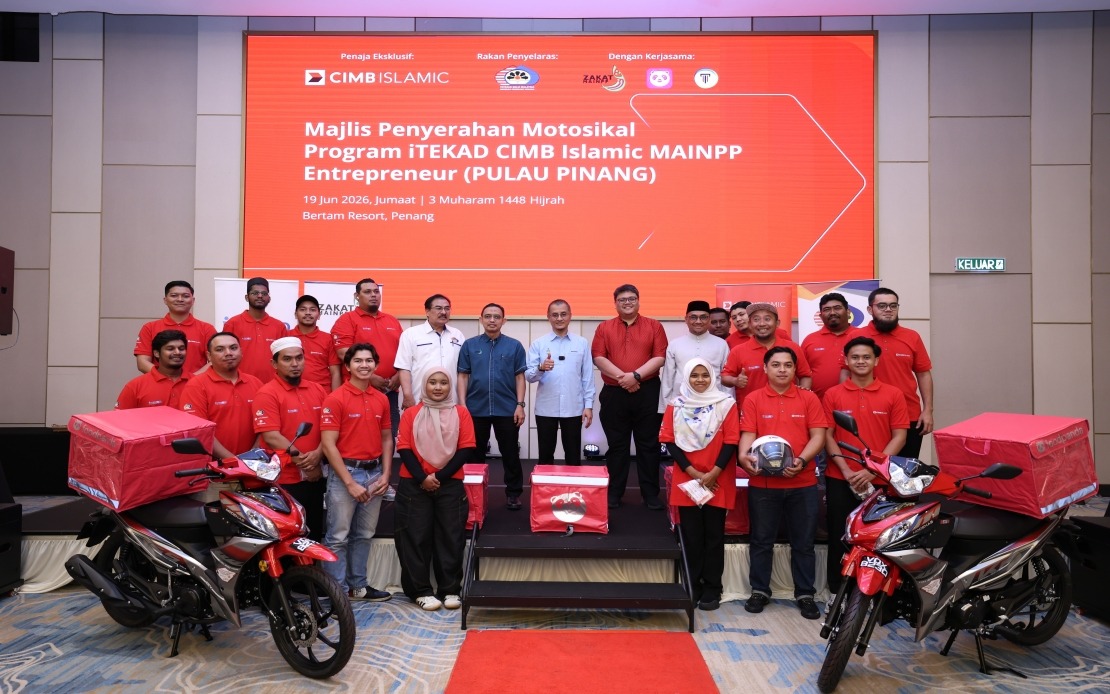
In a demonstration of collaborative social entrepreneurship, twenty carefully selected individuals from low-income households in Penang have received motorcycles and associated equipment to launch delivery-based income generation activities. The handover ceremony at Bertam Resort in Kepala Batas marked the culmination of the iTEKAD CIMB Islamic-MAINPP Entrepreneur programme, a joint initiative combining financial services, religious endowment structures, and community development expertise to create sustainable pathways out of poverty for the asnaf demographic—those eligible for zakat assistance under Islamic principles.
The programme represents a significant departure from traditional welfare approaches by anchoring recipient support in productive asset allocation rather than cash transfers alone. Penang Deputy Chief Minister I Datuk Dr Mohamad Abdul Hamid, who also chairs the Penang Islamic Religious Council (MAINPP), articulated this philosophy during the ceremony, emphasising that the motorcycles and equipment serve as catalysts for structured income generation through food delivery platforms and other logistics services. This asset-based approach mirrors international best practices in poverty alleviation, where recipients gain not only immediate earning capacity but also the psychological and economic benefits of asset ownership.
The financial architecture underpinning this initiative reflects institutional coordination across the Malaysian financial and regulatory ecosystem. The programme operates on a RM400,000 seed fund allocated as a matching grant, with CIMB Islamic Bank Berhad contributing RM200,000 from its Wakalah Zakat fund—a structure that leverages Islamic banking instruments for social benefit—whilst Bank Negara Malaysia, the central monetary authority, committed an equivalent RM200,000. This dual-source funding demonstrates growing recognition at both commercial and regulatory levels that poverty alleviation requires sustained capital deployment beyond ad-hoc charitable interventions.
Implementation of the programme involved rigorous participant selection processes designed to identify individuals with genuine entrepreneurial potential and commitment to self-improvement. Initial applications reached 151, indicating substantial demand for such opportunities within Penang's asnaf population. Candidates underwent intensive screening including formal interviews and a residential Entrepreneurship Camp conducted from May 31 to June 3, 2024, where participants developed foundational business competencies. This BootCamp model, increasingly adopted across Southeast Asia for entrepreneurship development, combines classroom instruction with immersive peer learning and mentorship, creating accountability mechanisms that extend beyond programme conclusion.
The curated selection of twenty participants represents less than fourteen percent of applicants, underscoring the selectivity applied to ensure resource allocation reaches individuals most likely to succeed. Beyond the motorcycles themselves, beneficiaries receive comprehensive delivery equipment compatible with foodpanda Malaysia's logistics network, positioning participants immediately within an established commercial ecosystem. This integration with a major regional delivery platform circumvents a common barrier to new entrepreneurs: the absence of reliable customer acquisition channels and payment infrastructure.
Capacity building extends well beyond equipment provision. Selected participants access structured training in fundamental financial management, workplace discipline standards, and entrepreneurial competencies essential for long-term viability. These non-asset interventions address human capital constraints that frequently limit success among low-income entrepreneurs. Many asnaf individuals lack exposure to formal business practices, accounting disciplines, or the psychological frameworks necessary to transition from employment-seeking to self-directed income generation. The training components acknowledge this reality, providing foundational knowledge that transforms asset recipients into functional entrepreneurs rather than mere equipment users.
The initiative explicitly aligns with Penang's broader Islamic Religious Development Agenda 2030, a strategic framework addressing multidimensional aspects of wellbeing including education, economic participation, family stability, and youth engagement. This sectoral integration positions the iTEKAD programme not as an isolated intervention but as a constituent element within comprehensive socioeconomic development strategy. For Malaysia more broadly, such programming reflects evolving understanding that Islamic financing and zakat mechanisms represent underutilised channels for poverty reduction and entrepreneurship support, particularly within Muslim-majority populations concentrated in specific geographic regions.
The collaboration between CIMB Islamic Bank, MAINPP, the Malaysian Youth Foundation, Taylor's Community, and foodpanda Malaysia exemplifies the multi-stakeholder approach increasingly necessary for sustainable development outcomes. Each partner contributes distinct capabilities: financial institutions provide capital and banking infrastructure, religious councils ensure Shariah compliance and community trust, youth foundations offer mentorship networks, community organisations facilitate local engagement, and commercial platforms supply market access. This ecosystem recognises that poverty alleviation cannot succeed through isolated institutional action but demands coordinated deployment of complementary resources and expertise.
For recipients themselves, the motorcycles represent transformative assets enabling transition from irregular informal-sector employment toward structured self-employment. Delivery work offers flexibility attractive to individuals managing caregiving responsibilities or health constraints, whilst providing documented income streams that may eventually enable access to further financial services, education, or asset accumulation. The multiplier effects extend to family units, as improved household income potentially improves children's educational outcomes and reduces economic desperation driving social dysfunction.
The programme carries specific significance for Southeast Asian readers observing similar poverty dynamics across the region. Malaysia's demonstration of zakat-based entrepreneurship financing offers replicable models for other nations with substantial Muslim populations, including Indonesia, the Philippines, and Thailand. The integration of Islamic finance with social enterprise, combined with commercial platform partnerships, creates scalability potential that many traditional charity programmes lack. Success metrics from this initiative could inform policy recommendations across ASEAN member states seeking sustainable approaches to inclusive economic participation.
Looking forward, programme sustainability depends on post-handover support infrastructure and medium-term performance monitoring. Whilst initial enthusiasm typically characterises grant receipt, maintaining entrepreneurial momentum requires ongoing mentorship, problem-solving support during market fluctuations, and adaptive guidance as business circumstances evolve. The structured BootCamp experience suggests organisers recognise this reality, though longer-term tracking of participant outcomes will determine whether this intervention meaningfully alters economic trajectories or represents temporary income augmentation.
For Malaysian readers, this initiative demonstrates how Shariah-compliant financial instruments can catalyse development outcomes aligned with social equity objectives. Rather than framing Islamic banking purely as religious or commercial enterprise, the programme illustrates potential synergies between financial innovation and poverty reduction. As Malaysia progresses toward upper-middle-income status, addressing remaining poverty pockets and enabling broader-based wealth participation requires precisely such integrative approaches that combine asset provision, human capital development, market linkages, and ongoing institutional support.

%22%2F%3E%3C%2Fpattern%3E%3C%2Fdefs%3E%3Crect%20width%3D%22100%25%22%20height%3D%22100%25%22%20fill%3D%22url(%23ph2hy9vg)%22%2F%3E%3Crect%20width%3D%22100%25%22%20height%3D%22100%25%22%20fill%3D%22url(%23ph2hy9vp)%22%2F%3E%3Ctext%20x%3D%2250%25%22%20y%3D%2250%25%22%20text-anchor%3D%22middle%22%20dominant-baseline%3D%22central%22%20fill%3D%22rgba(255%2C255%2C255%2C0.95)%22%20font-family%3D%22Georgia%2C%20'Times%20New%20Roman'%2C%20serif%22%20font-weight%3D%22700%22%20font-size%3D%22272%22%20letter-spacing%3D%22-0.02em%22%3EAnwar%3C%2Ftext%3E%3C%2Fsvg%3E)