The Paris Vivatech festival has become a showcase for emerging technologies that promise to reshape industries across the globe, with innovations spanning biotechnology, aerospace and artificial intelligence drawing particular attention from investors and industry leaders. Among the most significant unveilings were solutions addressing persistent challenges in medical implantation, urban mobility, financial security and athletic performance monitoring—each representing years of research and substantial capital requirements that underline the competitive intensity of the innovation landscape.
Berlin-based Blueprint Biomed is advancing a solution that could fundamentally alter orthopedic surgery by developing synthetic bone graft replacements for the millions of patients annually requiring skeletal reconstruction. Currently, surgeons rely heavily on autologous grafts harvested from patients' own bone tissue, a procedure that carries inherent risks. Chief executive Aaron Herrera explained that self-derived grafts frequently fail, necessitating additional surgical intervention, while complications arise frequently enough to justify seeking alternatives. The company's approach employs three-dimensional printing technology to construct biodegradable scaffolding from polycaprolactone, a synthetic polyester that integrates with natural collagen structures already present in the body. This engineered matrix provides mechanical support while the body gradually absorbs both materials—collagen dissolves within three months while polycaprolactone remains effective for up to two years before complete resorption. The flexibility of the manufacturing process allows customisation across diverse anatomical requirements, potentially expanding applications far beyond current standard graft options. Blueprint Biomed is pursuing US$2.5 million in funding to advance toward human clinical trials, with projections suggesting patient implantation could commence by 2028, a timeline that would position the company ahead of many competing biotech ventures still navigating regulatory pathways.
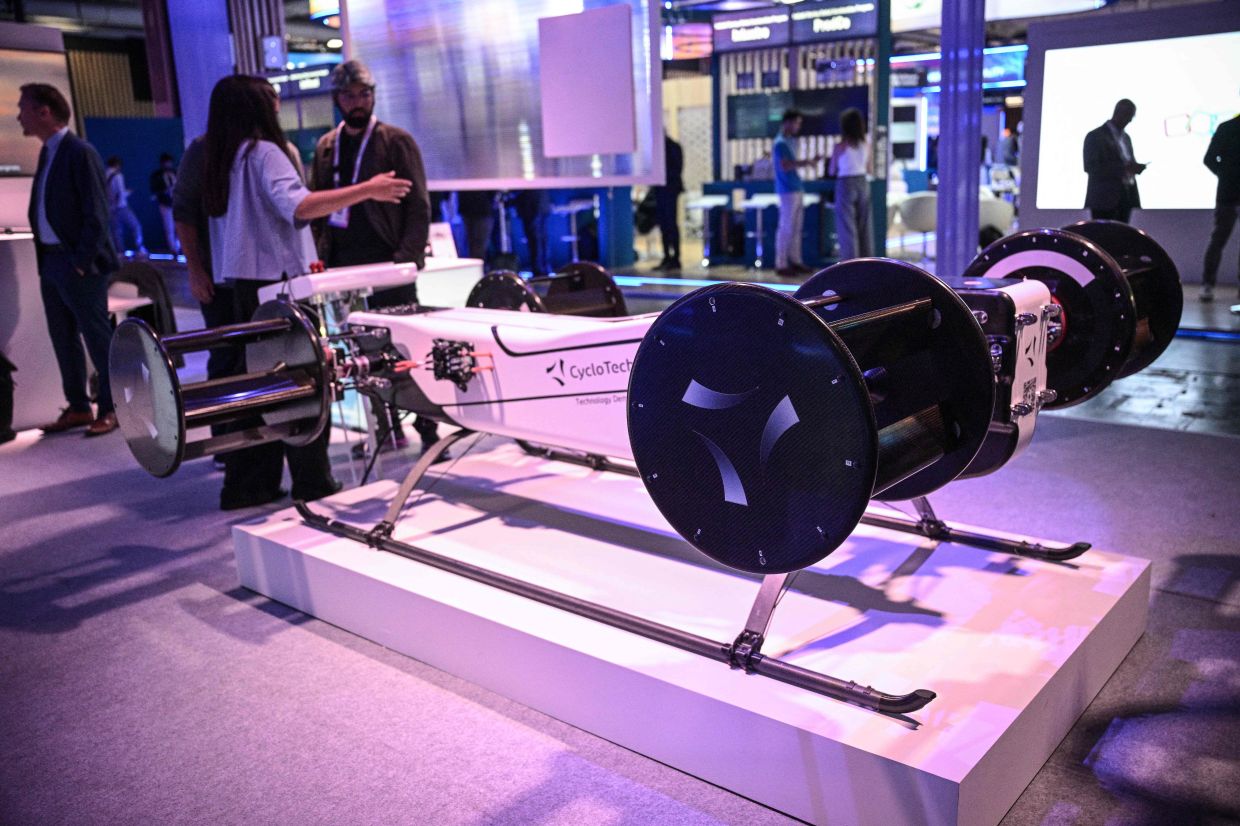
The drone sector continues attracting substantial venture capital, with Austrian startup CycloTech presenting an alternative motor architecture that challenges conventional quadcopter designs. Rather than employing traditional electric motors, CycloTech's cylindrical motor design integrates multiple blade-shaped elements around an open core, generating unprecedented flight characteristics. Marketing chief Andrea Marchsteiner highlighted that this configuration enables simultaneous capabilities previously requiring mechanical trade-offs: hovering stability comparable to helicopters, forward flight speeds matching fixed-wing aircraft, mid-air braking that conventional drones struggle to achieve, and reverse flight through air. The technology's flexibility promises application across urban delivery networks, passenger transport systems and military operations, though commercial viability ultimately depends on integration partnerships with established aircraft manufacturers. The 65-person company has already accumulated €40 million in funding and actively seeks additional investment and strategic partnerships to accelerate market adoption, indicating confidence in near-term commercialisation despite remaining technical optimisations.
Speech authentication technology is experiencing urgent evolution as artificial intelligence generates increasingly convincing voice imitation capabilities. French firm Whispeak, originally designed to verify banking customers' identities through voice recognition, has repositioned itself as a deepfake detection specialist addressing emerging security threats. Chief executive Florent Van Calster noted that contemporary technology enables voice replication of sufficient quality to deceive listeners within mere seconds of sample recording, often utilising freely available tools. The company's AI-trained detection system has achieved industry recognition through multiple competitive evaluations, claiming superior performance compared to alternative solutions. Whispeak's collaboration with French telecommunications operator Bouygues demonstrates practical deployment, with real-world applications generating error rates below one percent on available training datasets. However, Van Calster acknowledged the perpetual nature of the security challenge, characterising the situation as an escalating competition where fraudsters continually develop circumvention methods as detection technology advances. This cat-and-mouse dynamic ensures sustained demand for detection innovations while simultaneously rendering any current solution potentially vulnerable to future attacks.
Athletic performance monitoring is shifting from intrusive blood sampling toward non-invasive skin-based biomarker detection through Hong Kong-based startup PointFit's adhesive patch technology. The company's miniaturised sensors read physiological markers including glucose and cortisol levels directly from perspiration, eliminating needle punctures while providing continuous monitoring during competition and training. Chief executive Kenny Oktavius, who commenced development in 2019 while completing university studies, embedded artificial intelligence algorithms that personalise expected biomarker ranges according to demographic factors and environmental conditions like ambient temperature. This contextualisation addresses a persistent limitation of conventional heart-rate monitoring, which Oktavius observed fails to provide comprehensive physiological understanding despite widespread adoption among elite athletes. Professional marathon competitors, despite expensive wearable technology, occasionally experience catastrophic physiological collapse undetected by conventional metrics, demonstrating the inadequacy of existing monitoring approaches. Oktavius emphasised that hospitalised patients undergo biomarker assessment precisely because these indicators reveal pathophysiological realities that superficial measurements obscure. PointFit has already engaged premium partnerships including Red Bull's Athlete Performance Centre and Puma's Nitro Labs innovation division, validating the technology's credibility while establishing pathways toward mainstream consumer retail through retailers like Decathlon and consumer eyewear companies such as EssilorLuxottica.
These innovations collectively demonstrate the maturation of venture-backed technology development in sectors critical to human welfare and economic efficiency. The presence of such diverse solutions at a major technology festival underscores how capital availability and talent concentration in innovation ecosystems generates competitive advantages that extend far beyond individual companies. For Southeast Asian markets, these developments signal accelerating technology adoption cycles, particularly in healthcare innovation where regulatory frameworks increasingly accommodate advanced solutions addressing genuine clinical limitations. The intersection of artificial intelligence, biotechnology and hardware engineering evident across these projects suggests that future competitive advantages will accrue to regions developing integrated innovation ecosystems rather than isolated technological competencies.

%22%2F%3E%3C%2Fpattern%3E%3C%2Fdefs%3E%3Crect%20width%3D%22100%25%22%20height%3D%22100%25%22%20fill%3D%22url(%23ph4yddrg)%22%2F%3E%3Crect%20width%3D%22100%25%22%20height%3D%22100%25%22%20fill%3D%22url(%23ph4yddrp)%22%2F%3E%3Ctext%20x%3D%2250%25%22%20y%3D%2250%25%22%20text-anchor%3D%22middle%22%20dominant-baseline%3D%22central%22%20fill%3D%22rgba(255%2C255%2C255%2C0.95)%22%20font-family%3D%22Georgia%2C%20'Times%20New%20Roman'%2C%20serif%22%20font-weight%3D%22700%22%20font-size%3D%22194%22%20letter-spacing%3D%22-0.02em%22%3ERefugee%3C%2Ftext%3E%3C%2Fsvg%3E)