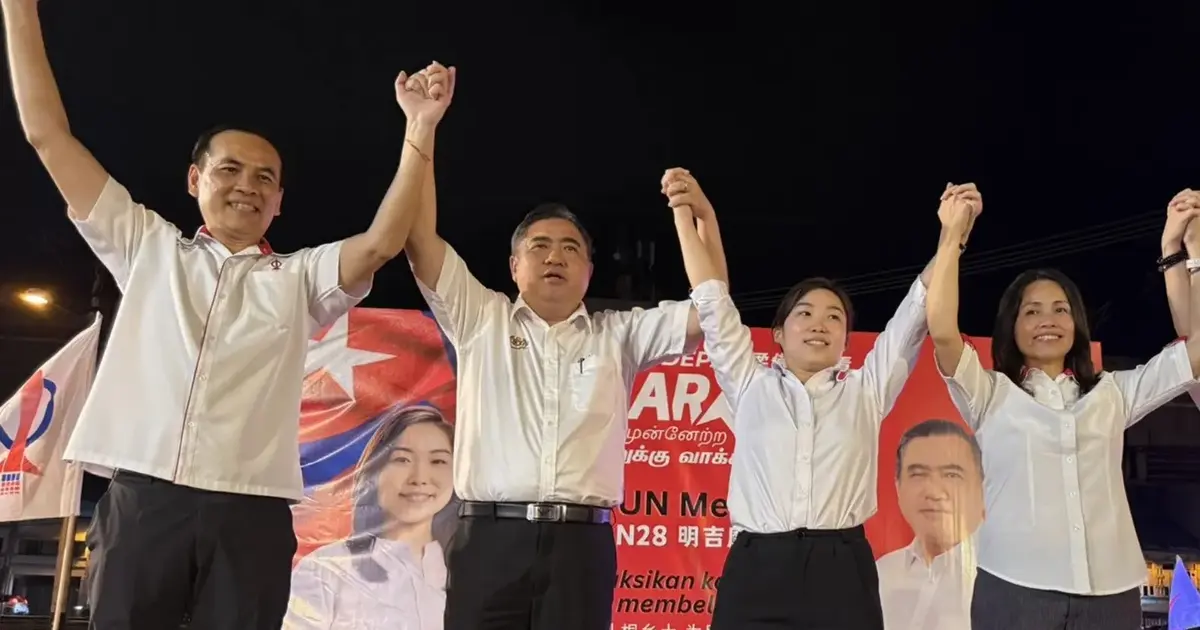
The Democratic Action Party has moved to refresh its representation in the Mengkibol parliamentary constituency, announcing a change of candidate for the forthcoming general election. Party secretary-general Loke Siew Fook unveiled lawyer Chu Poh Yee as the party's choice for the seat, signalling a transition from the existing two-term representative who has held the position through the previous electoral cycles.
The decision to field a new candidate represents a significant shift in DAP's strategy for this particular seat. Rather than relying on the incumbency advantage that typically benefits long-serving lawmakers, the party has opted to introduce fresh blood into its campaign machinery, potentially reflecting broader internal discussions about generational renewal and candidate selection criteria. Chu Poh Yee's background in law provides the party with a candidate whose professional credentials span the legal sector, an asset that may appeal to middle-class and educated voters who form a substantial portion of the Mengkibol electorate.
Mengkibol, a largely urban or semi-urban constituency, has historically been contested ground in Malaysian electoral politics. The seat's demographic composition and voting patterns have made it a focal point for DAP's parliamentary representation in the region. By introducing a lawyer as the new standard-bearer, the party appears to be banking on professional credibility and the capacity to articulate policy positions relevant to an increasingly sophisticated voter base concerned with rule of law, governance standards, and institutional integrity.
The replacement of a two-term incumbent is not a decision political parties typically make lightly. Such moves often signal internal assessments about electoral prospects, demographic shifts within the constituency, or broader party strategic recalibrations. Loke Siew Fook's announcement from his position as secretary-general carries official party sanction and indicates this represents considered leadership strategy rather than a localised endorsement or trial balloon.
From a Malaysian electoral perspective, the changing of Mengkibol's DAP representative underscores the evolving nature of parliamentary politics as the country approaches its next general election. Political parties across the spectrum are actively reviewing their candidate portfolios, attempting to balance the benefits of established representatives against the potential momentum generated by newcomers. This balancing act has become increasingly important as voter volatility appears to have grown, and as constituencies respond more sharply to local issues and individual candidate performance.
Chu Poh Yee's entry into the parliamentary race comes amid broader DAP positioning in what will likely be a fiercely contested election. The party has been actively consolidating its base in urban areas while simultaneously exploring expansion opportunities in constituencies where demographic and political conditions align with its political positioning. Mengkibol's selection as a seat where generational transition occurs suggests party strategists view the constituency as sufficiently strong to absorb a change in representation without significantly compromising electoral prospects.
The implications for other political parties competing in Mengkibol are noteworthy. Opposition and government coalition parties will need to recalibrate their own strategies in response to DAP's candidate announcement. The replacement of a sitting representative, while maintaining the party's ticket, may prompt competitors to revisit their own campaign planning, messaging strategies, and resource allocation for this particular seat.
For regional observers, the Mengkibol shift exemplifies the intense internal deliberations occurring within major Malaysian political formations as they prepare for national electoral competition. The Democratic Action Party's decision-making process reveals how sophisticated parties are becoming in their analytical approaches to seat-specific dynamics, taking into account incumbent performance metrics, evolving voter demographics, local sentiment, and broader national political currents.
The substitution also raises questions about what becomes of the outgoing two-term representative. Political transitions of this nature frequently result in incumbent MPs being offered alternative candidacies, retained positions within party structures, or accepting the decision gracefully while pursuing different avenues. The treatment of incumbent MPs during these transitions often signals much about a party's internal culture and its approach to managing relationships with established figures.
Mengkibol voters now face a choice between Chu Poh Yee's fresh candidacy and whatever alternatives other parties put forward. The constituency's electoral outcome will provide an important barometer of whether DAP's calculation about introducing new representation remains sound, or whether the two-term incumbent retained stronger local support than party strategists assessed. As the general election campaign intensifies, voter reception to Chu Poh Yee and the overall political environment will ultimately determine whether this strategic recalibration proves successful.

%22%2F%3E%3C%2Fpattern%3E%3C%2Fdefs%3E%3Crect%20width%3D%22100%25%22%20height%3D%22100%25%22%20fill%3D%22url(%23ph2hy9vg)%22%2F%3E%3Crect%20width%3D%22100%25%22%20height%3D%22100%25%22%20fill%3D%22url(%23ph2hy9vp)%22%2F%3E%3Ctext%20x%3D%2250%25%22%20y%3D%2250%25%22%20text-anchor%3D%22middle%22%20dominant-baseline%3D%22central%22%20fill%3D%22rgba(255%2C255%2C255%2C0.95)%22%20font-family%3D%22Georgia%2C%20'Times%20New%20Roman'%2C%20serif%22%20font-weight%3D%22700%22%20font-size%3D%22272%22%20letter-spacing%3D%22-0.02em%22%3EAnwar%3C%2Ftext%3E%3C%2Fsvg%3E)