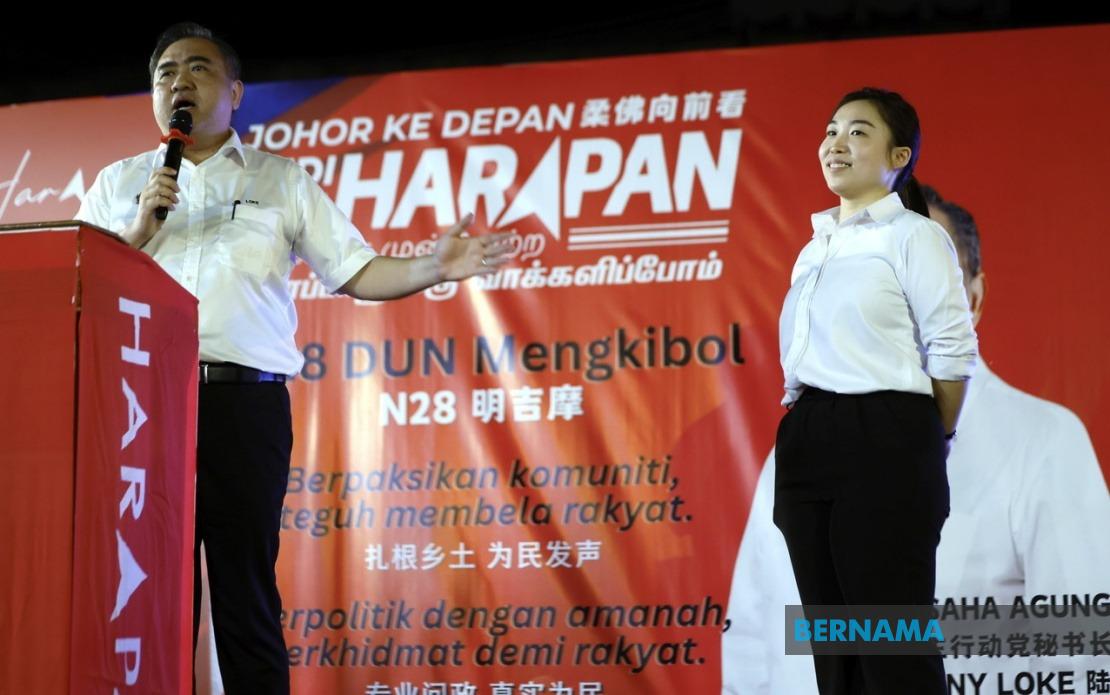
The Democratic Action Party announced on June 18 that it will field Chu Poh Yee, a 33-year-old legal professional, as its candidate for the Mengkibol state assembly seat in the forthcoming Johor state election. The selection marks a significant generational shift in the constituency, where two-term incumbent Chew Chong Sin will step aside to make way for fresh representation. The announcement took place at a candidate unveiling ceremony in Kluang, attended by party secretary-general Anthony Loke and Johor DAP chairman Teo Nie Ching, signalling the importance the party places on the succession.
According to Loke, the party's decision to transition the Mengkibol seat reflects a deliberate strategy to advance Chew's political trajectory toward higher office. The incumbent assemblyman is being positioned as the DAP's parliamentary candidate for Labis in the next general election, following the decision by current Member of Parliament Pang Hok Liong to retire from electoral politics. This represents a common progression in Malaysian politics, where state representatives move to federal constituencies as part of party succession planning and organizational development. The move underscores how the DAP views Mengkibol as an opportunity to nurture emerging talent while promoting experienced members to more senior roles.
Chu's professional background as a lawyer working within legal aid frameworks provides her with practical experience addressing constituent concerns that resonate particularly with lower-income residents requiring affordable legal assistance. Her involvement in supporting local elected representatives with law-related cases has given her visibility across Mengkibol and institutional knowledge of community needs. Such ground-level engagement in legal matters often proves valuable for representatives tackling housing disputes, employment claims, and family law cases that disproportionately affect ordinary Malaysians struggling with formal justice systems.
The DAP leadership emphasized Chu's multilingual capabilities as a strategic advantage in a diverse constituency. In Malaysian electoral contexts, language proficiency extends beyond mere communication; it reflects cultural awareness and an ability to connect with different demographic groups within a voting area. For a state seat in Johor, where the population comprises Malay, Chinese, Indian, and indigenous communities, fluency across multiple languages signals genuine commitment to serving all residents equally rather than addressing only one ethnic or linguistic group.
Chu's appointment aligns with the DAP's stated commitment to expanding women's representation within its political ranks and candidate slate. Women comprise approximately half the Malaysian population yet historically have been underrepresented in electoral contests across most major political parties. By nominating a young, professionally accomplished woman for a competitive seat previously held by the party, DAP demonstrates internal commitment to gender equality that extends beyond rhetorical support. However, the emphasis on her gender in official communications also highlights how political parties continue to frame women candidates as special cases rather than routine selections, a pattern that requires further normalization across Malaysian politics.
The broader context involves the DAP's comprehensive strategy for the Johor state election, where the party is contesting seventeen seats. Of these, ten represent constituencies the party currently holds, including Mengkibol, four are seats the DAP lost in previous elections and seeks to reclaim, and three are entirely new targets. This distribution reveals the party's ambition to both consolidate existing strongholds and expand into fresh territory, a balancing act that most political organizations must navigate during electoral cycles. The scale of the DAP's Johor campaign suggests the party views the state as a critical battleground for building momentum heading into broader national political contests.
Anthony Loke indicated that additional candidate announcements would follow in successive announcements, with four more names disclosed the following Saturday for constituencies including Tiram, Johor Jaya, Senai, and Bukit Permai. This staggered announcement strategy keeps the party's campaign narrative in public discourse throughout the lead-up period, generating multiple news cycles rather than concentrating attention in a single announcement. From a media relations perspective, this approach maintains party visibility and allows leadership to control news flow strategically.
The final slate of DAP candidates was scheduled to be announced collectively alongside other Pakatan Harapan coalition members by Malaysia's Prime Minister on the following Monday. This coordination reflects the coalition's operational framework, where major political appointments are synchronized across participating parties to present a unified front to voters. Pakatan Harapan's coalition structure requires balancing seat allocations and candidate selections among component parties—DAP, PKR, Amanah, and others—to maintain organizational cohesion while respecting each party's territorial interests and political strength.
For Malaysian voters, Chu Poh Yee's nomination represents the type of career progression increasingly visible in Malaysian politics, where professional expertise and grassroots community engagement serve as credentials for electoral candidacy. Unlike purely careeristic appointments, her legal background addressing social welfare issues suggests alignment with DAP's traditional voter base concerned with practical governance, service delivery, and social welfare accessibility. Her selection will likely influence how Mengkibol voters evaluate broader questions about representation, party renewal, and the qualifications they expect from elected officials.
The Mengkibol seat itself carries electoral significance for understanding Johor's political trajectory. As a state assembly constituency within Johor, which remains a crucial battleground between Pakatan Harapan and opposition forces, each seat's competitive status affects coalition calculations and national political implications. The decision to transition established incumbents to parliamentary contests while fielding new candidates in state seats reflects confidence in both the new representatives and the party's ability to retain these constituencies through changing political conditions.


%22%2F%3E%3C%2Fpattern%3E%3C%2Fdefs%3E%3Crect%20width%3D%22100%25%22%20height%3D%22100%25%22%20fill%3D%22url(%23ph2hy9vg)%22%2F%3E%3Crect%20width%3D%22100%25%22%20height%3D%22100%25%22%20fill%3D%22url(%23ph2hy9vp)%22%2F%3E%3Ctext%20x%3D%2250%25%22%20y%3D%2250%25%22%20text-anchor%3D%22middle%22%20dominant-baseline%3D%22central%22%20fill%3D%22rgba(255%2C255%2C255%2C0.95)%22%20font-family%3D%22Georgia%2C%20'Times%20New%20Roman'%2C%20serif%22%20font-weight%3D%22700%22%20font-size%3D%22272%22%20letter-spacing%3D%22-0.02em%22%3EAnwar%3C%2Ftext%3E%3C%2Fsvg%3E)