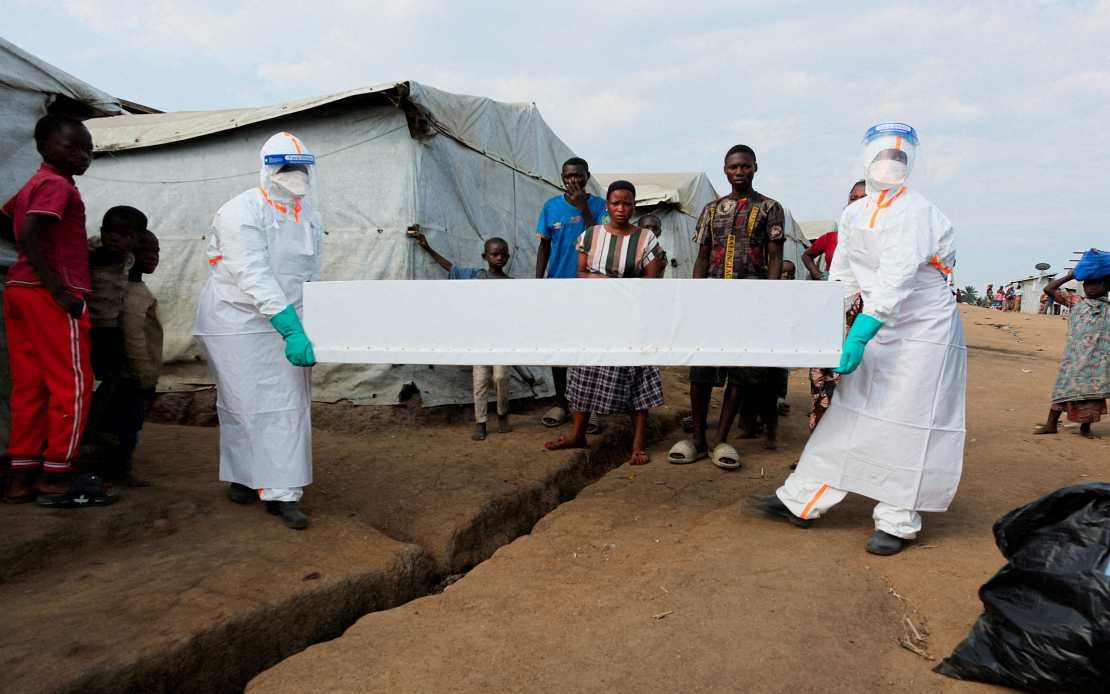
The Ebola outbreak in the Democratic Republic of Congo has entered a critical phase, with confirmed cases exceeding 1,000 as of mid-June, marking a significant escalation in the public health crisis gripping the Central African nation. Health authorities reported 1,003 confirmed infections and 254 deaths since the outbreak was declared on May 15, translating to a mortality rate of 25.3 per cent, underscoring the severity of the current epidemic compared to historical outbreaks in the region.
The geographical spread of the disease poses particular challenges for containment efforts. Health Minister Roger Kamba indicated that response operations are concentrated across three provinces—Ituri, North Kivu and South Kivu—where transmission chains remain active and difficult to interrupt. These eastern regions, already burdened by conflict and limited healthcare infrastructure, have become the epicentre of a health emergency that threatens not only the Congo but the stability of the broader East African region.
While some positive developments have emerged from the response efforts, the overall trajectory remains concerning. At least 100 patients have recovered from the disease, offering a glimmer of hope that treatment protocols can be effective when patients access care promptly. However, 365 individuals remain hospitalised or in isolation, representing a substantial patient load that strains already fragile medical systems in the affected areas. Perhaps more troubling is the reported decline in contact follow-up rates, a critical metric for preventing secondary infections.
Regional health authorities have sounded alarm bells about the potential for the current situation to deteriorate rapidly. The Africa Centres for Disease Control and Prevention warned last week that without swift containment measures, this outbreak could rival or exceed the devastating 2014-2016 West African epidemic, which claimed more than 11,000 lives across Guinea, Liberia and Sierra Leone. That cautionary assessment reflects genuine epidemiological concerns rather than mere speculation, as the West African crisis demonstrated how quickly Ebola can overwhelm response systems when transmission accelerates unchecked.
The identification of the causative virus strain provides important scientific context for understanding the outbreak's origins and behaviour. Researchers from Uganda's Health Ministry Department of National Health Laboratory and Diagnostic Services, working alongside Congo's Institute of National Biomedical Research, confirmed that the current pathogen is Ebola Bundibugyo and originated from a fresh wildlife spillover event. This determination is significant because it definitively rules out the possibility that the outbreak stems from a dormant infection resurfacing from a prior epidemic or an undetected chain of transmission persisting since an earlier crisis.
Understanding the zoonotic source of the outbreak has implications for prevention strategies going forward. Wildlife spillover events—where pathogens cross from animal populations to humans—are inherently unpredictable, making long-term prevention efforts challenging. The emergence of a new spillover suggests that ecological changes, habitat disruption, or hunting and butchering practices may be creating novel pathways for viral transmission. For policymakers across Southeast Asia and Africa alike, this reinforces the need for surveillance systems that can detect emerging infectious diseases at the human-animal interface before widespread transmission occurs.
Despite the sobering statistics and warnings, Congolese health authorities have maintained their commitment to intensified response efforts. The Health Ministry emphasised that response teams continue conducting active investigations in affected communities, implementing epidemiological surveillance to track disease spread, and maintaining prevention activities in outbreak zones. These foundational public health measures remain essential, though their effectiveness depends heavily on community cooperation and adequate resource allocation.
Community engagement represents a critical but often neglected dimension of epidemic response. Health Minister Kamba noted that efforts to communicate with local populations, improve diagnostic capabilities, and enhance case management continue to be scaled up. In conflict-affected regions like eastern Congo, building trust between health authorities and communities can prove as challenging as the medical aspects of outbreak control. Previous Ebola responses have demonstrated that misinformation, cultural practices, and scepticism of government health institutions can severely hamper containment efforts.
For Malaysian and Southeast Asian observers, the Congo outbreak carries important lessons about pandemic preparedness and regional vulnerability. The rapid establishment of surveillance networks, stockpiling of diagnostic equipment and protective gear, and training of rapid response teams—measures that appear routine during normal times—become invaluable when a new outbreak emerges. The Congo's experience demonstrates that even well-intentioned response efforts can struggle when systems are underfunded or when disease transmission occurs in complex humanitarian environments.
The coming weeks will be critical in determining whether the outbreak can be brought under control or whether it continues its upward trajectory toward the catastrophic scenarios health experts fear. Sustained international support, particularly for laboratory capacity and epidemiological investigation, remains essential. The Africa CDC's warning should serve as a wake-up call not only for Congo and its neighbours but for the global health community, which has learned through bitter experience that early, aggressive action against Ebola can mean the difference between a contained outbreak and a regional catastrophe.

%22%2F%3E%3C%2Fpattern%3E%3C%2Fdefs%3E%3Crect%20width%3D%22100%25%22%20height%3D%22100%25%22%20fill%3D%22url(%23phz7hyg)%22%2F%3E%3Crect%20width%3D%22100%25%22%20height%3D%22100%25%22%20fill%3D%22url(%23phz7hyp)%22%2F%3E%3Ctext%20x%3D%2250%25%22%20y%3D%2250%25%22%20text-anchor%3D%22middle%22%20dominant-baseline%3D%22central%22%20fill%3D%22rgba(255%2C255%2C255%2C0.95)%22%20font-family%3D%22Georgia%2C%20'Times%20New%20Roman'%2C%20serif%22%20font-weight%3D%22700%22%20font-size%3D%22272%22%20letter-spacing%3D%22-0.02em%22%3EAnwar%3C%2Ftext%3E%3C%2Fsvg%3E)