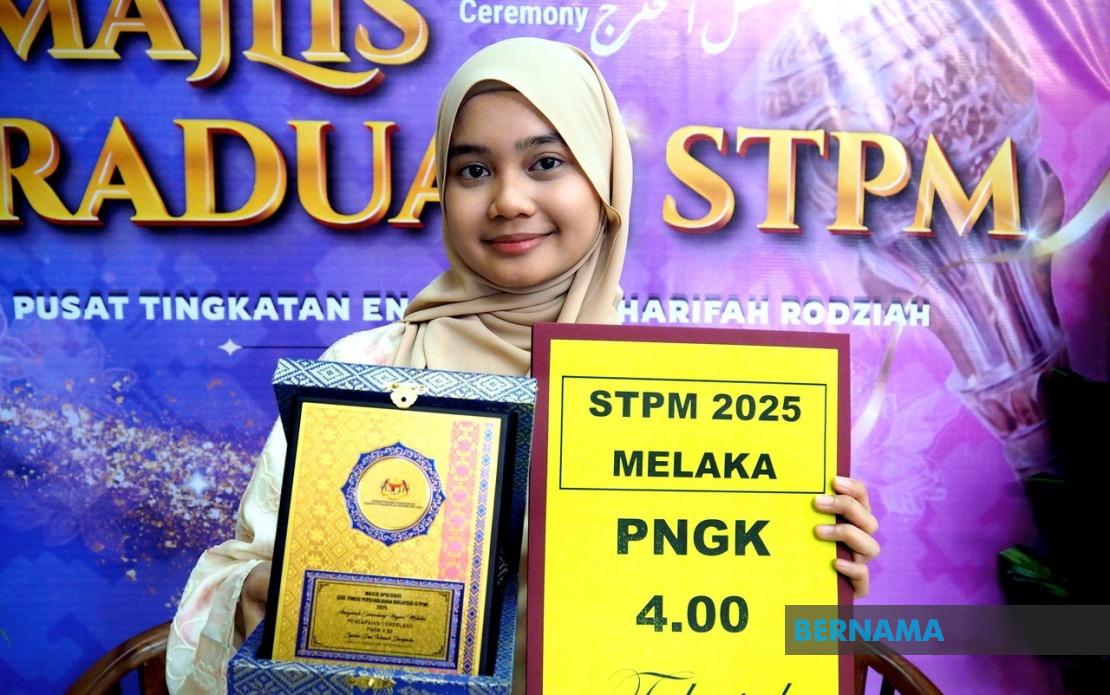
Nurfariesya Nasywa Hamedee's achievement of a perfect 4.00 Cumulative Grade Point Average in the 2025 Sijil Tinggi Persekolahan Malaysia examination carries profound emotional weight. The 21-year-old from Sekolah Menengah Kebangsaan Agama Sharifah Rodziah in Melaka succeeded despite losing her father, Hamedee Asri, just days before her SPM trial examination several years ago. The sudden passing of the 43-year-old from a heart attack could easily have derailed her academic journey, yet instead it became the foundation upon which her most recent success was built.
The turning point in Nurfariesya's determination came not from her own resilience alone, but through a message her mother, Yusnita Ruslan, relayed from her late father. His instruction to study diligently and not waste her potential became a constant touchstone during her grief. When confronted with the immediate aftermath of bereavement, the teenager considered abandoning school entirely to seek employment and contribute financially to her household. Such a decision would have been understandable given her family circumstances, yet the weight of her father's parting words proved stronger than financial necessity.
The psychological challenge of managing grief while maintaining academic focus is rarely discussed in examinations success stories, yet it represents a significant dimension of Nurfariesya's accomplishment. She has spoken openly about the loss of motivation that engulfed her after her father's death, illustrating how academic performance cannot be divorced from emotional wellbeing. The fact that she not only recovered from this crisis but ultimately achieved excellence suggests a maturity and emotional resilience that extends far beyond typical teenage experience. Her willingness to persist through such trauma offers insight into the character traits that underpin exceptional academic results.
What makes Nurfariesya's perfect score particularly striking is that she herself did not anticipate achieving it. Based on her trial examination results and preliminary calculations, she had estimated her CGPA would reach approximately 3.92. This modest self-assessment suggests she approached her final examinations without the confidence of someone expecting perfection, which may have paradoxically relieved pressure and allowed her to perform at her genuine capability level. The gap between her projected and actual outcomes indicates the value of sustained effort even when success seems marginally out of reach.
Her choice of subjects reflects a clear vocational direction that has sustained her motivation throughout secondary and pre-university education. Nurfariesya studied General Studies, Arabic, Usuluddin, History, and Shariah, subjects chosen deliberately to support her ambition of becoming a Shariah lawyer. This alignment between her academic pathway and long-term career goals is instructive for students navigating subject selection at similar educational junctures. Rather than treating STPM subjects as generic stepping stones to higher education, she leveraged them as strategic tools toward a specific professional identity. Her deep interest in Islamic law was evident during her school years, providing internal motivation independent of external pressure.
Nurfariesya's earlier academic record also demonstrates consistency across educational milestones. She obtained seven A grades in her SPM examination, establishing a pattern of excellence that continued through STPM. This trajectory suggests that her perfect 4.00 score represents the culmination of sustained effort rather than a sudden burst of exceptional performance. For Malaysian students considering their own academic paths, her consistency offers a model: excellence builds upon excellence, and short-term peaks matter less than sustained commitment to learning.
Her decision to pursue STPM rather than other post-secondary pathways reflects strategic thinking about educational efficiency. Nurfariesya viewed STPM as a more direct route to university degree programmes compared to alternative qualifications, acknowledging the time-sensitive nature of pre-tertiary education. She has since completed an interview for a Bachelor's degree programme at Universiti Malaya, positioning herself well for entry into one of Malaysia's most prestigious institutions. Her success in STPM has substantially strengthened that application.
When asked about the secret to academic success, Nurfariesya eschewed mystique, instead offering straightforward counsel: study diligently, maintain resilience through difficulties, and sustain faith in Allah. This unglamorous formula—hard work, persistence, and spiritual conviction—appears repeatedly in interviews with high-achieving Malaysian students. The consistency of this message across different personalities and backgrounds suggests that excellence emerges less from special talents or secret techniques than from ordinary effort sustained over extended periods.
Nurfariesya's achievement gained recognition during the Melaka State STPM Results announcement ceremony, where the occasion was officiated by Datuk Rosli Abdullah, State Deputy Exco for Education, Higher Education, and Religious Affairs. The formal recognition of student excellence at state level serves an important function in Malaysian society, acknowledging not merely individual accomplishment but also the institutional support systems—schools, teachers, families—that enable such achievements.
Alongside Nurfariesya's accomplishment, Ng Zhen Hong from Kolej Tingkatan Enam Tun Fatimah earned the National-Level Best Student Award for the Science Stream in 2025 STPM. The 20-year-old's recognition as the nation's top science student reflects similar patterns of parental support, teacher mentorship, and intrinsic motivation. Ng attributed his achievement partly to daily revision habits spanning one to two hours, suggesting that excellence in demanding subjects like science emerges from consistent, methodical practice rather than intensive cramming sessions. His appetite for problem-solving and calculations as a source of motivation rather than anxiety demonstrates how subject engagement differs fundamentally across learners.
Both Nurfariesya and Ng represent the visible apex of Malaysia's secondary education system. Their stories illustrate not merely individual capability but also the functioning of institutional structures designed to identify and nurture talent. STPM continues to serve as a filter through which Malaysia identifies students ready for elite tertiary institutions, though its role has evolved as alternative pathways to higher education have proliferated. For families and students evaluating educational options, these success stories provide concrete examples of what sustained commitment across multiple educational stages can yield.
The broader significance of these achievements extends beyond individual success. When students of Nurfariesya's and Ng's calibre pursue further studies in critical fields—Shariah law and engineering respectively—they contribute to addressing professional skill shortages in Malaysia's economy and legal system. The secondary education system's function in channelling talented individuals toward strategically important disciplines has direct implications for national development. Recognition of STPM excellence therefore serves not merely to celebrate individual accomplishment but to affirm the system's role in human capital development for a developing economy increasingly dependent on professional expertise.


%22%2F%3E%3C%2Fpattern%3E%3C%2Fdefs%3E%3Crect%20width%3D%22100%25%22%20height%3D%22100%25%22%20fill%3D%22url(%23ph2hy9vg)%22%2F%3E%3Crect%20width%3D%22100%25%22%20height%3D%22100%25%22%20fill%3D%22url(%23ph2hy9vp)%22%2F%3E%3Ctext%20x%3D%2250%25%22%20y%3D%2250%25%22%20text-anchor%3D%22middle%22%20dominant-baseline%3D%22central%22%20fill%3D%22rgba(255%2C255%2C255%2C0.95)%22%20font-family%3D%22Georgia%2C%20'Times%20New%20Roman'%2C%20serif%22%20font-weight%3D%22700%22%20font-size%3D%22272%22%20letter-spacing%3D%22-0.02em%22%3EAnwar%3C%2Ftext%3E%3C%2Fsvg%3E)