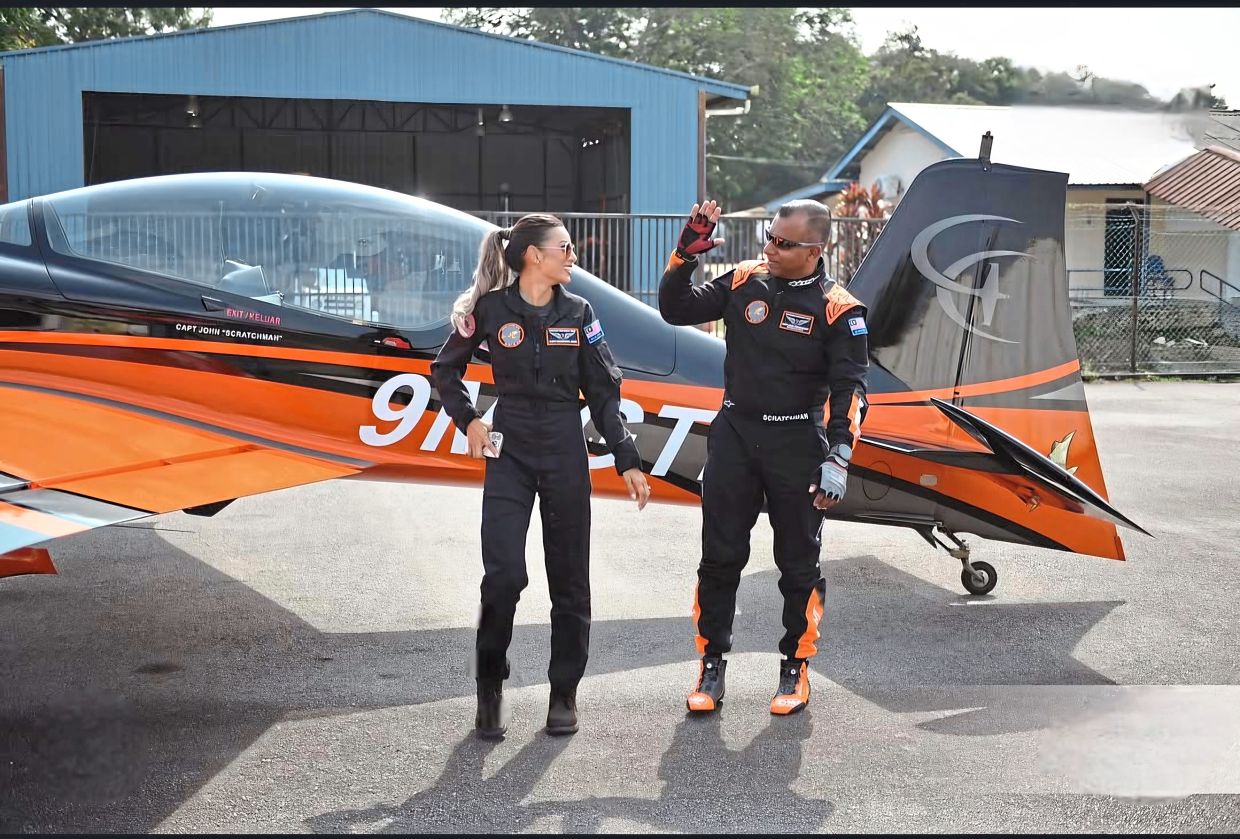
Samantha Laura John represents a growing trend of second-generation aviators in Malaysia, where passion for flight runs deeper than professional ambition. At 26, she has recently obtained her pilot's licence following graduation from flight school in Ipoh, mirroring the career trajectory of her father, retired Royal Malaysian Air Force fighter pilot Lieutenant-Colonel (R) John Sham Alagarsamy, who dedicated 26 years to military aviation before transitioning to commercial flying in 2019.
The younger John's journey into aviation began not with a formal career plan but with childhood wonder. Growing up on air force bases across Malaysia—from Labuan to Kuantan, Alor Setar and Butterworth in Penang—she witnessed firsthand the discipline, responsibility and purpose that defined her father's professional life. Those formative years, spent in environments centred on national defence and operational readiness, cultivated an early fascination with both aeroplanes and the uniformed service they represented. She recalls watching her father prepare for combat readiness training and navigation exercises, experiences that crystallised her aspiration to follow in his footsteps.
What distinguishes Samantha's path is that her parents deliberately avoided imposing their own professional choices upon their children. Instead, they created an environment where ambition and self-directed exploration were encouraged. John articulates this philosophy plainly: if children aim for the stars, they will at least reach the sky. Rather than prescriptive guidance, he offered his children permission to dream large and pursue their own interests, even when those interests diverged from aviation. This approach reflects contemporary parenting research from Universiti Teknologi Malaysia's social science journal, which demonstrates that strong parent-child relationships, genuine communication and mutual trust significantly influence career decisions by fostering independent exploration and long-term strategic thinking.
Samantha initially tested this independence after completing her International General Certificate of Secondary Education (IGCSE), enrolling in a two-year cadet pilot programme with an airline based in Sepang, Selangor in 2018. Although this role offered genuine professional reward, she eventually recognised it lacked the deeper fulfilment she sought. The experience, however, clarified rather than confused her direction. She returned to the pursuit of her pilot's licence with renewed conviction, understanding that her childhood fascination with aviation represented something more profound than fleeting interest—it was a core element of her identity and calling.
Her father's professional evolution has itself been unconventional within Malaysian aviation circles. Beyond his RMAF service and current role as head of training at a flying school in Ipoh, John holds a unique distinction as the country's first and only civil aviator recognised by the Civil Aviation Authority of Malaysia for aerobatics expertise. He has performed extensively at major airshows, including the prestigious Langkawi International Maritime and Aerospace Exhibition (Lima), executing aerobatic displays in the GB1 GameBird aircraft. This specialisation demonstrates that aviation expertise encompasses far more than standard commercial operations—it represents a lifelong pursuit of mastery and innovation that Samantha appears to have internalised.
The family's international exposure further shaped Samantha's understanding of aviation within broader geopolitical contexts. In 2012, the family relocated to Canberra when John was attached to the Australian Defence Force while completing a master's degree in military and defence studies from the Australian National University. This period abroad exposed Samantha to international defence cooperation frameworks and comparative aviation systems, providing perspective that transcended Malaysia's domestic context. She credits this formative experience with widening her comprehension of how aviation functions within international security architecture and cross-border defence protocols—knowledge that informs her current aspirations despite her temporary departure from active flying.
Currently based in Kota Kinabalu, Samantha manages an event management company alongside her husband, David Chong, 30, while also offering vocal coaching services. This apparent pivot from aviation reflects not abandonment of her pilot's licence but rather a pragmatic accommodation of her immediate family circumstances. She remains committed to eventually returning to commercial aviation as a career, viewing her present work as a temporary professional phase rather than a permanent redirection. The distinction matters significantly: many qualified pilots in Malaysia balance aviation aspirations with other professional and personal obligations, a reality often overlooked in narratives that assume linear career progression.
Samantha's experience gaining her licence has fundamentally altered her perception of professional responsibility and cognitive demand. She describes flying as a therapeutic experience precisely because it demands absolute situational awareness and forward-thinking cognition. Within the cockpit, pilots operate across multiple dimensions simultaneously—altitude, heading, speed, fuel management, navigation and communication—requiring the kind of integrated focus that transcends ordinary professional tasks. This dimensionality appeals to her on a level that transcends technical accomplishment, touching something more existential about human capability and responsibility.
The father-daughter relationship itself demonstrates values transmission across generations, though perhaps not in the heavy-handed manner often assumed. Observers note a distinctive quality in how Samantha speaks with John: genuine respect combined with evident affection, reflecting discipline and courtesy instilled from childhood. John himself emphasises that parental influence operates primarily through modelled behaviour rather than explicit instruction. He received the Most Gallant Order of Military Service (Kesatria Angkatan Tentera) during his RMAF service, recognition that validated decades of commitment to national defence. Yet he frames his most significant legacy not in medals or professional achievements but in the positive impact he has consciously attempted to create in his children's lives—influence that manifests not through coercion but through consistent example.
The John family narrative connects to broader patterns within Malaysian and Southeast Asian professional culture, where second-generation practitioners increasingly populate competitive fields. Sisters Safia Amira Abu Bakar and Safia Anisa Abu Bakar similarly followed their father Captain Abu Bakar Shafie into aviation careers, suggesting that parental exposure to specialised professions creates disproportionate representation among subsequent generations. This pattern reflects both genuine passion transmission and the practical advantages children gain through early familiarisation with professional environments, networks and expectations.
When Samantha recently visited her mother, businesswoman Lynda Shanti Ganesaguru, 45, and her brother Shayne Zacchaeus John, 22, in the Klang Valley, the family gathered for lunch at an Indonesian restaurant to share stories and reminisce about their years living on different air force bases. These moments of reconnection underscore that despite divergent current locations and professional pursuits, the family maintains cohesion grounded in shared history and mutual respect. For Samantha, those early years moving between air bases—challenging though frequent relocation may have been—instilled understanding of RMAF pilots' responsibility in safeguarding Malaysian airspace and maritime borders, a perspective that continues informing her life choices and aspirations.
The convergence of aviation passion, international exposure, parental encouragement and personal agency evident in Samantha's trajectory offers a template for understanding contemporary Southeast Asian professional development. She embodies neither blind filial imitation nor total generational rebellion, but rather thoughtful evaluation of inherited values and deliberate pursuit of personally meaningful work. Whether she ultimately returns to commercial aviation as her aspirations suggest remains to be seen, but the foundation—built on respect, discipline, genuine interest and parental trust—appears sufficiently robust to support whatever professional path she chooses.

%22%2F%3E%3C%2Fpattern%3E%3C%2Fdefs%3E%3Crect%20width%3D%22100%25%22%20height%3D%22100%25%22%20fill%3D%22url(%23ph2hy9vg)%22%2F%3E%3Crect%20width%3D%22100%25%22%20height%3D%22100%25%22%20fill%3D%22url(%23ph2hy9vp)%22%2F%3E%3Ctext%20x%3D%2250%25%22%20y%3D%2250%25%22%20text-anchor%3D%22middle%22%20dominant-baseline%3D%22central%22%20fill%3D%22rgba(255%2C255%2C255%2C0.95)%22%20font-family%3D%22Georgia%2C%20'Times%20New%20Roman'%2C%20serif%22%20font-weight%3D%22700%22%20font-size%3D%22272%22%20letter-spacing%3D%22-0.02em%22%3EAnwar%3C%2Ftext%3E%3C%2Fsvg%3E)